
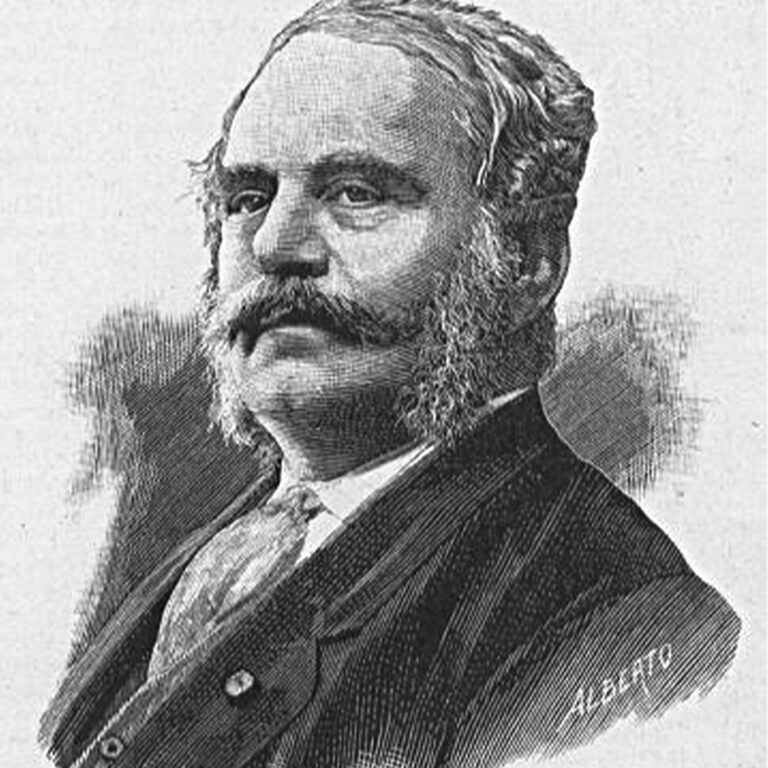
Angelo Frondoni was born in Parma between 1808 and 1809 and received his musical education in his hometown and in Milan. At the beginning of his career as a composer, his farce Il carrozzino da vendere was staged at La Scala in 1833¹. In 1838, he was hired by the Count of Farrobo, Joaquim Pedro Quintela, as artistic director of the Teatro de São Carlos in Lisbon. His first compositions on Portuguese soil, presented at this theatre, included an Overture (1838) and two ballets: A Ilha dos Portentos ~(The Island of Prodigies) (1839) and Volta de Pedro o Grande de Moscovo (The Return of Peter the Great from Moscow) (1841)².
In 1843, when the Count of Farrobo abandoned the management of São Carlos, Frondoni was replaced and chose to devote himself to teaching. Despite this, he managed to have his only opera written in Portugal, I profughi di Parga, on a libretto by Cesare Perini, staged at that theatre in 1844. After this experience, Frondoni decided to abandon the composition of Italian operas and sought to adapt to the characteristics of the Portuguese musical milieu, which in its secondary theatres privileged genres such as farce and comic opera, often resulting from adaptations of French works³.
Also in 1844, the public at the Teatro da Rua dos Condes applauded “one of his most brilliant and popular successes,” the farce O Beijo (The Kiss), with a text by Silva Leal⁴. Between 1845 and 1849, he composed three more operettas: O Caçador (The Hunter) (1845), Um bom homem d’outro tempo (A Good Man from Another Time) (1846) and Qual dos dois? (Which of the Two?) (1849). In 1850, he directed three more comic works at the Teatro do Ginásio, where he took over as artistic director after the departure of Joaquim Casimiro Júnior: 1762 ou os amores de um soldado (1762, or the Loves of a Soldier), A Bruxa (The Witch) and O Capelão do Regimento (The Regiment’s Chaplain)⁵.
If during these years he enjoyed particular prominence in the Portuguese musical scene, vying with Casimiro for leadership on the theatrical stage, he also suffered reprisals for his alignment with the republican cause. In 1846, he composed the famous Hino do Minho (or da Maria da Fonte), sung by those seeking to dethrone Queen Maria II, a fact that brought him several difficulties. According to Ernesto Vieira, Frondoni was “forced to hide, to avoid arrest, and Queen Maria II, so eager to honour distinguished artists, never received him at the palace.” Despite the tense relationship with the Crown, the composer continued to write music for Portuguese theatres until 1863⁶.
Later, between 1868 and 1873, he was artistic director and composer at the newly inaugurated Teatro da Trindade, where he presented his comic and burlesque opera Barba Azul (Bluebeard) in 1868, and composed music to accompany various plays, among which the mágicas (fairy plays) Gata Borralheira (Cinderella), Rosa de Sete Folhas (Rose of Seven Leaves), Três Rocas de Cristal (Three Crystal Spindles) and the comic opera O Rouxinol das Salas (The Drawing-Room Nightingale) stand out. Between 1873 and 1874, he directed the opera season at the Teatro de São Carlos and, the following year, presented the burlesque opera O Filho da Senhora Angot (The Son of Madame Angot) at the Teatro do Príncipe Real, a work with which he took leave of the dramatic repertoire⁷.
In his final years, Frondoni dedicated himself to promoting orpheonic singing in Portugal. To this end, he travelled to Paris and Belgium, where he made contact with choral societies, seeking to implement similar practices in Lisbon and Porto, albeit without great success. The composer died on June 4, 1891, leaving, in addition to his musical output, several verses, articles, pamphlets and collections of music published over the years⁸.