
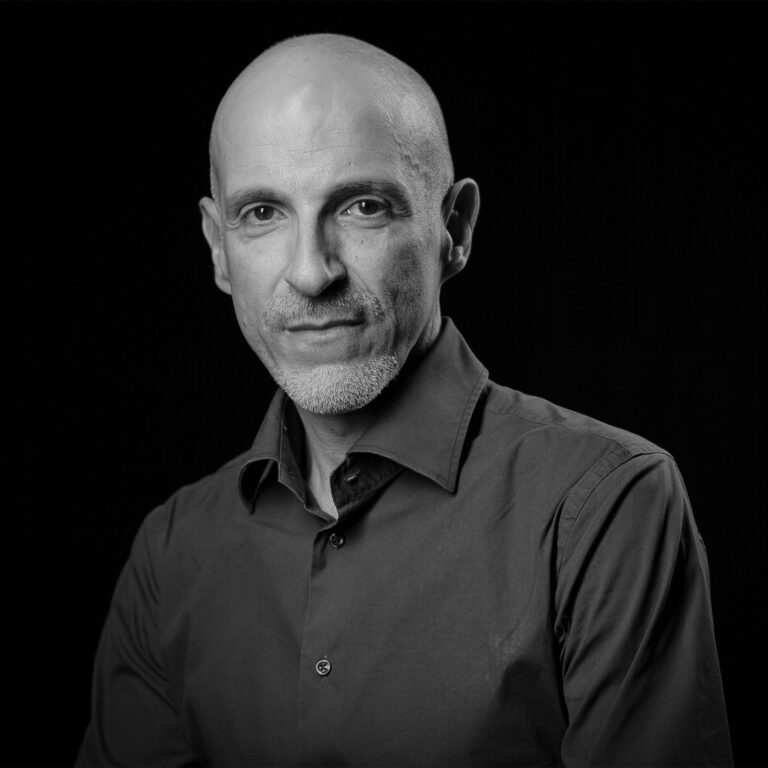
“Music is an art of images”¹ — this is how composer António Chagas Rosa (1960) often defines it in various interviews, pointing to the image-creating power of sounds. He advocates for music not only as thought but, above all, as a machine for creating images or activating them in those who lend it concentrated listening. A way of organizing narratives, even when words are absent. Because for him, there is no pure music: the composer who scrutinizes the world is, at every moment, in dialogue with the different constituent elements of his reality.
This is a way of understanding composition that, among other things, is guided by a fundamental principle: concern for the listener. Not in the parochial sense of gratuitously pleasing them, but in the radical desire to establish an affective communication with them, strong enough to imprint upon them a concrete and direct meaning, independent of academic or musicological discourses, which traverse much of contemporary music (and art) using sophisticated theoretical frameworks and analytical tools. Chagas Rosa developed this awareness in France, as a result of an encounter with conductor Roland Hayrabedian, at the premiere of his musical tale Les Sorcières (2006 Actes-Sud), with Ensemble Musicatreize in Marseille, which the composer describes as “a turning point and a learning experience; I believe my way of writing changed from then on. I felt the need to communicate.”²
His musical journey, however, had begun two decades earlier in Lisbon, where he was born. It was there that he completed his advanced degree in Piano (National Conservatory of Lisbon in 1981) and a degree in History (New University of Lisbon, in 1983). Afterwards, with a grant from the Secretary of State for Culture, he moved to the Netherlands, where, in addition to deepening his studies in Contemporary Piano Repertoire and Chamber Music (Sweelinck Conservatory in Amsterdam), he completed his advanced degree in Composition (Rotterdam Conservatory, in 1992), having studied with Klaas de Vries and Peter-Jan Wagemans.
In 1994, the year Lisbon was European Capital of Culture and following a commission from the now-extinct ACARTE service of the Calouste Gulbenkian Foundation, he composed his first opera: Cânticos para a Remissão da Fome (Chants for the Remission of Hunger). At the turn of the millennium, and again riding on the wave of two European Capitals of Culture (Porto and Rotterdam, in 2001), he composed his second opera, Melodias Estranhas (Strange Melodies). After a long hiatus, he returned to the operatic genre in 2022 with O Homem dos Sonhos (The Dream Man), a commission from Ópera do Castelo, which toured several Portuguese theatres.
Having since returned from the Netherlands, where he remained and worked until 1996 as a répétiteur at De Nederlandse Opera and the Sweelinck Conservatory, Chagas Rosa settled in Aveiro, where he has been a professor of Chamber Music and Music History at the University of Aveiro ever since. It was at this institution that he obtained his doctorate with research on the dialogue between music and text in Arnold Schoenberg’s Das Buch der hängenden Gärten.
S | B + 2 Actors + Cl | Bar Sax | Tbn | Tb | Perc | Pf (Synth) | Acc | Vln | Vc | Cb
See Opera
Ct | T | 2 Bar | B + Fl | Ob | Cl | Bcl | Fg | Hn | Tpt | Tbn | Tb| Perc | Pf (synth) | 4 Vln | 2 Va | 2 Vc | Cb
See Opera
2 S | A + Fl | Cl | Fg | Hn| Tpt | Tbn | Tb | Perc | Hp | Pf | Vln | Va | Cb
See Opera