
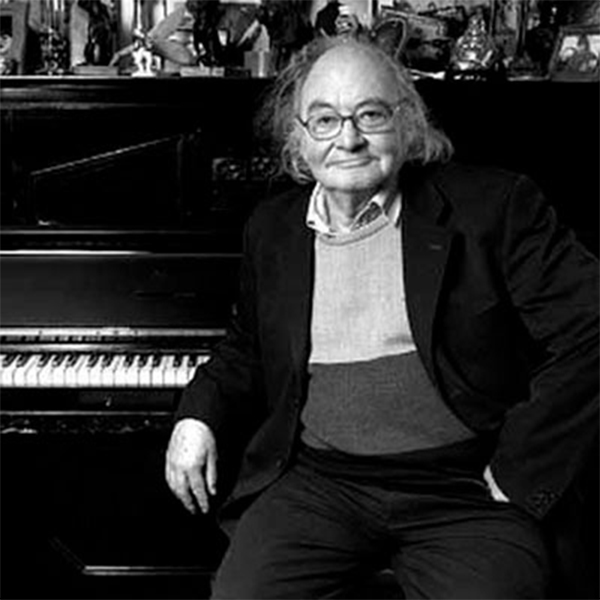
Composer, pianist, musicographer, broadcaster, conductor, writer, screenwriter, director… António Victorino d’Almeida has explored different forms of expression throughout a full life, which also included the role of cultural attaché.
António Victorino d’Almeida’s training began with private lessons from Marina Dewander Gabriel, followed by attendance at the National Conservatory, where he completed the piano course in 1959. He studied piano with Campos Coelho, who gave him a solid foundation,¹ piano and composition with Artur Santos, and orchestration with Joly Braga Santos. A scholarship from the Instituto de Alta Cultura allowed him to pursue further studies in Vienna, where he enrolled at the Academy of Music and Dramatic Arts. He attended the composition course with Karl Schiske, which he completed with distinction in 1966, and studied piano with Wladislav Kedra and Dieter Weber. Upon returning to Portugal, he worked as a music critic and columnist for the Diário Popular to support himself financially. A grant from the Calouste Gulbenkian Foundation to study electronic music led him to settle once again in Vienna; he would later reside in Austria for several years, between 1975 and 1981, this time as cultural attaché. His participation in the television programme Zip-Zip in 1969 as a pianist and commentator launched a career as a music broadcaster that expanded over the following decades and made Victorino d’Almeida one of the most publicly recognised figures in the Portuguese music scene. He took part in programmes produced by RTP and SIC between the 1970s and 1990s, including Histórias da Música, Temas e Variações, A Nota Sensível and Duetos Imprevistos. He also extended his skills as a communicator in presentations and conferences at the invitation of various institutions.²
As a pianist, Victorino d’Almeida performed on national and international stages, both solo and in ensembles, notably with the Trio Almeida‑Pluhar‑Marinoff, formed in 1983 with Erika Pluhar (voice) and Peter Marinoff (violin).³
Victorino d’Almeida’s extensive musical output reflects the author’s eclecticism and covers various orchestral and chamber genres, songs, suites and arrangements, as well as music for theatre, cinema and television. His literary work encompasses fiction and musicography, including titles such as Coca‑Cola Killer, Tubarão 2000, Música e Variações and Grandes histórias da música, in addition to the more autobiographical Ao princípio era eu (2010).⁴
5 S | 2 Mz | 2 A | 3 T | 5 Bar + Chorus + Orch
2 S | Mz | 2 T | Bar/B + Chorus + Tpt | PT Gtr | Acc | Pf
7 S | Mz | 5 T | 2 Bar | 3 B + 3 Soloists + Actor + Sp + Chorus + Orch
See Opera