
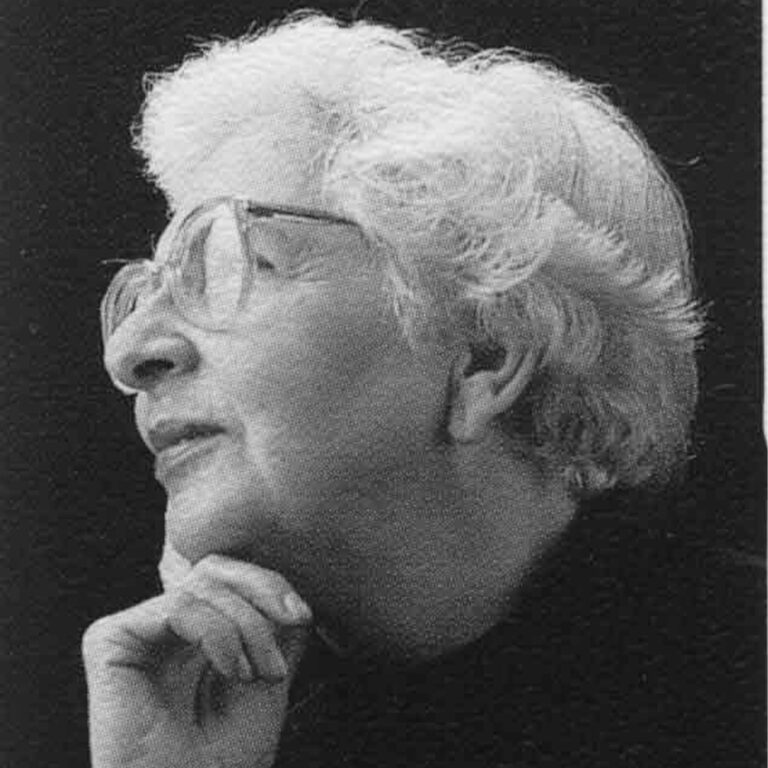
“I have always been irreverent, a challenger; I was never afraid of anything, I never cared if people spoke well or ill of me” — thus defended Clotilde Rosa, when asked what it was like to be a woman composer in her time¹.
Clotilde Rosa was born in Queluz in 1930, into a musical family — her father, José Rosa, a violinist and tenor, and her mother, Branca Belo de Carvalho Rosa, a harpist and pianist. Even so, her artistic career was, as musicologist Manuel Pedro Ferreira notes, “atypical: married and a mother from an early age, then a professional harpist, it was only in 1976, in middle age, that she embraced musical composition. If initially her works appeared at a sparse pace, from 1985 onwards her production accelerated drastically, having already surpassed a hundred titles.”²
She had “her first private piano lessons at the age of ten,” and in 1949 completed her higher studies at the Conservatório Nacional de Lisboa with Professor Ivone Santos. “She began studying harp at the same institution at the age of twelve with Cecília Borba, completing the Complete Harp Course in 1948, this being the instrument to which she devoted herself professionally.” Ten years later, she resumed her studies,
becoming part of the Menestréis de Lisboa directed by Santiago Kastner, with whom she studied figured bass applied to the harp and early music interpretation. From 1960 to 1963, she received scholarships from the Calouste Gulbenkian Foundation and the Dutch government to study harp, particularly with Phia Berghout in Amsterdam. In 1964, she studied harp with Jacqueline Borot in Paris and studied figured bass in 1967 with Hans Zingel in Cologne, Germany, with grants from the Calouste Gulbenkian Foundation. It was in the summer of 1962 that Mário Falcão proposed that they perform Imagens sonoras, a piece for two harps composed by Jorge Peixinho, which led to Clotilde Rosa’s approach to this composer and to the Portuguese avant-garde musical scene, a fundamental contact for her life.³
In the early 1960s, at a time when Jorge Peixinho was studying with Pierre Boulez in Basel, the composer also had the opportunity to meet the conductor and leading authority on post‑Second World War avant‑garde composition. Later, Peixinho and Rosa would attend courses together in Darmstadt, meeting, among others, Stockhausen. In the 1970s, she would be one of the founders of the Grupo de Música Contemporânea de Lisboa, led by Jorge Peixinho.
With regard to composition, she defined herself essentially as self‑taught, although she had “some lessons in Counterpoint with Jorge Croner de Vasconcelos, in Composition with Jorge Peixinho”; had attended “Analysis classes with Álvaro Salazar”, and studied Instrumentation with Carlos Franco. “She identified herself as a composer in 1976 with the work Encontro. Submitted to the Tribune Internationale des Compositeurs in Paris by Joly Braga Santos and Nuno Barreiros, at Jorge Peixinho’s proposal, the piece was recorded by RDP and achieved 10th place ex‑aequo, among 60 works from 30 countries. She also won 1st Prize in the National Composition Competition of Oficina Musical do Porto with Variantes I, for solo flautist.”⁴
According to Clotilde Rosa herself, it was Jorge Peixinho who initiated the creation of her symphonic opera O Desfigurado, which was never premiered, as well as her Piano Concerto. The piano was, moreover, one of the instruments for which she composed the most. In addition to her activity as a composer, she distinguished herself as a harpist — collaborating with various Portuguese orchestras — and as a harp teacher.
S | A | T | 2 Bar | B + Chorus + 2 Fl (Picc) | 2 Ob (E H) | 2 Cl (Bcl) | 2 Bsn (Cbsn) | 4 Hn | 2 Tpt | 2 Tbn | Tb | Timp | 3 Perc | Pf | Vln | Vla | Vc | Cb
See Opera