
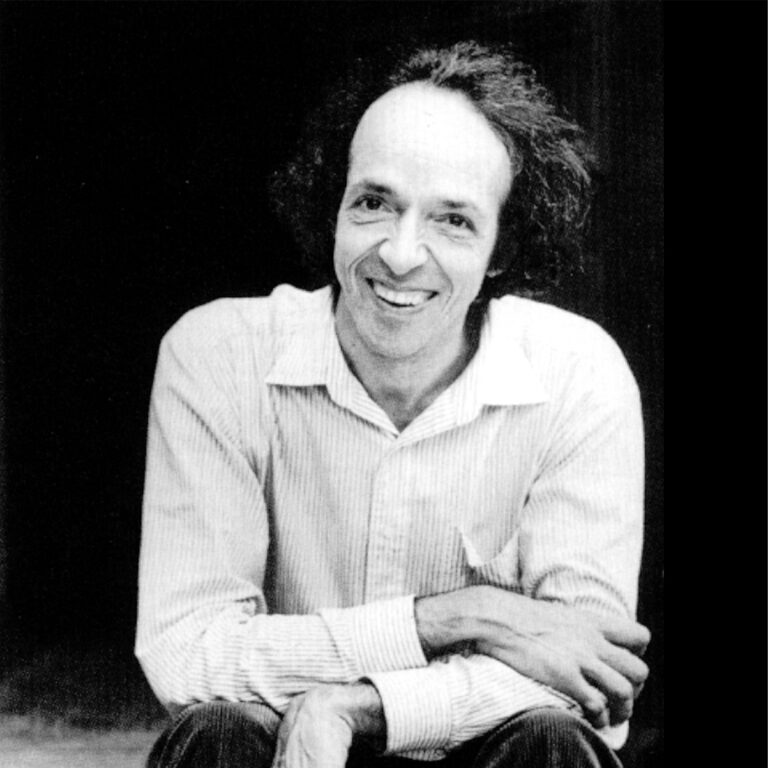
Emmanuel Nunes studied harmony and counterpoint with Francine Benoît at the Academia de Amadores de Música between 1959 and 1963, and also received private lessons from Fernando Lopes‑Graça in 1959. He pursued literary studies at the Faculty of Letters of the University of Lisbon. He continued his musical training in Germany and France. He took part in the Darmstadt Summer Courses between 1963 and 1965, attended an introductory course in electronic music directed by Henri Pousseur in Munich, came into contact with the work of Pierre Boulez in Paris, and attended the analysis and composition classes of Karlheinz Stockhausen, the electronic music class of Jaap Spek, and the phonetics class of Georg Heike in Cologne. The close monitoring of Stockhausen’s compositional work would become an important moment in Nunes’s training and his development as a composer. He later settled in Paris, where he graduated in Marcel Beaufils’s musical aesthetics course at the Paris Conservatoire and began a doctorate on the work of Anton Webern at the Sorbonne. Boulez, Stockhausen, Pousseur, and Heike were key influences on Nunes, but elements of his musical language also evoke the music of J. S. Bach, the Romanticism of Schubert, and the Second Viennese School, especially Webern, as well as the theoretical work of the philosopher Edmund Husserl.¹
Throughout his career, Nunes received institutional support from various entities, notably the Portuguese Ministry of Education, the Calouste Gulbenkian Foundation, and the DAAD (Germany). In 1989, Nunes began a collaboration with IRCAM (Institut de Recherche et de Coordination Acoustique/Musique, Paris), which allowed him to deepen certain aspects of his musical language and explore spatialisation through real‑time electronics. The works Es webt (1974–1975), Tif’ereth (1978–1985), Wandlungen (1986) and Lichtung I (1990–1991) resulted from this collaboration.²
As a teacher, Nunes taught at various institutions, such as the University of Pau (France), Harvard University, and the Paris Conservatoire, where he was professor of composition between 1992 and 2006. He also taught at the Darmstadt Summer Courses and at ICONS in Novara (Italy), and directed the composition seminars of the Calouste Gulbenkian Foundation (1986–1992).³
Das Märchen (2007)
2 S | A | Ct | 2 T | 2 B + Chorus+ 5 Actors + Ballet Dancers + 4 Fl | 4 Ob (2 Eh) | 4 Cl | 2 Bcl | 2 Bsn | 6 Hn | 3 Tpt | 3 Tbn | 1 Euph | 2 Hp | 6 Perc | Elec/MIDI | Keyb/Synth | Vln | Vla | Vc | Cb
See Opera