
Librettist: Emmanuel Nunes
Libretto based on Das Märchen by Goethe
Symbolist opera in a prologue and two acts
Date: 2007
Duration: 3 hours 40 minutes
Language: German
Large-scale
Lilia: soprano
Serpent: soprano
Will-o’-the-wisp I / King IV / The Old Woman: countertenor
Will-o’-the-wisp II / King II / Prince: tenor
Ferryman / The Man: bass
King I: bass
King III: tenor
The Man with the Lamp: bass
The Old Woman: contralto
Symbolist opera in a prologue and two acts. The prologue alludes to the power of the imagination, as a preparation for what is found in Goethe’s fantastic tale on which it is based. In this work, we encounter the Ferryman and the Will‑o’‑the‑wisps, the Green Serpent who swallows the gold coins given by them as payment for crossing the river, which makes her incandescent; the Man with the Lamp and the four Kings who reside in the Subterranean Temple; the Old Woman; the beautiful Lilia, a character with magical powers condemned to kill anyone who touches her; and the Prince who falls in love with her. The story unfolds around the crossing of the river, which represents the division between different worlds, and the union of the various characters to overcome the challenges that arise. The libretto ends with the Serpent’s sacrifice, transubstantiated into precious stones by Lilia, which are then used to build a bridge that unites the two banks of the river. The first act is entitled “Game of the Elements” and the second act “Metamorphoses”.
2 S | A | Ct | 2 T | 2 B + Chorus + 5 Actors + Ballet Dancers + 4 Fl | 4 Ob (2 Eh) | 4 Cl | 2 Bcl | 2 Bsn | 6 Hn | 3 Tpt | 3 Tbn | 1 Euph | 2 Hp | 6 Perc | Elec/MIDI | Keyb/Synth | Vln | Vla | Vc | Cb
Publisher: G. Ricordi & Co.
Opera in two acts with music and libretto by Emmanuel Nunes based on The Tale or The Tale of the Green Serpent by Johann Wolfgang von Goethe. Interest in this symbolic text dates back to the 1970s, when Nunes read it along with Yvette Centeno’s study A Simbologia alquímica no conto da Serpente Verde de Goethe (1976). He worked intermittently on the writing of the libretto and the music until its final completion in 2008. The opera resulted from a partnership between the Calouste Gulbenkian Foundation, Casa da Música and the Teatro Nacional de São Carlos, co‑produced with Ircam‑Centre Pompidou.
It was a megalomaniac project, not only because of the orchestral and stage apparatus involved, but also because of the decision to broadcast the premiere live to different theatres in Ponte de Lima, Porto, Vila Flor, Aveiro, Coimbra, Castelo Branco, Leiria, Torres Novas, Portalegre, Estremoz, Beja, Faro, the Azores and Madeira. However, the cultural decentralisation initiative did not achieve its intended goals, and media reports focused on the number of spectators who left the performance during the evening.¹ The final balance was mixed: while the production side considered it positive, even taking into account the audience departures, several figures saw the audience’s behaviour as a sign of the initiative’s failure, blaming the choice of a contemporary work with a difficult musical language and the lack of preparatory work to educate listeners.²
The complex production and extrinsic circumstances overshadowed the music, and the opera’s reception was strongly marked by the political and institutional debates surrounding it. Tensions between the Secretary of State for Culture and the direction of the Teatro Nacional de São Carlos – which led to Paolo Pinamonti not being reappointed as director – and Nunes’s public statements in favour of the director’s dismissal (displeased with the opera being withdrawn from the theatre’s programme in previous years due to delays in its completion) created a certain animosity from the outset towards the work that was about to premiere. In the analysis of Pedro Amaral, who considers the work admirable despite certain problems, it is pointed out that the staging by Karoline Gruber proved inadequate in conveying the musical depth of the work. Moreover, the instrumental forces required by the work meant that some instruments were placed in adjacent rooms of the Teatro Nacional de São Carlos and their sound relayed through loudspeakers in the main hall, which compromised the listening experience.³
Despite the circumstances that dominated its reception, this is a significant and important work of Nunes’s style. The opera is structured in a prologue and two acts and incorporates symbolic references through a dense network of internal references and orchestration. According to Laurent Feneyrou, “given the importance of the number three to Goethe’s tale, Nunes extends it through three levels in the opera: choreographic, theatrical, and musical. It has, then, an affinity with Mozart’s The Magic Flute, where the number three also plays a major structural role. Rather than remaining on the level of philosophical abstraction, the number three permeates the opera’s imagery.”⁴
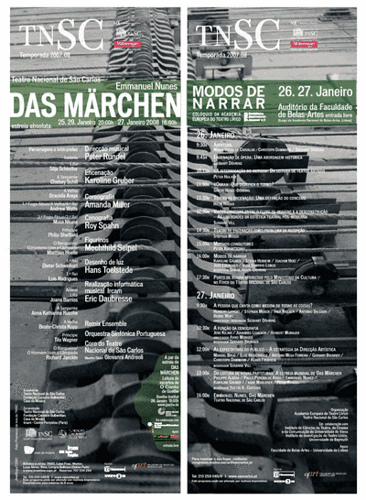
The opera had three performances in Lisbon (25, 27 and 29 January; only the first was broadcast to regional theatres).
Date: 2008
Venue: Teatro Nacional de São Carlos, Lisbon
Commission: Calouste Gulbenkian Foundation, Casa da Música, Teatro Nacional de São Carlos and Ircam‑Centre Pompidou
Staging: Karoline Gruber
Musical direction: Peter Rundel
Cast: Chelsey Schill, Silja Schindler, Matthias Hoelle, Andrew Watts, Graciela Araya, Musa Duke Nkuna, Philip Sheffield, Dieter Schweikart, Luís Rodrigues, Joana Barrios, Anna Katharina Rusche, Beate‑Christa Kopp, Tilo Wagner, Richard Jaeckle; Remix Ensemble and Portuguese Symphony Orchestra and Chorus of the Teatro Nacional de São Carlos