
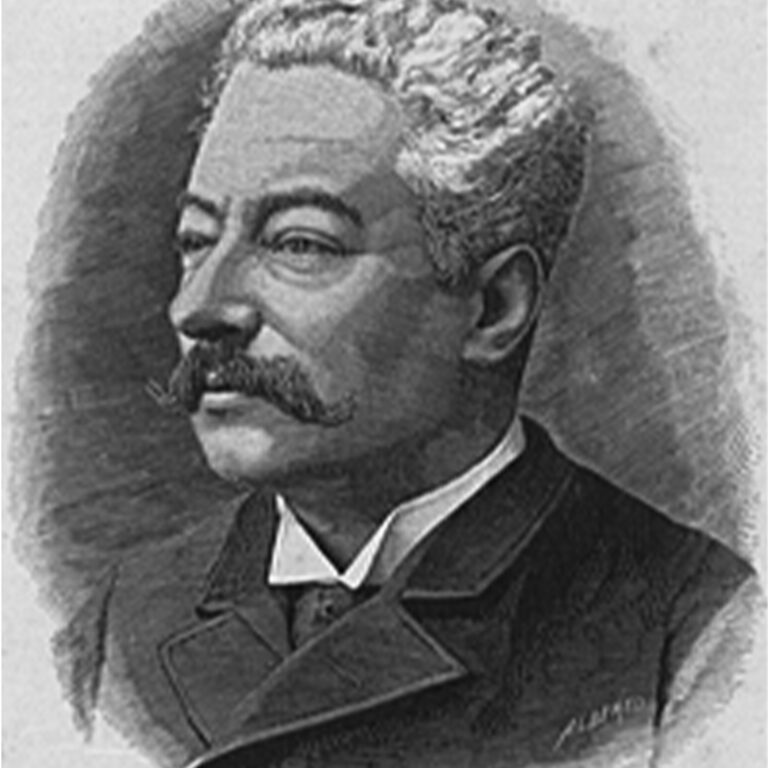
Francisco de Freitas Gazul was born in Lisbon on September 30, 1842, into a family with a long musical tradition – he was the grandson of José Gazul, a horn player in the orchestra of the Teatro de São Carlos, and the son of Francisco Gazul (1815–1868), a professor of rudiments at the Conservatório Nacional and timpanist in various royal institutions.¹ He received his training at that same institution, where he began by studying harmony, counterpoint and fugue with Eugénio Ricardo Monteiro d’Almeida and, from 1856, received cello lessons from João Jordani and later from Guilherme Cossoul. In 1867, he won first place in a competition for the positions of second cellist in the opera and first cellist in the ballet of the São Carlos Orchestra.²
Gazul built a long career as a conductor, having directed the orchestras of the Teatro de São Carlos – as assistant to Guilherme Cossoul in 1859 – of the Teatro da Rua dos Condes and the Teatro da Trindade, as well as the Banda de Música União e Capricho of the Sociedade Filarmónica Alunos de Apolo.³ In 1875, he served as rehearsal conductor at the Teatro de São João in Porto, where he conducted operas such as Linda de Chamonix, Guilherme Tell, La sonnambula, Il barbiere di Siviglia, Un ballo in maschera, Otello and La traviata.⁴
As a composer, Freitas Gazul produced a vast and diverse body of work, encompassing sacred music, opera, operetta, mágicas (fairy plays), theatre music, revues and chamber music. It was with the opera Frei Luís de Sousa, presented at the Teatro de São Carlos in 1891, that he achieved the greatest public recognition.⁵
Alongside his activity as a composer and conductor, he developed a long pedagogical career as a professor of Musical Rudiments at the Conservatory of Lisbon. He published a solfège method and a manual of musical rudiments, the former being widely used by philharmonic bands and known as “the bands’ solfège”. Among his students, José Vianna da Motta stood out. There also existed in Lisbon a philharmonic society that bore his name, testifying to the prestige he enjoyed in the Portuguese musical milieu.⁶ Gazul died on October 20, 1925, in Lisbon.⁷
2 S | 2 T | 2 Bar | B + Chorus + 3 Fl | 2 Ob | 2 Cl | 2 Bsn | 2 Tpt | 4 Hn | 3 Tbn | Tb | 2 Perc | 2 Hp | Vln | Vla | Vc | Cb
See Opera