
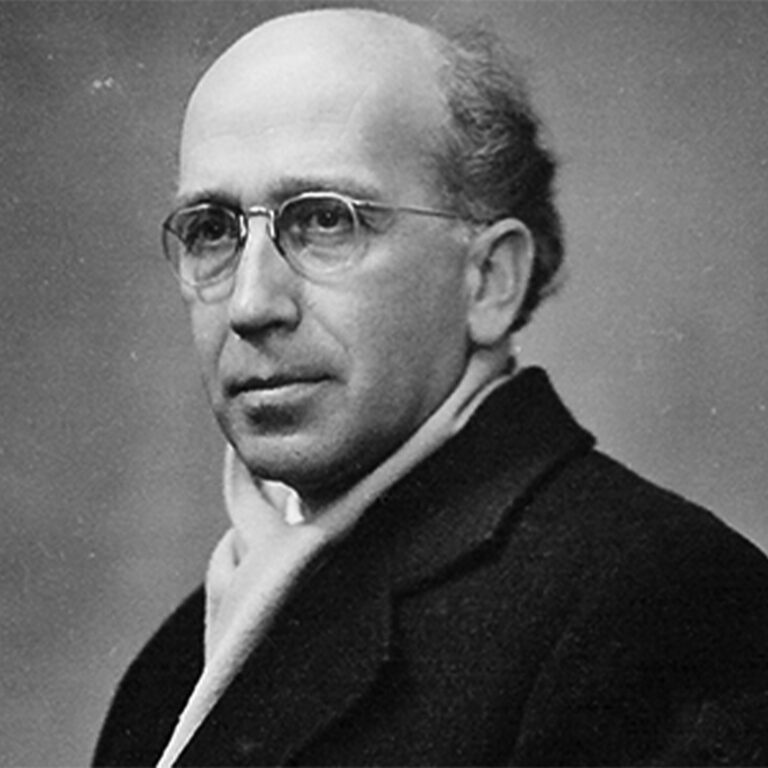
Frederico de Freitas divided his career between composition, conducting, and teaching, being involved in several significant cultural initiatives of twentieth-century Portugal and producing an extensive and varied musical output.¹
He began his musical studies with his mother and, between 1915 and 1925, attended courses in composition, piano, violin, and music sciences at the Conservatório Nacional. His debut as a composer took place while still a student, in a concert he himself organised at the Salão Nobre of the Conservatório Nacional in 1924. The works he presented already reveal aspects of his compositional profile, as well as the literary and musical influences that shaped him. Encouraged by Luís de Freitas Branco, he pursued further studies abroad.²
He was awarded a State scholarship and settled in Paris, where he studied with Florent Schmitt, returning to Portugal in 1926. He then began a highly productive career as a composer of ballet music and songs for revue theatre, operetta, and musical theatre, some of them in collaboration with the dancer Francis Graça. Benefiting from the development of radio and the phonographic and film industries in Portugal during the 1930s, many of his works became genuine commercial successes. He also composed the music for the first Portuguese sound film, A Severa, by Leitão de Barros (1931). Light music and art music coexisted throughout his career, and his catalogue includes works for symphony orchestra, chamber music, ballets, theatrical pieces, hymns and arrangements, choral works, opera, among others. He was appointed conductor of the company Bailados Portugueses Verde Gaio, founded in 1940, for which he composed the ballets O Muro do derrete, A Dança da menina tonta, Imagens da terra e do mar, and Nazaré. As a conductor, he led the Orquestra Portuguesa and the Orquestra de Câmara da Emissora Nacional; he served as second principal conductor of the Orquestra Sinfónica Nacional and was appointed principal conductor in 1963.³
He took part in celebratory events and historically themed performances integrated into the cultural and nationalist programmes of the SPN/SNI. He was also invited to conduct foreign orchestras and participated in conferences, concerts, and cultural exchanges in Europe and the Americas.⁴
Alongside his compositional and conducting activities, he was a choral teacher at the Liceu Nacional de Camões and Liceu Gil Vicente, and a composition teacher at the Instituto Gregoriano de Lisboa. He gave numerous lectures throughout his life and collaborated with various press outlets as a columnist and music critic, notably with the newspapers Novidades and O Comércio do Porto, and the magazines Ritmo (Madrid) and Panorama.⁵
His archive is held at the University of Aveiro.
S | T | Bar + Chorus + Orchestra
See Opera