
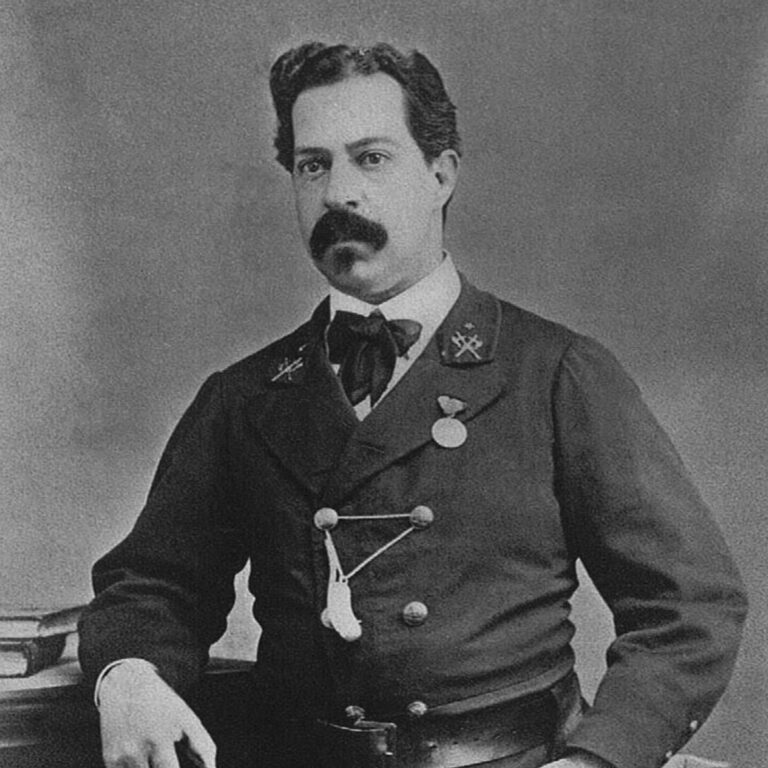
Guilherme António Cossoul was born in Lisbon on April 22, 1828, the son of the violinist João Luís Olivier Cossoul and the pianist Virgínia Tomassu. One of the most committed figures in the affirmation of classical music in Portugal in the second half of the 19th century, Cossoul began his musical training at an early age: he started learning piano and harp with his mother and cello with his father, and later received harmony lessons from Santos Pinto.¹
His first public appearance took place in 1840, before he turned twelve, at the Teatro da Rua dos Condes. In 1842, at only fourteen, he was already conducting the amateur orchestra of the “Assembleia Filarmónica”. The effective start of his professional career dates from 1843, the year he joined the Irmandade de Santa Cecília and became a member of the São Carlos Orchestra as second cellist. In 1848, he was promoted to maestro, and the following year he was appointed musician of the Royal Chamber.²
Alongside his activity as an instrumentalist and conductor, Cossoul also ventured into composition. His output includes around 37 works, with special emphasis on the comic operas A Cisterna do Diabo (1850), O Arrieiro (1852) and O Visionário do Alentejo, as well as important sacred works, including a Te Deum dedicated to King Pedro V (1855) and a Mass for the acclamation of the same monarch (1856).³ In 1853, he travelled to France and spent two years with the Orchestra of the Paris Opéra.⁴
From 1861 onwards, he was professor of cello and double bass at the Conservatory of Lisbon, taking over as director of the institution’s Music School in 1863. His role in the development of the Conservatory is widely praised by Ernesto Vieira:
In that institution, Guilherme Cossoul rendered the most relevant services, with a zeal, activity and intelligence that, unfortunately, has not served as an example. His cello students included Eduardo Wagner, Cunha e Silva, Freitas Gazul and others; in double bass, he had as a student Julio Soares, a double bassist of great merit. As director of the school, he ordered all professors to organise study programmes for their classes, which until then they either did not have or did not follow; he himself, in agreement with Eugenio Masoni, drafted the programme for the piano course, a programme far superior to all those made afterwards and whose only drawback was being too difficult.⁵
Committed to disseminating the great repertoire, he organised a Concerts Society at the Casino Lisbonense, in Largo da Abegoaria, with musicians from the Associação Musical 24 de Julho. The initiative, whose first concert took place on August 17, 1860, at that same casino, had an important impact on the training of both musicians and audiences. From 1864 onwards, he took over the management of the Teatro de São Carlos, in collaboration with Campos Valdez and Guilherme Lima. Although he managed to bring several notable works to that theatre, the last years of Cossoul’s life were marked by illness – the maestro saw his activity progressively limited until his death on November 26, 1880.⁶