
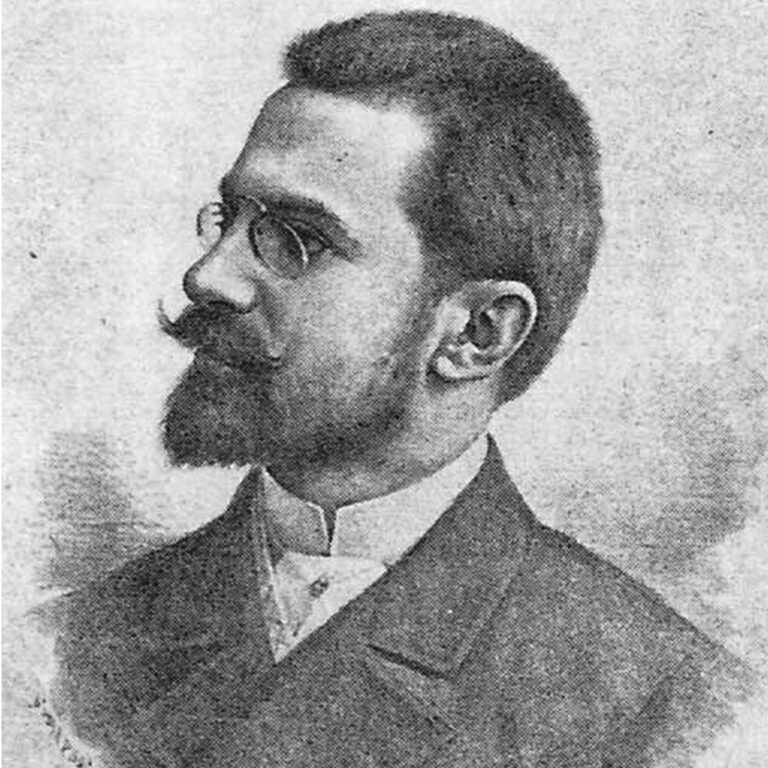
João Marcelino Arroyo was born in Porto on October 4, 1861, into a family with several figures connected to music. The son of the musician and merchant José Francisco Arroyo, of Spanish origin, he grew up in an urban environment marked by intense musical activity, a circumstance that favoured early learning: by the age of twelve he already played piano with ease and was beginning to compose¹. His teachers included Miguel Ângelo Pereira, Bernardo Valentim Moreira de Sá and his own father, and he also devoted himself to choral conducting. In this first phase of his career, he composed several pieces that he would later destroy and exclude from the catalogue of his musical works, among them an opera entitled La Fiancée d’Abydos².
At his father’s direction, he enrolled in 1877 in the Law course at the University of Coimbra, where he reconciled legal studies with an intense musical life, founding and directing the university choir. He earned his doctorate in Law and pursued an academic career, becoming a full professor, while simultaneously developing a notable political activity, serving as Deputy, Peer of the Realm and Minister in several portfolios – he was Minister of Naval and Overseas Affairs between January and April 1890; Minister of Public Instruction and Fine Arts between April and October of the same year; and Minister of Foreign Affairs between June 1900 and June 1901³.
From the beginning of the 20th century, music began to occupy a central place in his life. He then composed the operas Amore e Perdizione and Leonora Telles, the first presented at the Teatro de São Carlos in 1907, and the second posthumously, in 1941. In dramatic terms, both works reveal an attraction to nationalist themes that interested, at that time, some of João Arroyo’s compatriots, such as Alfredo Keil and José Augusto Ferreira Veiga, Visconde do Arneiro. Stylistically, the composer preferred to distance himself from the dominant Italian model and draw closer to Wagnerian aesthetics through the recurring use of chromaticism⁴.
A pianist of great technical facility, Arroyo presented his music in several European countries, achieving particular international projection after the success of his opera Amore e Perdizione (Liebe und Verderben) in Hamburg in 1910⁵. He died on May 18, 1930, in Almoçageme, Sintra, leaving behind a body of work that uniquely intersects Portuguese political, academic and musical life⁶.
4 S | Mz | 2 T | Bar + Chorus + 2 Fl (Picc) | 2 Ob (Eh) | 2 Cl (Bcl) | 2 Bsn| 4 Hn | 3 Tpt | 3 Tbn | Tb | 3 Perc | 2 Hp | Vln | Vla | Vc | Cb
See Opera
Leonora Telles (c.1910)