Librettist: Francisco Braga
Libretto based on the novel Amor de Perdição by Camilo Castelo Branco
Lyric drama in 3 acts
Date: 1907
Language: Portuguese
Large-scale
Thadeu d’Arbuquerque: baritone
Teresa: soprano
Baltdassare Coutinho: tenor
Margherita: soprano
Simone Botelho: tenor
Marianna da Cruz: mezzo-soprano
Abbadessa del Monastero di Monchique in Oporto: soprano
Una Monaca del Monastero di Vizeu: soprano
The action takes place in Portugal in the 19th century, between Viseu in the first two acts and Porto in the last. This passionate drama, in the Romantic style, narrates, akin to Romeo and Juliet, the saga of two lovers whose families, the Albuquerques and the Botelhos, oppose their love. Simão, one of the five sons of Domingos Botelho, a young man of explosive temperament, falls in love with Teresa Albuquerque, his neighbour. When the forbidden courtship is discovered, Domingos sends Simão to Coimbra, leaving Teresa with two options: marry her cousin Baltasar or enter religious life.
For a time, the young people resist the separation by exchanging letters, with the help of Mariana, daughter of the blacksmith João da Cruz, who ends up falling in love with Simão, even though she knows this love can never be reciprocated. After threats and attacks, Teresa rejects the marriage and is sent to the Convent of Monchique in Porto. Simão decides to abduct her, kills Baltasar and surrenders to the police. João da Cruz tries to help him escape, but he refuses. While Simão goes to prison, Teresa remains in the convent, and Mariana stays by Simão’s side, supporting him whenever possible.
Sentenced to the gallows, Simão’s sentence is commuted, and he is deported to India. Upon seeing her love depart, Teresa dies of grief. During the voyage, Mariana shows Simão Teresa’s last letter. Realising his beloved has died, Simão falls ill and dies. The following morning, his body is cast into the sea, and Mariana, unable to bear the loss, throws herself into the sea, drowning in Simão’s embrace.¹
4 S | Mz | 2 T | Bar + Chorus + 2 Fl (Picc) | 2 Ob (Eh) | 2 Cl (Bcl) | 2 Bsn| 4 Hn | 3 Tpt | 3 Tbn | Tb | 3 Perc | 2 Hp | Vln | Vla | Vc | Cb²
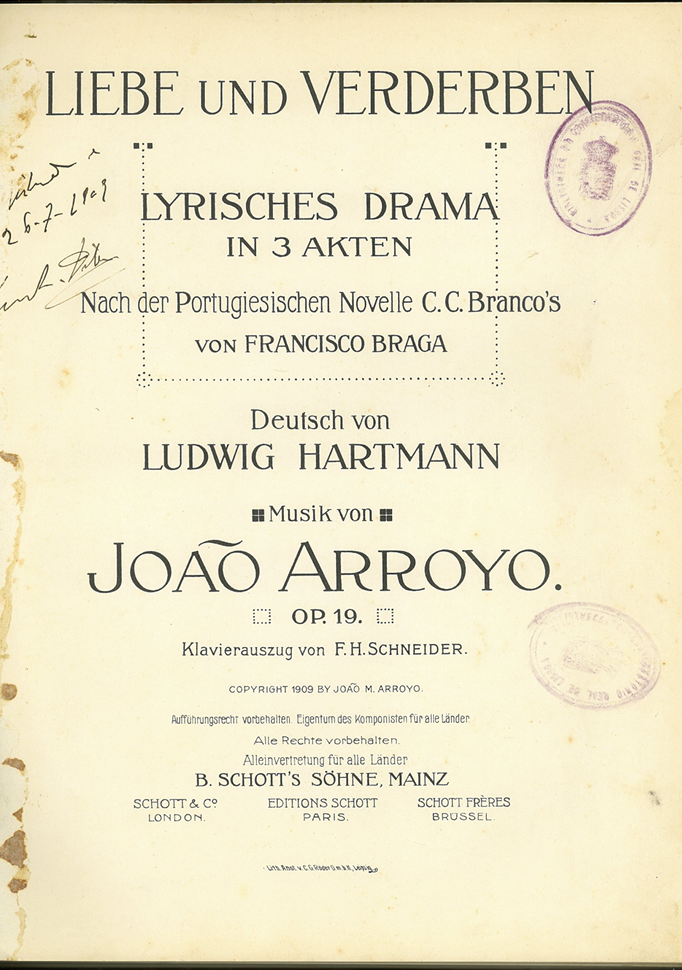
Publisher: B. Schott’s Söhne, Mainz
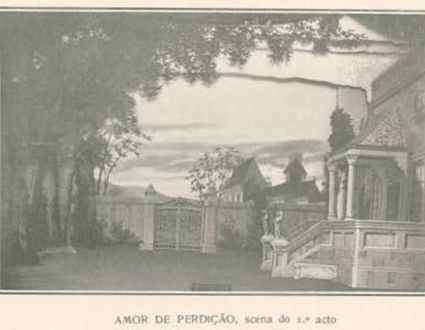
The opera Amore e Perdizione, written to a libretto by Francisco Braga, itself based on the well‑known novel by Camilo Castelo Branco, Amor de Perdição, is considered the most significant work by João Arroyo. It was premiered at the Teatro de São Carlos on March 2, 1907, and repeated in the following two seasons before going to Hamburg, where, in 1910, it was received with enormous enthusiasm. Several years later, in 1948, it returned to São Carlos.³
Regarding Arroyo’s decision to set this classic of Portuguese literature to music, Bernardo Moreira de Sá wrote:
He was enamoured with the ardent desire to set to music a drama of passion, of burning fatal love, where his fiery inspiration, the incomparable brilliance of form that makes him a premier colourist, could find a place. […] The imperative force of communicability that dominates all manifestations of his talent […] had long been urging him towards the creation of a lyric drama, that, lamented in the orchestra, lived on stage, suggesting to the public, would finally consecrate in the applause of the masses the multiform aptitudes of his talent as a dramatic musician. For this, nothing was better than Amor de Perdição. Camilo’s novel, so brilliantly felt, as it is imbued with painful passion, attracted him, fascinated him.⁴
After the opera’s premiere, several critics surrendered to Arroyo’s score. In A Arte Musical of March 1907, Esteves Lisboa described the “warm ovations given to Conselheiro João Arroyo,” the “toasts offered to him” and the high “number of curtain calls.” The author anticipated the success awaiting the opera in Germany, writing that Amore e Perdizione revealed a musical genius with the necessary aptitudes to open “the doors of foreign lyric theatres, where talent is always appreciated.”⁵
Date: 1907
Venue: Teatro de São Carlos, Lisbon
Music Direction: Luigi Mancinelli
Cast: Russitano, Fazzini, Bonini, Gagliardi, Torreta, Leonardi, Loonardi, Molayoli and the Orchestra of the Teatro de São Carlos
Scores: Portuguese Opera Portal