
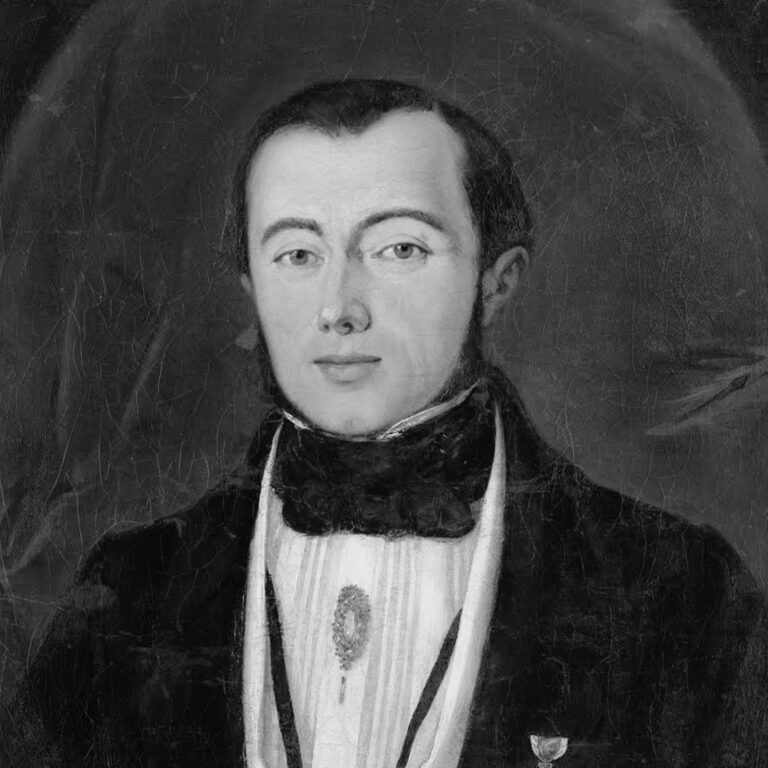
The pianist and composer João Guilherme Daddi was born on November 12, 1813, in Porto. He showed aptitude for music from an early age and began his piano lessons with the Italian Caetano Martinelli at the age of seven. Two years later, his rapid progress prompted his parents to travel with the young musician to Lisbon, where he presented himself to the public for the first time, at the Teatro de São Carlos.¹ Still as a child, his singing studies secured him a role in Fioravanti’s opera Camilla, presented in 1824. The public surrendered to the young man’s talent and, a year later, still at the age of 11, Daddi made his debut as a composer and conductor with a Cantata written on the occasion of the birthday of King João VI.²
Although no significant activities are known from him during the Miguelist period, Daddi reappeared with the advent of the liberal government in 1833, even composing a Te Deum hymn to mark the landing of Queen Maria II in Lisbon. In the following years, his career as a pianist flourished and paved the way for an artistic tour in 1839, through which he reached audiences in Spain, France and England. In Portugal, he had the opportunity to perform alongside Franz Liszt on the stage of the Teatro de São Carlos, at the virtuoso’s own request, performing Thalberg’s fantasy for two pianos on Bellini’s Norma.³
At the beginning of the 1840s, Daddi was invited by the Count of Farrobo to assume the musical direction of the Teatro da Rua dos Condes, where, at the initiative of the aristocrat and the theatre’s director, Émile Doux, comic operas translated into Portuguese began to be presented.⁴ Between 1841 and 1843, under Daddi’s direction, audiences at this theatre heard Auber’s O Dominó Preto, Neve, Receção de uma Cantora and Fra Diavolo; Boieldieu’s A Dama Branca; Hérold’s Le Pré aux Clercs; and Rossini’s O Barbeiro de Sevilha.⁵ Immersed in this environment and with the encouragement of the Count of Farrobo, the composer decided to venture into the dramatic genre with the comic opera O Salteador, performed on May 1, 1845, at the Teatro das Laranjeiras. According to Ernesto Vieira, it was “a small piece in one act, which was performed by the Count himself, by D. Carlos da Cunha Menezes, Duarte de Sá, D. Carlota Quintella and Fortunato Lodi.”⁶
In the following years, he composed two other theatrical works: the “dramatic-lyrical extravaganza” Um passeio pela Europa, with poetry by José Maria da Silva Leal and inspired by an old French vaudeville, presented at the Laranjeiras in 1851; and the operetta L’organiste, with a French text, presented at the same theatre in 1861.⁷ He is also believed to have composed, at the beginning of the 1840s, an opera entitled Ismalia, which was never staged.⁸
Alongside his activity as a pianist and composer, Daddi distinguished himself as a promoter of musical life in Portugal and as a disseminator of international repertoire on national territory. Alongside figures such as Joaquim Casimiro Júnior, Santos Pinto and Guilherme Cossoul, he conducted various concerts for societies and amateur academies, among which the Academia Melpomenense stood out. He was also responsible for inaugurating public chamber music sessions, with a concert held in the hall of the Teatro D. Maria in 1863.⁹ Later, in 1874, he created the Sociedade de Concertos Clássicos – an ephemeral project that faded out in less than three months – and, in 1875, founded the Sociedade de Música de Câmara, both dedicated to promoting works by the principal composers of the Classical and Romantic periods.¹⁰
João Guilherme Daddi died in Lisbon on May 16, 1887.