
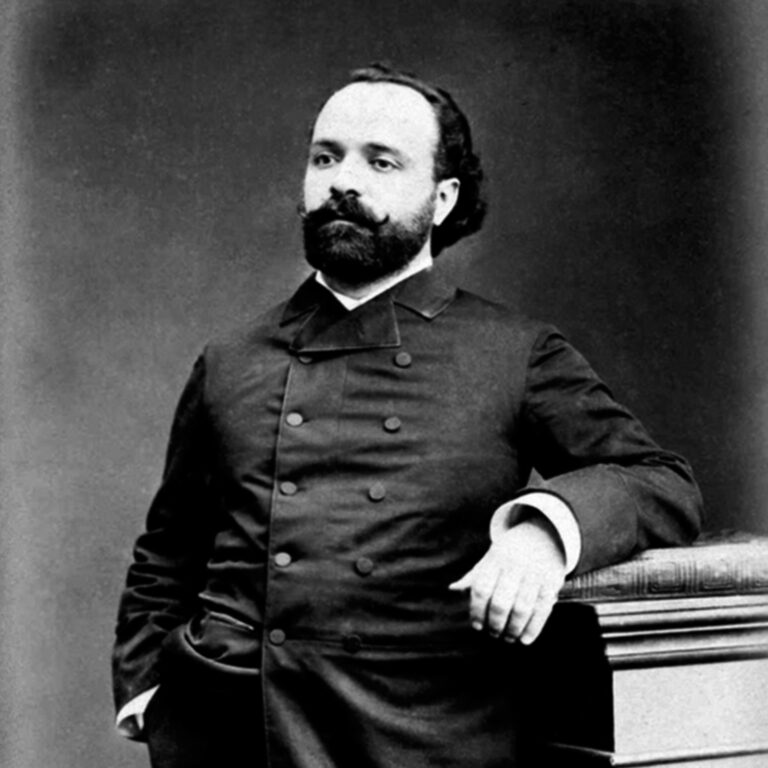
Joaquim Thomaz Del-Negro was born on June 5, 1850, into an Italian family connected to the musical world, which had settled in Lisbon at the end of the 18th century.¹ His father and uncle were part of the Sociedade Filarmónica of João Domingos Bomtempo.² He began his career in 1861 and achieved a position of great prominence in the Portuguese musical scene of the late 19th and first quarter of the 20th centuries. During his training at the Conservatório Nacional de Música de Lisboa, he was awarded several prizes in the courses of Rudiments and Horn.³
Del-Negro was admitted as first horn in the Orchestra of the Teatro de São Carlos in 1867 and remained there until 1878, returning in 1890 – in the decade separating these dates, he lent his pedagogical and musical services to the Royal Chapel and the Teatro Real in Madrid. The musician was also deputy conductor of the Banda da Guarda Municipal de Lisboa and professor of horn at the Conservatório Nacional for 27 years, until his retirement in 1930.⁴ In addition to these roles, he held a directorial position in the Associação Música 24 de Junho, through which he was involved in organising concerts and promoting symphonic music. In 1882, he made his debut as an orchestra conductor at the Teatro do Príncipe Real in Porto, and in the following decade he settled in the city of Porto and became impresario of the Teatros D. Afonso and Carlos Alberto. In the field of journalism, he was co‑owner of O Álbum-Jornal de Música para Piano (1869–1871), musical director of O Mundo Artístico – Gazeta Musical de Lisboa (1883) and a contributor to various other periodicals, such as Gazeta Musical de Lisboa, Perfis Artísticos and A Semana Musical.⁵
As a composer, he explored various genres, such as sacred music, chamber music and repertoire for philharmonic bands, although he devoted particular attention to musical theatre and operetta from the end of the 19th century onwards. He composed around 50 revues and 40 operettas. The musician received several decorations – the Order of Christ in 1881, the Order of Santiago of the Sword, and the Order of Isabella the Catholic (in Spain) – and died on February 11, 1933.⁶
(Operettas⁷)
20 Soloists + Chorus + Fl (Picc) | Ob | 2 Cl | Bsn | 2 Hn | Cnt | 2 Tpt | 2 Tbn | 2 Perc | Vln | Vla | Vc | Cb
See Opera