
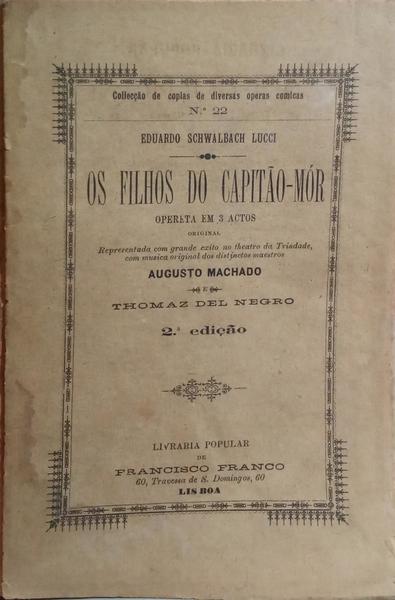
Composers: Augusto Machado (Act I and II) and Joaquim Thomaz Del‑Negro (Act III)
Librettist: Eduardo Schwalbach
Operetta in three acts
Date: 1896
Language: Portuguese
Large-scale
Cogominho Mimoso:
Romão:
Capitão Gaudêncio:
Cosme:
Gonçalo:
Manoel:
Bernardo:
Victorino:
Caetano:
Eduardo:
Joaquim:
Maria:
D. Martinha:
D. Perpetua:
Catarina:
Michaela:
Seraphina:
Tia Anna:
Marianna:
Francisca:
Chorus
“The action takes place in 17… There was a capitão-mór around the Bragança area who made all the women of the land mothers of male babies with which he kept populating the foundling wheels. To protect some love affairs and to exploit the credulity of two old noblewomen, D. Martinha and D. Perpetua, almost a whole regiment passes itself off as their sons. From these misunderstandings, at times repeated and drawn out, the tangled plot is born”.¹
Fl (Picc) | Ob | 2 Cl | Bsn | 2 Hn | Cnt | 2 Tpt | 2 Tbn | 2 Perc | Vln | Vla | Vc | Cb
The operetta Os filhos do Capitão-Mór (The Sons of the Capitão-Mór) is the result of a collaboration between composers Augusto Machado and Joaquim Thomaz Del-Negro. The former was responsible for the music of the first two acts and the latter for the composition of the third. On the combination of their traits, critic Joaquim Miranda wrote: “The two maestros, although easily distinguishable to even the most untrained ear in their methods, are both equally worthy of praise for the harmonious and complete whole they managed to give to their work, a whole that is not always achieved and is not easy to obtain in works of collaboration”. In his reaction to the premiere, the same author highlights among his favourite moments “that of the blind man’s bluff game and the lesson duel, difficult to execute in both verse and music and which, well sung by confident performers, must be admirable”.²
Date: 1896
Venue: Teatro da Trindade, Lisbon
Cast: José Ricardo, Queiroz, Firmino, Gomes, Correia, Maria Costa, Laura Ferreira, Duarte Silva, José Franco, Holtreman, António Duarte, Cinira Polonio, Emilia Eduarda, Amelia Barros, Luz Vellozo, Maria da Luz, Julia Correia, Elvira Roque, Candida de Sousa e Thereza Morgado