
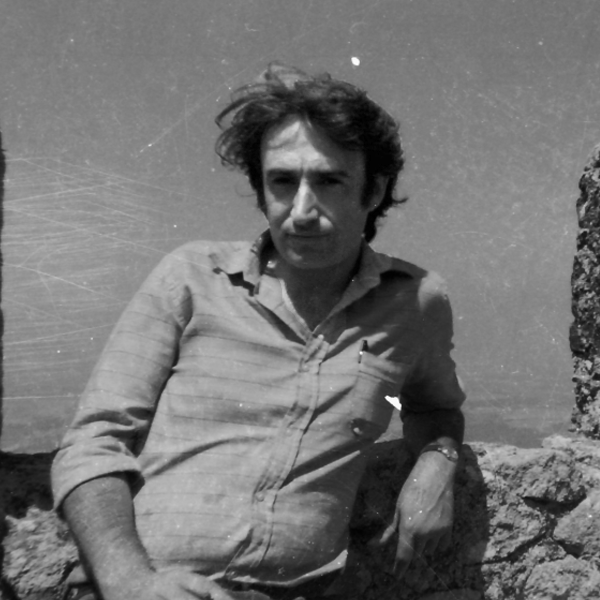
José Alberto Gil was born in Covilhã on 3 March 1949. He completed his general studies at the Salesian Seminary in Mogofores, where he studied music, piano and composition. In 1968, already in Lisbon, he took lessons with composer Jorge Peixinho at the Juventude Musical Portuguesa (Portuguese Youth Music), and around that time, he enrolled in the psychology course at the former Instituto Superior de Psicologia Aplicada (now ISPA – University Institute of Psychological, Social and Life Sciences).
He was an editor for the Diário de Lisboa in the jazz section, collaborated with the theatre group 1º Acto in Algés, worked with the artist Ernesto de Sousa, and was a co-founder of the Ar.Co project (where he would later establish the first home of his Companhia de Opera Buffa). Even before the Revolution of 25 April, he began composing/staging happenings in collaboration with professional singers and other figures such as Luiza Neto Jorge, Manuel João Gomes Paciência, Quenina, Luís Calado and João César Monteiro.
In 1973, together with Helena Vaz and tenor Fernando Serafim, he founded the Companhia de Opera Buffa (Comic Opera Company), later renamed Marionetas de São Lourenço (São Lourenço Puppets). The Marionetas de S. Lourenço project aimed to study, interpret and reconstruct the characteristics of 18th-century comic opera. Based on the knowledge acquired, it sought to adapt them to the present day without destroying their historical characteristics and, above all, to convey the psychological trait of opera characters: mordacity and truculence.¹ In the post-revolutionary period (after the 25 April 1974), he travelled across the country with his Marionetas de São Lourenço and their cart, as part of the Literacy and Cultural Dynamisation campaigns organised by the Comissão Dinamizadora Central (a structure of the 5th Division of the Armed Forces General Staff), which aimed to democratise access to culture and other areas of knowledge for rural populations in the north and centre of Portugal. In 1984, the company took part in the ACARTE Encounters (promoted by the Calouste Gulbenkian Foundation), presenting an exhibition on the work of the Portuguese writer and playwright António José da Silva – “the Jew” (1705–1739) – using puppets/marionettes that recreated characters from his comedies, which the author himself called “joco-serious operas”. This exhibition-show thus consisted of performances and, simultaneously, the presentation of the marionettes by the singer Fernando Serafim, the Cicerone. The chamber ensemble that accompanied him consisted of Fernanda Nunes (singer), Artur Moreira (clarinet), Carlos Passos (violin), Leonardo de Barros (cello), Nelson Rocha (trumpet) and José Alberto Gil (percussion).²
Some of his operas reflect an archetypal musical composition in terms of the reuse and mixture of 18th-century music composed for opera buffa and comic operas (e.g., António José da Silva/António Teixeira), reusing arias and texts from a wide variety of sources. Examples: D. Quixote (António José da Silva), Salomé (Old Testament), As variedades de Proteu (The Varieties of Proteus) (António José da Silva), O Romance do Conde de Alemanha (The Ballad of the German Count) (traditional Portuguese tale) and O Pranto de Maria Parda (The Lament of Maria Parda) (Gil Vicente). The composition of music for the puppet operas by José Alberto Gil was often a process of immediate creation, depending on the occasion and the scenic and dramaturgical needs of the moment. The Baroque pattern is frequent in his music, in rhythmic and formal aspects (overtures, arias and recitatives), while avoiding tonality whenever possible. The performance of his instrumental music also requires certain nuances: the frequent presence of portamentos and glissandos, especially in wind instruments; and the deliberate use of some non-classical music practices and techniques, resulting in a distinctive sonority and atmosphere.
José Alberto Gil saw some of his operas recognised and awarded internationally, in Italy in 1977 with the film O Romance do Conde de Alemanha directed by Jorge Listopad, and at the Festival Mondial du Théâtre de Nancy in 1980.
Among the pieces he staged and performed, the following stand out: Gerinaldo o Atrevido (Gerinaldo the Daring), Romance do Conde da Alemanha (The Ballad of the German Count), D. Mariana, Pranto de Maria Parda (Lament of Maria Parda), D. Quixote, Salomé, Os encantos de Medeia (The Enchantments of Medea), As variedades de Proteu (The Varieties of Proteus) and O Procurador-Geral da Cultura (The Chief Prosecutor of Culture).³
He also composed music for cinema: for Quem Espera por Sapatos de Defunto Morre Descalço (If You Wait for Dead Men’s Shoes, You’ll Die Barefoot)) (1971) by João César Monteiro, and for Relação Fiel e Verdadeira (Faithful and True Relation) (1987) and Luz Incerta (Uncertain Light) (1994) by Margarida Gil.
The composer died on 10 January 1998.