
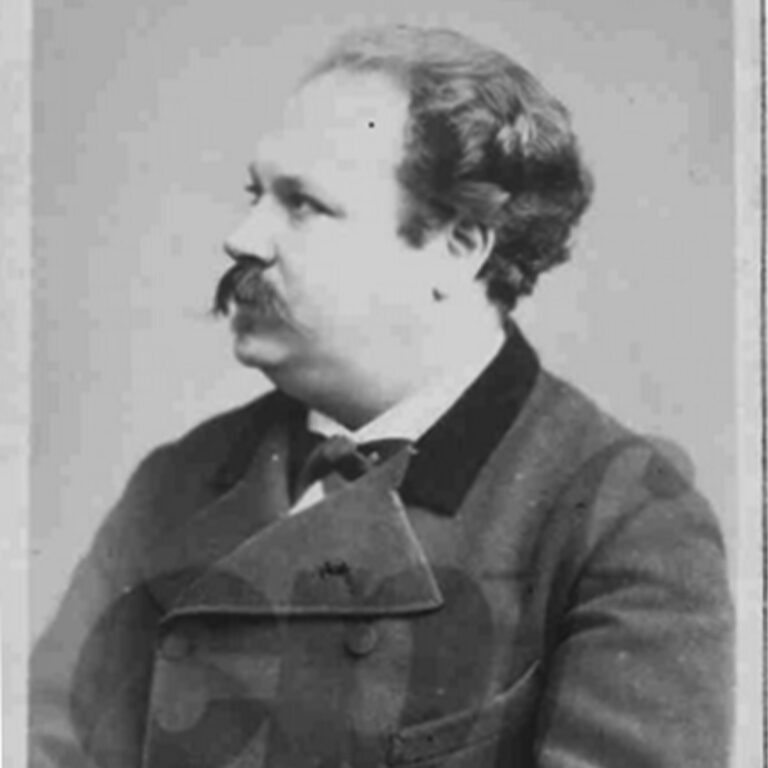
José Augusto Ferreira Veiga was born in Macau on November 22, 1838, the son of Joaquim José Ferreira Veiga, originally from Braga, and Joanna Ulman da Veiga, of Dutch descent. In 1855, he enrolled in the Law course at the University of Coimbra and, throughout his studies, already established a solid reputation as a musician and composer. Still in Coimbra, he saw his operetta A Questão do Oriente performed in 1859 at the Teatro Académico, which at the time operated under his direction.¹
After completing his degree, he began practising law in Lisbon, while simultaneously devoting himself to new compositions and performances as a pianist. Among the works composed in this period, the fantastic ballet Ginn, written in 1866 and received with enthusiasm in the capital, and a Te Deum from 1871 stand out. Ten years later, the composer returned to the operatic genre with L’elisir di giovinezza, an opera-ballet with a libretto by the French poet Jean Jacques Magne, which was premiered at the Teatro de São Carlos.² Accounts of the reaction to this opera are contradictory: some sources claim it did not gain public favour,³ while others report that:
[…] the Visconde do Arneiro had this consecration in Portugal, one of the most brilliant and most resounding, when in 1876 he presented at the São Carlos theatre his first grand opera, O Elixir da Mocidade, sung by Vitali, Corsi, Rota and Vidal, with a most remarkable success.⁴
What is certain is that, after a new presentation of the opera in Italy, Ferreira Veiga chose to adapt his music to a new libretto, written by Rodolfo Paravicini, based on a novel by Ann Radcliffe.⁵ The reworked work was entitled Dina la derelitta and was presented at the Teatro de São Carlos on March 14, 1885, finally achieving a consensually positive reception: “the success was complete and enormous.”⁶
Ferreira Veiga also composed another opera, Don Bibas, based on the then-unknown novel O Bobo by Alexandre Herculano, revealing a certain nationalist tendency common to several figures in the Portuguese musical milieu of the time.⁷ Already in 1885, the periodical O Occidente drew attention to the magnificence of the drama that was to come:
It is a grand composition that we hope to see on stage at our theatre next year, and of which we already know marvellous excerpts. The opera has great mise‑en‑scène expenses, but the country has a strict obligation to make these expenses, so that this opera, whose subject is purely national, enriches the repertoire of our lyric theatre. The Visconde do Arneiro is working actively on this work, which will be yet another crown of triumph for him and which will reproduce in music one of the most beautiful masterpieces of Portuguese literature.⁸
This last operatic project by the Visconde do Arneiro, however, remained unstaged. At that time, the composer decided to settle in Italy and remained there until his death on July 7, 1903.⁹