
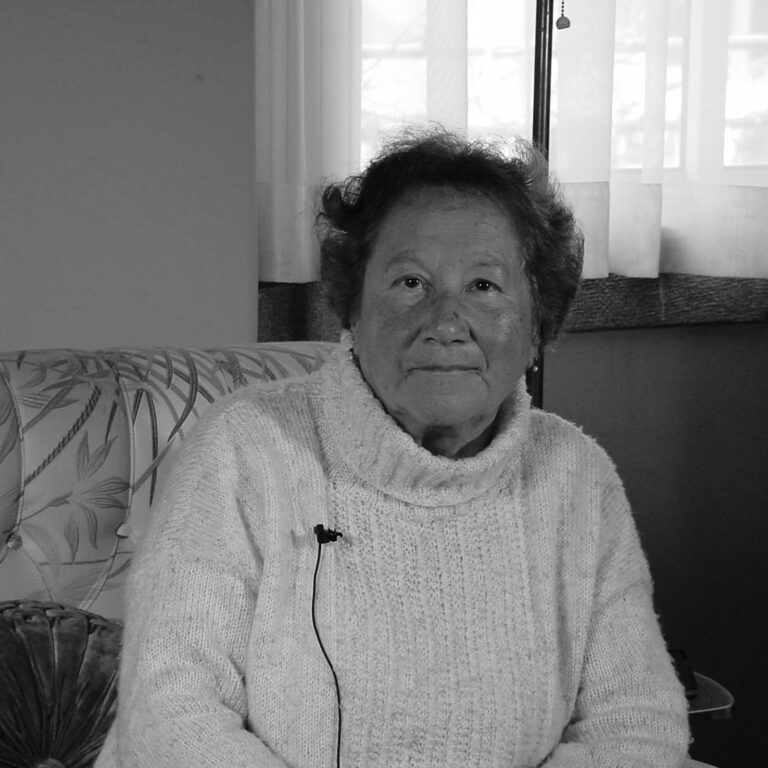
Maria de Lourdes Martins’ professional and personal life was divided between pedagogy and composition. Her early musical training took place with her mother, Maria Helena Martins, after which she attended the Conservatório Nacional, completing advanced studies in piano with João Abreu Mota and in composition with Artur Santos and Jorge Croner de Vasconcelos, as well as studying harpsichord and clavichord with Santiago Kastner. According to the composer’s own recollections, her more serious interest in composition emerged during her studies with Croner de Vasconcelos, and her first compositions date from the 1940s. From that point on, she devoted herself to a wide range of musical genres, pursuing a career that spanned almost her entire life and resulted in an extensive catalogue of more than sixty works, some of which received awards. Nevertheless, she expressed a certain frustration with the Portuguese musical environment, lamenting that many of her works remained unknown or were not performed beyond their premieres.¹
In 1948, Martins began her career as a pianist at Emissora Nacional, where she performed her own works. She later became a fellow of the Fundação Calouste Gulbenkian, within which she attended composition classes with Harald Genzmer at the Hochschule für Musik in Munich (1959–1960), as well as the Darmstadt Summer Courses under the guidance of Karlheinz Stockhausen (1960). She also participated in seminars with Angelo Francesco Lavagnino on film music in Siena and with Bruno Maderna in Darmstadt (both in 1961). In an initial phase, her work reveals the influence of Igor Stravinsky and particularly Béla Bartók, whom she herself identified as one of her most important influences. However, from the mid-1960s onwards—following her contact with the avant-garde of Luigi Nono, Pierre Boulez, Karlheinz Stockhausen, and others—she developed a more personal musical language, rooted in atonality, timbral exploration, the use of aleatory procedures and improvisation, and harmonic structures based on clusters. Works such as Esqueletos para quatro instrumentos (1963) and the cantata O Encoberto (1965) exemplify this stylistic shift, which would be further consolidated in the following years. An interest in folklore and Portuguese popular themes coexisted with this new language and was closely linked to her pedagogical work. During her stay in Munich, Martins came into contact with Carl Orff and his methods of music education. Upon returning to Portugal, she became a committed advocate of the Orff-Schulwerk, translating and adapting its first manuals, and dedicating herself both to children’s music education and to teacher training.²
She taught at the Instituto de Música de Coimbra, the Academia Luísa Todi in Setúbal, the Escola-Piloto de Formação de Professores de Educação pela Arte, the Escola Superior de Teatro, and the Conservatório Nacional. She was a member of the board of the International Society of Music Education and Juventude Musical Portuguesa, and one of the key figures behind the creation of the Associação Portuguesa de Educação Musical.³