
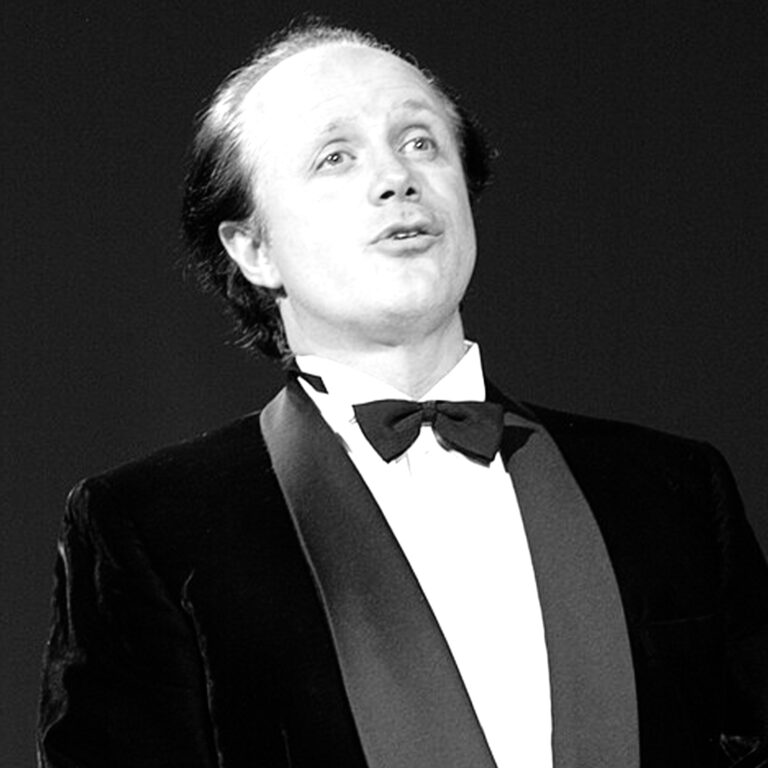
The baritone Jorge Chaminé (1956), born in Porto, studied piano, cello, and voice at the Conservatório de Música do Porto between 1973 and 1977, respectively with Maria Teresa Xavier, Madalena Sá e Costa, and Isabel Malaguerra. In 1978, he continued his vocal studies in Paris, completing the program at the École Normale de Musique the following year. He subsequently refined his training as a scholarship recipient of the Fundação Calouste Gulbenkian, studying in Munich with Hans Hotter (1980–1982), in Madrid with Lola Rodríguez Aragón (1982–1984), at The Juilliard School in New York with Daniel Ferro (1985–1987), and also with Teresa Berganza.¹
Since then, he has performed at major international venues such as the Théâtre des Champs-Élysées, Carnegie Hall, and the Concertgebouw in Amsterdam, among others, accompanied by leading orchestras including the Boston Symphony Orchestra, the London Symphony Orchestra, and the Berlin Philharmonic, among others, and working with distinguished conductors.²
His eclectic repertoire encompasses opera (particularly Mozart roles, Russian repertoire, and 20th-century works), major choral-symphonic works of the 18th and 19th centuries, and especially Lied. He has also shown a particular interest in contemporary music, having been the dedicatee and first performer of numerous works. He has further distinguished himself in the fields of tango, bolero, and Brazilian music, among others. In addition, he has taught at Stanford University since 2012 and has promoted various initiatives supporting young musicians. Among the many distinctions he has received throughout his career, notable is the Human Rights Medal awarded by UNESCO in 1993.³