
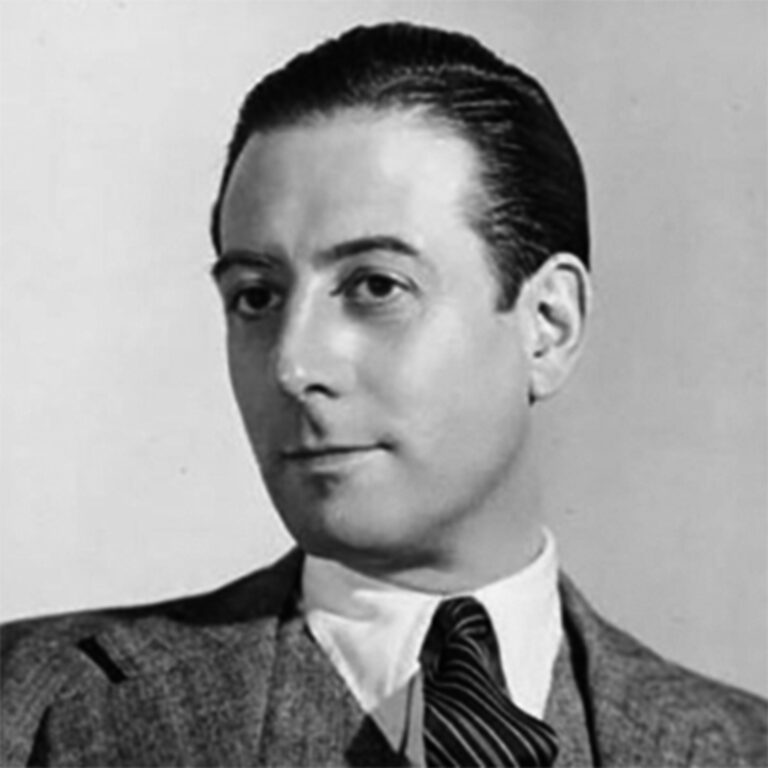
The tenor Tomaz Alcaide (1901–1967), born in Estremoz, studied voice in Lisbon with Alberto Sarti, Francisco de Sousa Coutinho, and Eugenia Mantelli. He made his debut at the Club Estefânia and the Teatro Nacional de São Carlos in the early months of 1924, followed by performances in other venues in the capital.1
On April 19, 1925, he traveled to Milan, where he furthered his training with Fernando Ferrara. His Italian debut took place on December 5 of that same year, in Mignon by Ambroise Thomas at the Teatro Carcano in Milan, receiving excellent reviews from both audiences and critics. This success led to the rapid launch of his international career beginning the following year, with engagements not only in Italy but also in Switzerland, the Netherlands, and the United States.2
During the 1929–1930 season, Alcaide’s career reached its peak, gaining access to major venues in the Italian circuit such as the Teatro Reale dell’Opera in Rome, the Teatro alla Scala in Milan, and the Teatro Massimo in Palermo, while continuing to perform in Portugal. In the following seasons, he also appeared at the Finnish National Opera, the Teatro del Liceo in Barcelona, the Opéra de Paris, the Salzburg Festival, and the Vienna State Opera, among others, particularly in southern and northern France as well as in Belgium.
It is also worth noting his recordings of operatic arias made for the Columbia Gramophone Company in 1930 and 1934, followed by a set of six Portuguese songs in 1936.3
The outbreak of World War II interrupted his European career, with the cancellation of contracts. In the spring of 1940, Alcaide embarked on a tour of South America, performing in several Brazilian theaters and at the Teatro Colón in Buenos Aires, before returning to Lisbon in 1942.4
Between 1943 and 1945, he was forced to suspend his career due to health problems, and after his recovery, he was unable to regain the same level of success, making his final operatic appearance in Brazil in early 1948. He subsequently worked as a program assistant at the Emissora Nacional, while continuing to perform occasionally in Portuguese theaters in operetta productions until his definitive retirement in 1955.5
In 1962, he also took on roles as a voice teacher and stage director within the newly established Companhia Portuguesa de Ópera, based at the Teatro da Trindade, positions he held until his death in 1967.6