Composer: Alexandre Delgado
Librettist: Alexandre Delgado
Libretto based on the play O tempo feminino by Miguel Rovisco
Chamber opera in two acts
Date: 2006–09
Language: Portuguese
Duration: 60 minutes
Small-scale
D. Maria I: soprano
D. Henriqueta/Crimson Lady: mezzo-soprano
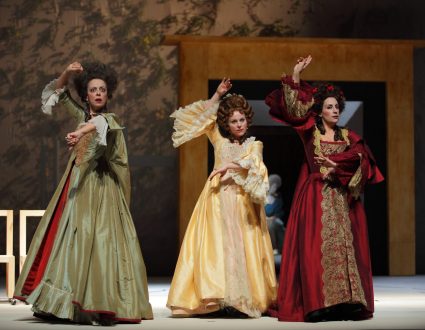
Green Lady: soprano
Yellow Lady: soprano
Rosa: actress
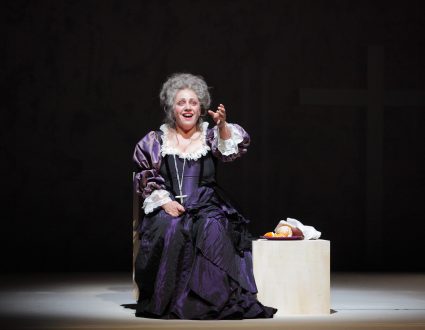
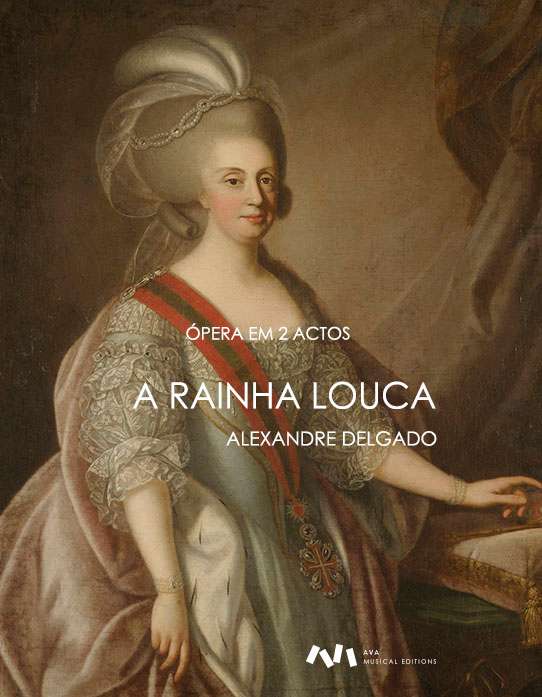
Amid echoes of the French Revolution and the beginning of the collapse of the Ancien Régime, D. Maria I is the Mad Queen, a queen imprisoned in a world of dementia and evasion. Comic, tragic and moving, this queen “who ceased to be one” was unforgettably embodied by the actress Fernanda Alves in the premiere of Miguel Rovisco’s Trilogia Portuguesa at the Teatro Nacional D. Maria II in 1987.
The play is based on historical data that contradicts two centuries of set ideas in anti-monarchist historiography. Responsible for the creation of the Academy of Sciences and the National Library, promoter of the first scientific expedition to the Amazon, of the renewal of Education and the Navy, D. Maria I (1734–1816) was cultured and sensitive, given to music and the arts; reigning was simply not in her nature. Her madness, which permanently removed her from office in 1792, had several probable origins: fanatical priests convinced her that her father was burning in hell, due to the Marquis of Pombal and the persecution of the Jesuits; to the loss of her husband was added the death of her firstborn at the age of 27 from smallpox; the priests would have forbidden the inoculation of the vaccine that was being tested at the time, “because it was against God’s will”. The imprisonment of Marie Antoinette and the idea that France itself, the light of the Old Continent, could decapitate its queen, may have been the last straw.
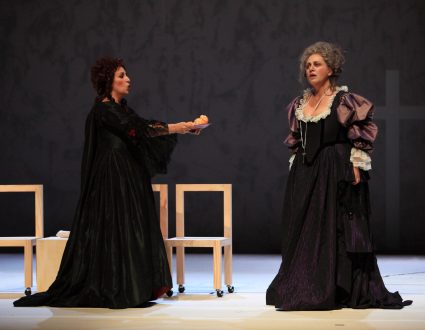
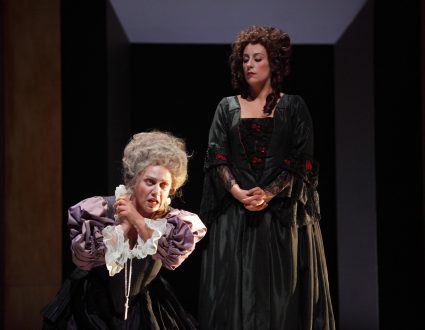
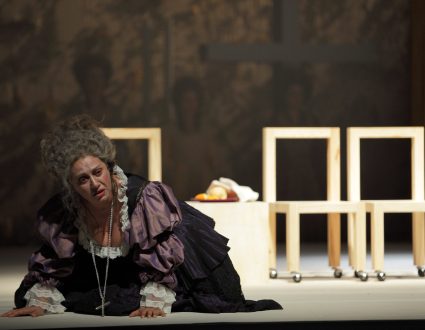
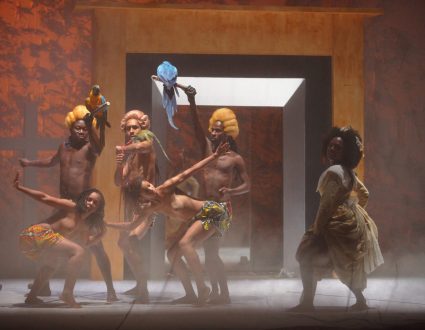
In this opera, D. Maria wants to escape to a world “far from this misery”, a world of dream and beauty symbolised by the Estrela Basilica, that mark she dared to leave in a Lisbon “that does not belong to me, full of dogs, criminals and rubbish”. Beside her is the young Henriqueta, a cold and sour lady-in-waiting, who embodies the dehumanised reaction against society; the confrontation between the two women fills the entire 1st act, which ends with the queen dancing the minuet, “as once, with my beloved husband”. Another presence is Rosa, the black servant whose historical model was a dwarf cherished by the queen, representing the noble savage, the being of origins for whom the concept of sin does not exist; the fofa, “an obscene dance, from your Africas”, will be her mode of escape at the end of the opera.
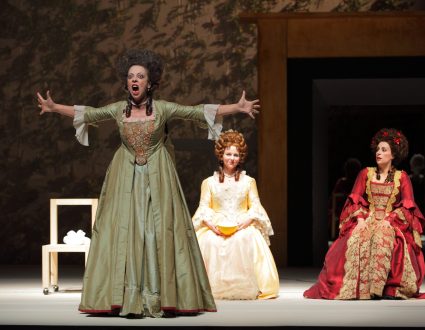
The 2nd act materialises D. Maria’s hallucinations: on her birthday, she is visited by three ladies who draw a hilarious and persistent portrait of Portuguese historical reality, interspersed with the queen’s outbursts and memories, culminating in the historical evocation of the aerostat, the balloon that rose in the gardens of the Ajuda Palace, carrying a chimpanzee to whom she secretly gave the name Estrela (Star)…
In an orchestra of 13 elements with a wind quintet and string quintet, the harp, harpsichord and marimba symbolise respectively D. Maria, Henriqueta and Rosa; timpani, xylophone and other percussion contribute to a more exuberant atmosphere in the 2nd act. Second part of a Trilogia da Loucura (Trilogy of Madness) begun in 1994 with O Doido e a Morte, in this opera, composed between 2003 and 2009, the ghosts of the human mind are visited to the sound of an imaginary 18th century.
Fl | Ob | Cl | Bsn | Hn | Vln | Vla | Vc | Cb | Hp | Cemb | Mar
Publisher: Ava Musical Editions
The stage premiere of a contemporary Portuguese opera is in itself unusual; however, it was by no means common that Alexandre Delgado not only repeated the presentation of a new opera in 2011 – having premiered O Doido e a Morte in 1994, based on the homonymous play by Raul Brandão – but also once again recovered in the libretto of A Rainha Louca a dramatic text that had been unjustifiably erased from theatre companies’ repertoires: the play O tempo feminino by Miguel Rovisco (1959–1987), third part of the Trilogia portuguesa, written in 1986.
In writing the libretto, the composer closely followed the play on which he based it, only choosing to condense into the musical apotheosis that precedes the opera’s finale the 3rd Scene (and last) of the play, the one in which the queen’s madness is explained. More an icon of a disjointed contemporary Portugal than a historical portrait, this D. Maria is pure excess, the stage of a delirious and tormented imagination in which the fearsome news reaching her from the French Revolution, the doubt about the eternal destiny of D. José I, her father (ultimately responsible for the actions of the Marquis of Pombal, whom the queen had outright renounced), or even the death of the Infante D. José, her son, to whom she supposedly refused the smallpox vaccine, trusting in a distorted miracle-seeking religiosity, are all stirred up.
In the first of the two parts into which the opera A Rainha Louca is divided, Alexandre Delgado characterises the co-protagonists of the drama, distinguishing them by timbres and leitmotifs that seal their fate. The harp marks the poetic and faltering D. Maria; the harpsichord the edgy and bitter Henriqueta; and the marimba signals the servant, in a musical-dramatic echo of the festive and intoxicating innocence attributed by 18th-century European culture to the overseas “noble savage”.
In the second part, the composer draws a delirium that wanders between D. Maria’s oneirism and the diabolical intervention of the spectre-women who torment her, having as its horizon the typical frenzy of operetta or late 19th-century boulevard theatre. In this beautiful sequence, it is particularly touching how text and music interweave the protagonist’s afflictive conflict, as she tries to escape the heavy exercise of memory as a relentless scourge (so characteristic of Portuguese self-reflexivity) through a very light poetic flight, recalling her only moment of happiness, “on that April afternoon, decades and decades ago”, when in the gardens of the Ajuda Palace the aerostat rose into the air, “a paper balloon, oval in shape, eighteen feet long”. This impressive suspension leads to a festive epitome of the opera’s motifs and the most bewildering quotations from the composer’s musical memory – with fairy-like and spectral irruptions of Wagner, Puccini, Bizet, Rimsky-Korsakov, Tchaikovsky… –, ending A Rainha Louca in an unexpected fofa, the servant’s liberating dance, which exorcises in a beneficent timbral and rhythmic vitality the tormented memories of a postponed country.
This “ramified study on madness” – a definition in which the composer sums up his new opera (after all a “study” already begun in O Doido e a Morte, although what in the 1994 work was a festive comic jouissance is here densified) – had its absolute premiere at the Pequeno Auditório of the CCB, in a production integrated into the 2011 Almada Festival. Joaquim Benite’s staging acutely signalled this set of surrealising variations over which madness presides, both by circumscribing a space as oppressive as the tortured mind of the queen, and by highlighting the emancipatory strangeness of intermittent and contrasting desires for escape.
Miguel-Pedro Quadrio
Date: 2011
Venue: Pequeno Auditório, Centro Cultural de Belém, Lisbon
Commission: Centro Cultural de Belém and Câmara Municipal de Matosinhos
Direction: Joaquim Benite
Musical direction: Alexandre Delgado
Cast: Ana Ester Neves, Maria Luísa de Freitas, Ana Paula Russo, Teresa Cardoso de Menezes, Nilma Santos and OrchestrUtopica