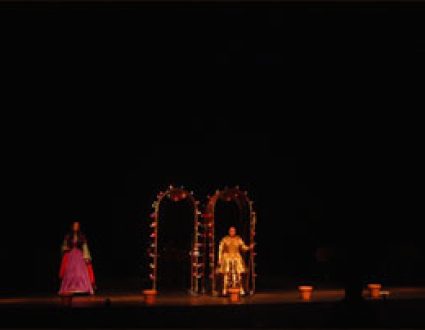
Librettist: Carlos Marecos
Libretto based on a poem by Teresa Duarte Martinho
Short opera
Date: 2003
Language: Portuguese
Duration: 27 minutes
Small-scale
Mother: soprano
Daughter: soprano
Fl | Cl | Ob | Bsn | Hn | Tpt | Tbn | Perc | 2 Vln | Vla | Vc | Cb
In Caminho ao Céu – Cenário Gaza, the scene is a painting. The singers, the instrumentalists, the conductor, the audience—everyone is inside the painting. Yes, part of the audience is on stage, sharing the scenic space with the performers. The lighting, video, and grain on the image, in the background and on faces, construct this painting. The projected images, forming a triptych scenography, are not well-defined. Although realistic, the images are distorted by the recesses of the stage walls, and the grain of the projection on the rough surfaces imparts the beautiful and unstable “imperfection” of the texture of a painted canvas.
Shadow, light, faces with visible and hidden sides, hands, silhouettes, shadows projected on the floor that move with the bodies. The colors: the blue, the grey on the performers’ faces, the earth tone, the lines drawn on the floor connecting the instrumentalists to the conductor, and the color of the sunset—the hope, the light that moves and highlights each instrumental soloist.
The bodies, their movement, their stillness, the skin, the dirty skin, the movement of hands, the gazes, the gazes between mother and daughter, the Daughter’s look of suffering, the mother’s courage and support. The instrumentalists are also characters, but they do not act; they merely are, they exist, they observe, and with the music, they offer support, solidarity to the victims, also giving them the comfort possible, helping them bear the pain.
The setting is Gaza. The young woman is injured, hit by a bombardment; her skin is grey from the dust of destroyed concrete, her face and limbs are wounded and bleeding.
The audience is inside the scene, close to the performers, seated beside the instrumentalists, as close as one violinist is to the other. They inhabit the same space; they were placed inside the artistic object to witness it, as if virtually transported into the action, as in a dream. They are characters, ghosts inhabiting the scene. The spectators on stage construct their own cinematic close-up, a flesh-and-blood close-up; each is a protagonist and part of another’s framing. In the auditorium, the close-up is common to that part of the audience, observed through live video, the intimacy filmed closely, characteristic of cinematic language. But physical proximity surpasses technology; the flesh-and-blood close-up is more intimate.
The musicians observe the Daughter and Mother’s path of suffering; they know it; they have a particular gaze. Each, in their own time, tries to play the same melody, a solo that is never complete, that is always interrupted. Another soloist continues what the previous one started, the melody completing itself fragment by fragment, creating meaning, accompanied by the movement of the sunset light—a light that also dances, that moves in space and time.
Fragmentation is the musical form; it is necessary to gather all the fragments for the structure and form to take shape. The memory of each unfinished solo grows as the piece unfolds. The musicians hold the secret of the form; they too have skin grey with concrete dust; they are inhabitants of Gaza.
The Daughter, though she falters three times, insists on proceeding, trying to aid the other wounded. Affectively, she seeks direct contact with her Mother: “Hold the hand, it is I who hold the wound.” With this support, the pain becomes bearable to continue. The lines on the floor, connecting the performers, move near them, rising in a way that recalls a cross—a symbol of the suffering the Daughter carries and, simultaneously, the support that sustains her.
There is still room for a moment of pause and intimacy: “from the body a fountain… from your hair a river.” The body, the stage of pain, transforms into something new, into a fountain; the sensory aspect of water with inner life that washes the wounds. The Daughter’s hair, intimate, fragile, human, is seen by the mother as the beautiful and fluid movement of an eternal river.
Finally, the Daughter shows her that she is mortally wounded. The Mother embraces her, and they sing: “The body is a bow that I play.” This Pietà seems like a dance, a cyclical movement between life and death, a deep intertwining in the pain of both. The Mother embraces the body of her Daughter, who has just died in her arms—this gesture is not only the eternal embrace of the Daughter but an embrace of all humanity.
Date: 2025
Premiere: Escola Superior de Música de Lisboa
Commissioned: IPL/IDI&CA2024/PCM-AE_ESML research project
Music Director: Carlos Marecos
Cast: Maria João Pacheco, Catarina Martins and ClusterLab XL of the Escola Superior de Música de Lisboa