Librettist: Pedro Mexia
Based on: the traditional tale O Macaco de Rabo Cortado
Comic opera in three scenes
Date: 2018
Language: Portuguese
Duration: approx. 80 minutes
Small-scale
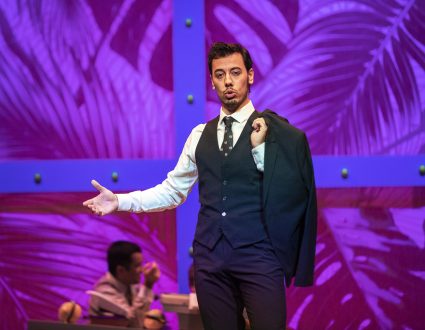
Monkey: baritone
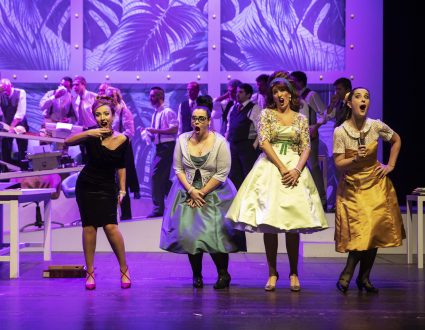
Woman I: soprano
Woman II: mezzo-soprano
Woman III: soprano
Opponent: tenor
Woman IV: soprano
Monkey’s colleagues: male chorus
(Setting: Office of a prestigious law firm. Legal books, compilations of legislation, comfortable swivel chairs, diplomas on the walls, glass partitions, computers, bibelots. The enclosed glass spaces can be transformed into an auditorium, canteen, rooms, etc.)
(Monkey, Woman 1, Chorus)
“Is there anyone who can resist me?” The Monkey explains his success and his methods. Demonstration.
First seduction. Triumph. Speech of the seduced woman. The chorus presents itself. Phallic hymn.
(Monkey, office colleagues, Women 2 and 3)
The Monkey recounts his success. The admiration of his colleagues. Sexual digression using legal terminology.
The Monkey changes woman. Second seduction, identical to the first. Triumph. The Monkey celebrates. Speech of the opponent. Androphobic hymn.
The Monkey changes woman again. Third seduction. Triumph. Speech of the opponent, immediately crushed by the apotheosis of the chorus.
(Monkey, Women 1, 2, 3 and 4)
Lament of the abandoned women 1, 2 and 3. Chorus battle: the male chorus against a small chorus of the three women (revisiting previously stated arguments).
The Monkey justifies himself. Discourse on Casanova and Don Juan (Kundera) (recitative?).
The Monkey changes woman. Fourth seduction. Failure, incomprehension. Instrumental turmoil. “Final judgement”, with all on stage.
Fl (Picc) | Ob (Ob d’am/Eh) | 2 Cl (2nd Bcl) | Bsn (Cbsn) | 2 Hn | Tpt | Tbn | Tb | 4 Perc | Hp | Synth | Vln | Vla | Vc | Cb
The Danish comedian Victor Borge once accompanied an opera singer at the piano when, suddenly, he stopped playing and remarked: “You just said that.” When Inês de Medeiros and Nuno Côrte-Real invited me to write a libretto, my relationship with opera could be described in much the same way. Even operas that I consider masterpieces display a degree of textual redundancy and exaggerated pathos that I find comic. Perhaps that is why I have always preferred opera buffa — which, incidentally, coincided with the challenge that was proposed to me and that I accepted without hesitation.
As I wrote, maintaining contact with Nuno (a man of immeasurable patience and cordiality), we gradually moved away from the original theme, which was a commentary on the traditional Portuguese tale of the monkey with the cut tail. If you do not know the story (as I did not), it concerns a monkey whose tail, as the name suggests, has been cut off, and who trades it (through successive acts of theft) for the razor that cut it, then the razor for another object, and so on, until he mysteriously announces that he is going to Angola. The notion of “exchange” in its economic sense did not interest me as much — particularly since Nuno had already composed, with a libretto by Vasco Graça Moura, the opera Banksters, with its gangster-bankers. What interested me was another kind of exchange, of a Don Juan– or Casanova-like nature. This led me to establish another parallel, inevitable though tenuous, with Don Giovanni by Wolfgang Amadeus Mozart and with the idea of the “punished libertine.”
Thus, from a thematic point of view, Canção do Bandido deals with seduction — an increasingly problematic and distant concept (“when I was young, there was something very beautiful called seduction,” said the popular singer Victor Espadinha, as did Mario Vargas Llosa). In an equally ambiguous way, other notions come into play: self-esteem, nature, masculinity, the right to harassment, and voluntary servitude. Our proposal presents, so to speak, a Don Juan in the age of #MeToo, within a cultural context in which the “seducer” is punished not for being libertine, but for using his sexuality abusively. That we transformed the monkey (from the tale) into a lawyer seemed natural to me, since legal language offers endless libidinous ambiguities and formulas well suited to a “bandit song.”
And yet, what this opera may be from a thematic point of view is less important than what it explores formally: the play of repetition, variations on the same situation, apotheoses followed by collapse, a Darwinian choreography, or a carnival of allusions that, on the textual level, ranges from the poet João Roiz de Castel-Branco to the popular singer Dino Meira, forming a linguistic patchwork between the sublime and the ridiculous. Ultimately, this is a very serious subject — that is to say, a seriously comic one.
Date: 2018
Venue: Teatro da Trindade, Lisbon
Commission: Teatro Nacional de São Carlos, Teatro da Trindade, Temporada Darcos
Stage direction: Ricardo Neves-Neves
Music direction: Nuno Côrte-Real
Cast: André Henriques, Bárbara Barradas, Cátia Moreso, Inês Simões, Marco Alves dos Santos, Sónia Alcobaça, Chorus of Teatro Nacional de São Carlos and Portuguese Symphony Orchestra