
Composer: Alexandre Delgado
Librettist: Alexandre Delgado
Libretto based on the homonymous play by Luís de Sttau Monteiro
Opera in two acts
Date: 2024
Language: Portuguese
Duration: 90 minutes
Large-scale
D. Miguel Forjaz: baritone
Principal Sousa: tenor
Beresford: bass-baritone
Vicente: tenor
Matilde de Melo: dramatic soprano
António de Sousa Falcão: baritone
Peasant Woman: lyric soprano
Former Soldier: baritone
Policeman/Servant/Sacristan: actor
Chorus of Common People: chorus
Act I
The action takes place in Lisbon in 1817. A group of common people gather, lamenting their difficult situation and recalling the songs of the regiment of General Gomes Freire de Andrade, whom they consider a defender of the people.
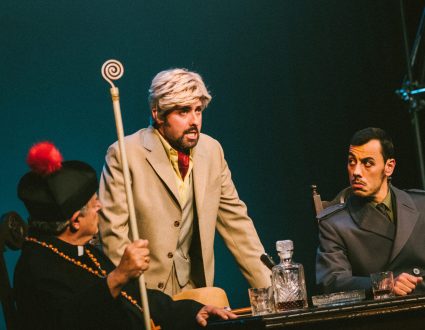
Meanwhile, the governors of the Kingdom – D. Miguel Forjaz, Principal Sousa and Marshal Beresford – meet, concerned about rumours of a conspiracy and revolution associated with General Gomes Freire. They decide they need to crucify someone to serve as an example.
An informer, Vicente, spies on a suspicious meeting at the general’s house and warns the rulers. They see Gomes Freire as a threat capable of destroying the established order because he speaks to the people. They then decide to choose him for condemnation, in order to annihilate the seeds of anarchy.
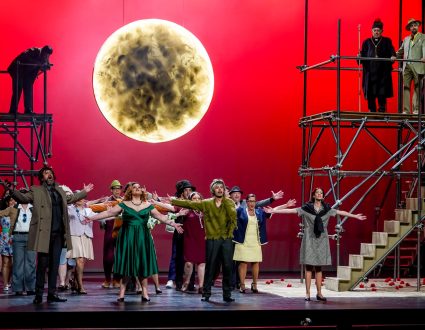
This act vividly portrays a moment of social and political convulsion, with the people dissatisfied and rumours of revolution, leading the ruling power to seek a scapegoat to condemn. General Gomes Freire appears as a figure loved by the people but feared by the rulers.
Act II
The people comment that General Gomes Freire has been arrested, ending the hope for change. Matilde, the general’s wife, laments the fate of just and loyal men in a world of hypocrisy and injustice.
António de Sousa Falcão, a friend of Gomes Freire, says that the general was always a threat to the ruling power because he exposed its flaws. Matilde asks Marshal Beresford for clemency, but he refuses, stating that the mere existence of certain men is a crime.
A woman of the people consoles Matilde. Sousa Falcão brings news of the general in prison, in poor conditions. Matilde tries to appeal to D. Miguel Forjaz and Principal Sousa, but is rejected, accused of being the lover of a traitor. Principal Sousa thanks God for the capture of the revolutionaries.
Matilde confronts Principal Sousa, accusing him of condemning innocents, giving alms but hanging those who defend the poor, selling Jesus for power. She tells him that he will die deafened by curses.
The people comment that they are going to hang and burn the general, casting his ashes into the sea. D. Miguel Forjaz states that the smell of roasted meat will remain in the memory of anyone who thinks of revolt.
Sousa Falcão laments by the pyre that he did not read Gomes Freire’s courage to fight on the front line.
Matilde, dressed in a green skirt, imagines the general coming to embrace her and say goodbye. In the glare of the pyre, Matilde says that this is a beginning, not an end, and that that light will bring hope and illuminate the entire earth, because “until the day comes, fortunately, there is moonlight.” Everyone joins in this song of hope.
2 Fl | 2 Ob | 2 Cl | 2 Bsn | 2 Hn | 2 Tpt | Tbn | Hp | 2 Perc | Vln | Vla | Vc | Cb
Publisher: AVA Musical Editions
(Excerpt from a lecture given at the University of Zurich on 15 November 2024, within the framework of the Colloquium History and the Arts: (re)writing)
In 2011, when Joaquim Benite staged my opera A Rainha Louca, he challenged me to compose an opera about my grandfather, Humberto Delgado, but I told him I wouldn’t be able to, as it was too personal a subject (I was five months in the womb when my mother learned that her father had been murdered).
In 2022, Osvaldo Ferreira challenged me again: to compose an opera about the 25th of April, to commemorate the 50th anniversary of the Revolution. Initially, I hesitated, finding the theme not very operatic and not knowing any interesting theatrical text on the subject. But then I remembered Luís de Sttau Monteiro’s play, which I had the idea was inspired by the figure of my grandfather.
To compose an opera, I need a gripping story, with flesh-and-blood protagonists, preferably combining the comic and the tragic. That is exactly what I found when I re-read Felizmente Há Luar, a historical play about the death sentence of General Gomes Freire, accused of conspiring against the absolutist regime in 1817.
The play was written after the 1958 presidential elections, in the same year that the colonial war began (1961); a year later, the student revolt began. Sttau Monteiro dedicated it “to Fernando de Abranches Ferrão, who almost forced me to write this play.” Abranches Ferrão was the lawyer for several regime persecutees, among them Humberto Delgado, in the disciplinary proceedings brought against him after the elections. After the murder of my grandfather and his secretary in February 1965, he was the family’s lawyer, together with Mário Soares.
Published in 1961, the play was acclaimed by the critics and won Sttau Monteiro the Grand Prize for Theatre from the Portuguese Society of Authors. Vasco Morgado wanted to stage it at the Monumental, Amélia Rey-Colaço at the Teatro Nacional and António Pedro at the Teatro Experimental do Porto, but the censors did not authorise it. The book had seven editions before the 25th of April, but the play, premiered in Paris in 1969, could only be performed in Portugal after the Revolution. It was staged in 1975 at the Teatro Ensaio do Barreiro and in 1978 at the Teatro Nacional D. Maria II, directed by the author.
Sttau Monteiro (1926–1993) was a mixture of bon vivant and enfant terrible. From a traditional family, he had an absolute contempt for the Salazar regime, but did not engage in political actions. A law graduate, he worked mainly as a journalist and writer. His first novel, Angústia para o Jantar, was published in the same year as Felizmente Há Luar, 1961.
Sttau Monteiro was even imprisoned in 1967 because of two satirical plays: A Guerra Santa and A Estátua. In an interview near the end of his life, he told the JL that “contrary to what might be thought, I had no political intention when writing [Felizmente Há Luar]” (which is a lie). But he added: “It was a kind of sneeze against everything that irritated me, then, in Portugal: the vileness, the nastiness, the cowardice of those who accommodate themselves.”
What is certain is that the play is full of allusions to the Estado Novo in Portugal, in the post-’58 election context, and can only be seen as a libel against the dictatorship. The constant mention of the General, whom the people see as a saviour and the rulers as a threat, had an evident political reading after the gigantic demonstrations of support for Humberto Delgado, which made the regime tremble. It is estimated that they gathered a million people in Porto; in Lisbon, the crowd that awaited him would have been even larger, but was dispersed by the GNR. His exile in Rio de Janeiro, in April 1959, made news around the world.
One of the play’s discoveries is that the protagonist is absent: Gomes Freire, who is spoken of from the beginning to the end of the play, never appears on stage. A martyr of liberty, he is today less remembered than he deserves. The son of a Portuguese ambassador and a German countess, Gomes Freire was born in 1757 in Vienna, from where he came to Portugal at the age of 24. A brilliant military man, he had long missions abroad, notably in Russia (in the service of Catherine the Great) and in Catalonia. He joined Freemasonry in Vienna – in the same lodge as Mozart – and was one of the founders of the Grande Oriente Lusitano in 1802. Recognised for his bravery, he was decorated several times, but was seen as rebellious and impulsive, as well as inclined towards the ideals of the French Revolution, which made him detested by the absolutist regime. In 1817, in the aftermath of the French invasions and with D. João VI in Brazil, Portugal was governed by a “Regent Council”, a triumvirate that brought together the army, the church and the nobility, represented respectively by Marshal Beresford, Principal Sousa and D. Miguel Forjaz. Faced with signs of revolt in the air, they decided to find a scapegoat and Gomes Freire was arrested in May. After a farce of a trial in which nothing was proven, on 18 October, he was hanged, burned and cast into the sea at the Fort of São Julião da Barra in Oeiras, while eleven other army officers were executed in Lisbon at what is now called, in their memory, Campo dos Mártires da Pátria.
Gomes Freire and Humberto Delgado have much in common, beyond the fact that they were both murdered by the State for defending freedom. The way Sttau Monteiro describes Gomes Freire in the play resembles the usual descriptions of Humberto Delgado: lucid, intelligent, exemplary as a soldier, forthright and fearless, impulsive, reckless.
The image that Sttau Monteiro gives of the people is somewhat cynical and distrustful of their goodness. Manuel, whom the stage directions define as “the most aware of the common people”, is an odious character whom I suppressed, although I used some of his lines for the many I created for the chorus, a collective character that was crucial for the opera. His wife, Rita, became the figure of the Mulher do Povo (Woman of the People), who, together with the Antigo Soldado (Former Soldier), represents the more human face of the anonymous people. Avoiding the excess of secondary roles in the play, I excluded the second informer, two of the policemen and the confessor priest, keeping only one policeman, one servant and one sacristan, who can be played by a single actor/extra.
I kept the play’s structure of two very contrasting acts: the first more political, centred on the trio of rulers and the search for a culprit for the revolt; the second more intimate, centred on Gomes Freire’s wife, Matilde de Melo, and her desperate attempt to save her husband.
Given the anniversary of the 25th of April, I wanted this to be an opera for a wide audience, with melodies that would stick in the ear, approaching the world of musicals, which in the 20th century took on the role that previously belonged to operas. Like my two previous operas, Felizmente há Luar is at the opposite pole from Wagner’s “continuous melody”, although it makes abundant use of the Leitmotiv technique. It is entirely divided into numbers, with songs, arias, choruses, duets, trios and quartets. It also has some spoken parts, not very long, which are always accompanied by music, in the style of melodrama.
I wrote the libretto entirely in verse and often with rhyme, which is common in musicals but almost taboo in contemporary opera. A good libretto must be concise to leave room for the music: a considerable difference between opera and theatre is that with little text, a great deal of music is generated. It is not possible to use all the text of a play, as that would make the opera unbearably long (we cannot, nor is it desirable, sing at the speed we speak). Not everything lends itself to being sung, and the lines must be dry, saying a lot with few words. I reduced the text to about one fifth of the original and cut characters: there were 16 in the play, there are eight in the opera, divided into a “bad” quartet – Vicente (the PIDE informer) and the trio of the regent council – and a “good” quartet – the Mulher do Povo, the Antigo Soldado, Matilde de Melo and António de Sousa Falcão, Gomes Freire’s best friend. I like the idea of the two antagonistic quartets, which end the 1st and 2nd acts, respectively. I was delighted by the humour with which Sttau Monteiro treats the characters of Principal Sousa and Miguel Forjaz. But it was especially the character of Matilde de Melo that made me want to compose the opera, with her greatness of soul, her courage and, in the end, her optimism, capable of launching that cry of hope that foreshadows the 25th of April: “Fortunately, there is moonlight!”
Date: 2024
Venue: Teatro Municipal da Guarda
Commission: Orquestra Filarmónica Portuguesa
Stage Direction: Allex Aguilera
Music direction: Osvaldo Ferreira
Cast: Sílvia Sequeira, Raquel Mendes, Tiago Amado Gomes, Carlos Guilherme, André Henriques, Christian Lujan, Pedro Cruz, Manuel Matos, Tomás Rodrigues, Orquestra Filarmónica Portuguesa and Coro ProART.