
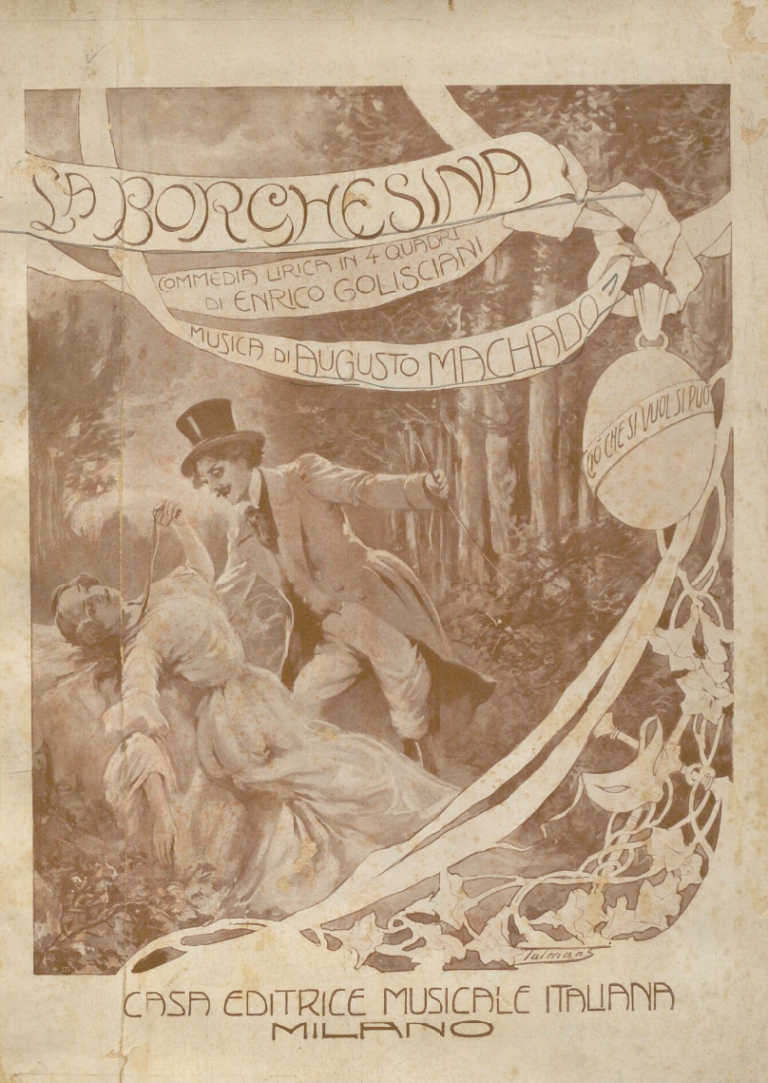
Librettist: Enrico Golisciani
Libretto was based on the novel Lion Amoureux by Frédéric Soulié
Lyric comedy in four tableaux
Date: 1909
Language: Italian
Lisa: soprano
Germana: mezzo‑soprano
Lingart: tenor
De Sterny: tenor
Tirlot: tenor
Prospero Gobillou: baritone
Laloine: bass
Flaminia: soprano
Fattorino: soprano
Amanda: mezzo‑soprano
Marinet: baritone
Domestico: bass
Chorus
The action takes place in Paris around 1830. The first Tableau begins with the wedding banquet of Prospero and Germana at the Cadran Bleu restaurant in the Faubourg Saint‑Martin, Paris. Germana and her sister Lisa are daughters of Laloine, a plumassier (feather‑maker). They represent a suburban lower‑middle‑class family. Lisa has suffered from heart problems since her mother’s death. The family awaits the visit of the Marquis de Sterny, an aristocrat of easy living and dubious morality, who, upon arriving, sits beside Lisa and tries to seduce her. She does not take him seriously. Tirlot, who is in love with Lisa, becomes irritated with De Sterny and makes offensive remarks about him. However, Lisa prefers the Marquis’s company, and the two remain alone for some time. She shows him a locket inherited from her mother, on which is written “Ciò che si vuol si può” (“Everything is possible when one truly desires”). De Sterny asks her who is the chosen one of her heart, and she replies: “Everything is possible when one truly desires,” adding “except to be loved.”
The second Tableau begins in De Sterny’s richly decorated house. The Marquis is pensive while a group of friends tries to enter his room, mocking him and insinuating that he is in love with the Borghesina or with Flaminia, a woman of easy virtue who greatly resembles Lisa. They invite him for an outing to Saint‑Germain the following day, and he accepts. After they leave, De Sterny contemplates Lisa’s locket, laments his empty life of excess, and realizes that he is in love with her. Prospero goes to his house to thank him for attending the wedding. Upon learning that Lisa, Germana and Laloine are in the carriage outside, De Sterny invites them in. They admire the luxury of the house. The Marquis offers a gift to the newlyweds and asks Lisa to choose something for herself. She chooses a simple fan, but De Sterny’s initial reaction is hesitation. Lisa thinks it is a love token and faints. De Sterny explains that the fan belonged to his mother; upon recovering, Lisa is overjoyed. However, she realises that she has involuntarily revealed her love. Tirlot enters, and Lisa tries to disguise her feelings, appearing animated by his presence and by the outing to Saint‑Germain. De Sterny grows sad and, feigning indifference, returns the locket to her. Lisa departs heartbroken, and he feels anguished and guilty for her suffering.
The third Tableau takes place in the forest of Saint‑Germain in the afternoon. While some children play blind man’s bluff, Laloine, Germana and Prospero scold Tirlot for having frightened Lisa’s horse, which was only saved thanks to the Marquis’s sudden intervention. Meanwhile, De Sterny and Lisa move away, and the family searches for them. The Marquis declares his love, but Lisa fears the difference in social status. Finally, she gives in and surrenders to his arms. Suddenly, De Sterny’s friends appear, making ironic comments. Lisa faints again. Furious, the Marquis drives them away and tries to revive her. A storm approaches. When Germana, Laloine and Prospero draw near, Lisa asks the Marquis to leave, and he departs before the others arrive. Upon seeing Lisa weakened, the tableau ends.
The final Tableau takes place at dawn in De Sterny’s house. A masquerade ball is in progress, and the Marquis is in the arms of Flaminia, who proclaims herself his official mistress. Amanda comments that he is trying to console himself with Flaminia because the Borghesina scorns him. Outside, the tolling of a funeral bell is heard. Prospero enters and announces Lisa’s agony and death. Outside, the bells continue, a Dies Irae is heard in the street, while inside the house, the party continues. An orchestra on stage plays a waltz. De Sterny weeps for Lisa’s death, and Prospero asks God to forgive him.¹
2 Fl (Picc) | Ob | Cl A | Sax A | 2 Bsn | 4 Hn | 2 Tpt A | 3 Tbn | Tb | 3 Perc | Hp | Vln | Vla | Vc | Cb
Scores: Biblioteca Nacional de Portugal
Edition by António Vassalo Lourenço
La Borghesina (The Little Bourgeois Woman) is the last opera composed by Augusto Machado. The opera is divided into four acts (called “Tableaux”) and reveals the influence of Massenet’s later compositions, especially Werther, reflecting Machado’s Francophilia. However, it is also representative of the Portuguese composer’s knowledge of and interest in Italian verismo and Puccini’s work. Some melodic characteristics associated with Puccini — such as fragmented vocal lines, the expression of intense emotion in short phrases, and the reinforcement of the voice by the orchestra — may have reached Machado both directly and indirectly, including through Massenet’s influence.²
Date: 1909
Venue: Teatro de São Carlos, Lisbon