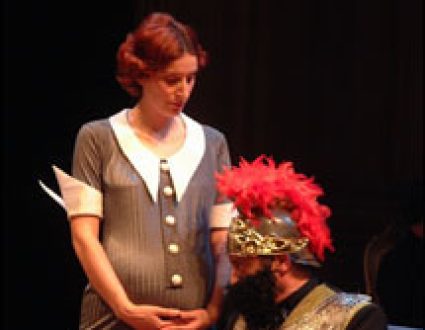
Modern version of the intermezzo musicale by G. B. Pergolesi
Librettist: G. A. Federico
Intermezzo musicale
Date: 2002
Language: Portuguese
Duration: 90 minutes
Small-scale
Serpina, the maid: soprano
Uberto, the Master: baritone
Mute Servant: actor
Serpina, the cheeky maid of Uberto. She, nevertheless, charms him, serves him slowly and haughtily and carries her audacity to the point of, first, wanting to condition her master’s outings and, later, imposing herself as his bride, which he refuses. A mute servant, Vespone, also in Uberto’s service and not even treated very well by Serpina, will be her precious accomplice in the farce that will lead the master to accept the maid in marriage: taking on the “mask” of a Captain, in a true commedia dell’arte farce, he pretends to be Serpina’s fiancé, to whom the master must give a dowry, or, if he does not, then take her for himself. Uberto’s refusal to pay is Serpina’s triumph, who goes from maid to mistress, marrying Uberto, who gladly agrees in the face of the threat of the terrible Captain Tormenta.
Fl | Ob | Cl | Perc | Vln | Vc | Cb
La Serva Padrona is, in a way, an inaugural piece of comic opera and is therefore frequently performed worldwide. Unprecedented, perhaps, is the intervention now made on this intermezzo musicale, although this is not the first time a Pergolesi score has been, so to speak, revisited by a contemporary composer, as Stravinsky had already done in Pulcinella (ballet with song in one act).
Musically, it bets on a different orchestration, with an instrumentation close to some emblematic 20th-century works, somewhere between Schönberg’s Pierrot Lunaire and Stravinsky’s The Soldier’s Tale. This instrumentation possesses qualities that can bring the music closer to sounds linked to the Baroque (flute, oboe, and strings) but also, through the use of the vibraphone and clarinet and the suppression of the harpsichord—the quintessential Baroque instrument—can immediately set it apart from that period. Modernity, however, is achieved more by the type of musical language used than by the instrumentation.
The arias and duets receive a contemporary orchestral treatment, while generally respecting Pergolesi’s score, and the recitatives are not sung but spoken. One might think of Mozart’s singspiel in The Magic Flute, where there is no accompaniment for the dialogues, but here there is original music framing the singers’ “speeches,” where the creative work goes further than in the orchestration, without ever losing sight of the starting point, obviously.
Thus, a dialogue with the Baroque work is proposed, in which it still has primacy, and it is up to the staging to sustain this dialogue and explore it to the limit of rupture without acrimoniously achieving it.
Date: 2002
Venue: Palácio Nacional da Ajuda
Commissioned: Ministry of Culture/Portuguese Institute for Arts and Performance
Stage Director: Paulo Lages
Music Director: Humberto Castanheira
Cast: Margarida Marecos, Fernando Marques Gomes and Guilherme Filipe