
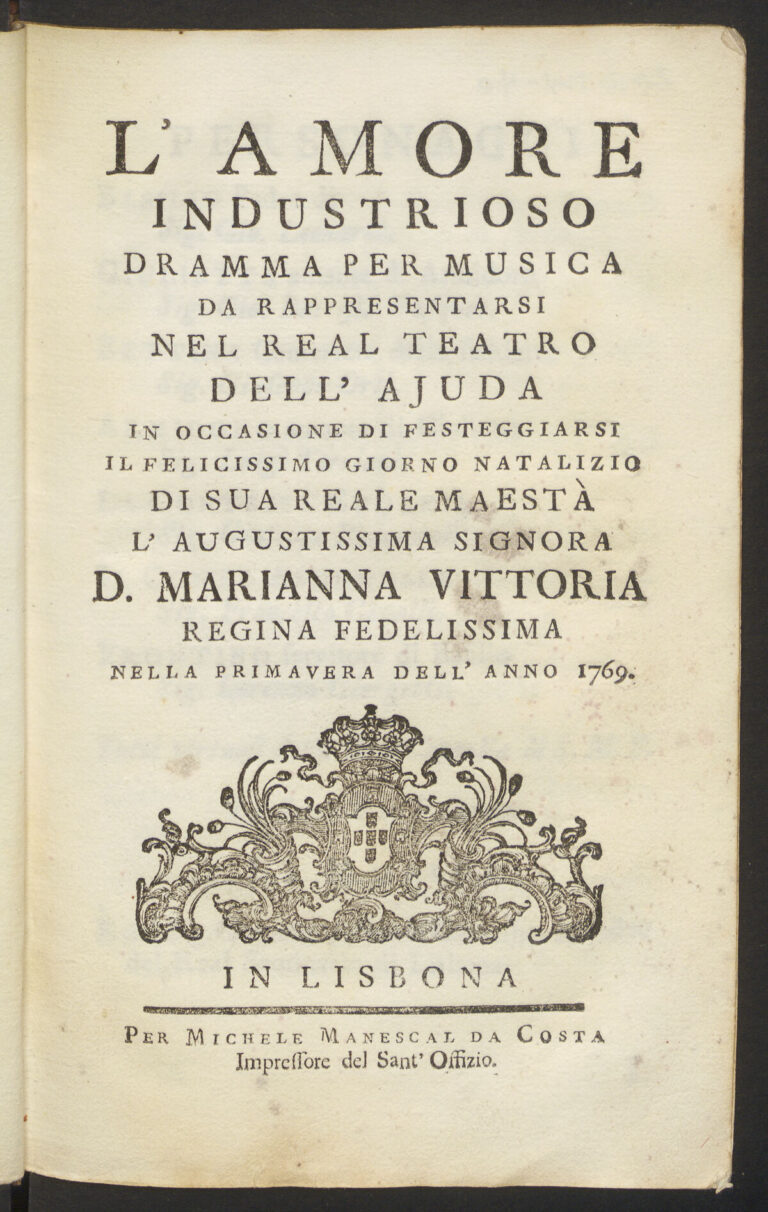
Librettist: Anonymous (attributed to Ferdinando Casorri)
Dramma giocoso in three acts
Date: 1769
Language: Italian
Small-scale
Basílio: bass
Giulietta: soprano
Bettina: soprano
Armidoro: tenor
Contessa Eugenia: soprano
Asdrubale: tenor
Frontino: tenor
Act I
Scene 1
Armidoro, Giulietta, Frontino and Bettina evoke the anxieties caused by love and the trials that lovers must undergo. Giulietta’s father, Basílio, intends to marry her to a penniless Count, Asdrubale, in order to obtain the long-desired title of nobility. Armidoro devises a plan to discredit the Count and prevent the marriage, but for this Giulietta must pretend to accept the marriage, while Armidoro disguises himself as a French secretary in Basílio’s service.
Scene 2
The Count is surrounded by his numerous creditors, who demand payment of his debts. Announcing his marriage to a wealthy heiress, the Count manages to rid himself of the creditors by promising to pay with the dowry he will soon receive.
Scene 3
The Count asks Bettina to summon Giulietta. Fulfilling her role in Armidoro’s plan, Bettina feeds the vain Count’s conceit.
Scene 4
The Count reveals his calculations. His fiancée belongs to a social class lower than his, but his desperate situation leaves him no alternative. But his fiancée is pretty and, being rich, she can settle his debts. Moreover, since Basílio shows an inclination towards his sister, perhaps a double wedding could be arranged.
Scene 5
Basílio comes to greet his future son-in-law and parades his lackeys in the refined livery he has ordered for the wedding, and proposes to marry Eugenia, the Count’s sister. The Count accepts but warns that there will be no dowry. Basílio replies that he only seeks to recover the illustrious lineage of his descendants… that is, ancestors.
Scene 6
Armidoro, presenting himself as Basílio’s French secretary, announces that Giulietta has agreed to the Count’s marriage proposal.
Scene 7
Giulietta declares her love for the Count, but in truth addresses Armidoro. Basílio announces that he, too, will marry and proposes to pay a visit to Eugenia. Not expecting the invitation to be accepted, the Count invites everyone to lunch at his house.
Scene 8
The Count is in great trouble. All the furniture in his house is at the pawnbroker’s, and he has no way to offer lunch.
Scene 9
The Count expresses his concern to the French secretary, invoking momentary difficulties that prevent him from offering lunch. Armidoro realises that he can take advantage of the situation and offers to solve the problem.
Scene 10
Armidoro reflects on the mystery of love: it makes one suffer, but we cannot do without it.
Scene 11
Eugenia laments her situation. What use are her family’s noble titles if she is forced to marry a man she despises?
Scene 12
Basílio is introduced to Eugenia, showering her with exaggerated politeness and trying to imitate a language he does not master. Eugenia has no choice but to accept marrying Basílio. When the Count reiterates the invitation to lunch, Eugenia is perplexed.
Scene 13
Armidoro announces that lunch is ready. Eugenia is impressed by the young man and can barely hide her feelings. Giulietta becomes jealous. Frontino hints to Bettina that something unexpected is about to happen.
Scene 14
Eugenia is left alone and again laments her situation. How she would like to marry the Secretary instead of Basílio.
Scene 15
Lunch begins. Everyone eats, sings and drinks. Suddenly, there is a knock at the door. Armidoro announces that it is the suppliers who want to take everything back because they have not been paid. To the Count’s despair and Basílio’s astonishment, cutlery, tablecloths, plates, and everything is taken away without any respect for such illustrious guests. The Count realises that this is Armidoro’s doing. Basílio does not know what to think.
Act 2
Scene 1
At Basílio’s house, Giulietta, Armidoro, Bettina and Frontino are again in despair. Everything returns to the beginning; Basílio reconciles with the Count. Giulietta confesses to Armidoro that she is jealous of Eugenia. Armidoro protests his fidelity. They promise each other eternal love. Armidoro promises to pay Frontino and Bettina well if they help them devise a new plan.
Scene 2
Bettina hints to Frontino that with that money, they could already marry. Frontino pretends not to understand. Bettina is disconsolate at such a lack of romance.
Scene 3
Frontino, alone, confesses that he likes the idea of having money and a wife.
Scene 4
Basílio and the Count shower each other with friendship and affection. The Count convinces Basílio that he was the victim of a trap.
Scene 5
Basílio rejoices at the idea of his marriage. Eugenia disguises her contempt, hoping to find the secretary.
Scene 6
The Count keeps the Secretary under surveillance. The Countess does so too, but for other reasons.
Scene 7
Armidoro plays his role as a charming Frenchman for Countess Eugenia. Giulietta watches them hidden.
Scene 8
Eugenia, desperately in love with Armidoro, laments that she cannot harbour any hope.
Scene 9
Giulietta, blinded by jealousy, decides to accept the Count’s courtship to punish Armidoro.
Scene 10
Giulietta and Armidoro accuse each other of infidelity. Armidoro kneels, trying to make peace.
Scene 11
Basílio and the Count arrive in time to witness the scene. They both realise that Frontino has been Armidoro’s ally. Giulietta repels Armidoro.
Scene 12
Giulietta makes peace with Armidoro.
Scene 13
Basílio and the Count arrive with armed men carrying sticks and expel Armidoro and Frontino. Armidoro vows revenge.
Scene 14
Basílio and the Count plan a musical soirée with Signor Semi-Colcheia. Bettina watches hidden and devises a new stratagem.
Scene 15
Giulietta is dying of sadness without Armidoro. Bettina advises her not to show her feelings. The arrival of the music master is announced.
Scene 16
Frontino, disguised, announces the arrival of Signor Cromático, a Bolognese music master who comes to replace Signor Semi-Colcheia, and who is none other than Armidoro in disguise.
Scene 17
While Frontino tries to keep Basílio and the Count distracted, Armidoro sings a duet with Giulietta. The Count and Basílio cannot resist showing off their singing talents. Armidoro and Frontino end up exposing themselves. Basílio expels them again. Armidoro draws two pistols and swears that Giulietta will be his. Basílio locks Giulietta and Bettina in a room.
Scene 18
Giulietta and Bettina are at the window. Armidoro and Frontino plan to abduct their beloveds. They go off in search of a ladder. Basílio and the Count observe everything and anticipate them. When Armidoro and Frontino return, they find Basílio and the Count hanging from the ladder. Under threat from Armidoro’s pistols, Basílio hands over the key to the room. Soldiers arrive to arrest the Count for his debts. The Count flees.
Act 3
Scene 1
Basílio pays the Count’s debts and maintains the plans for a double wedding, but Armidoro has more tricks up his sleeve.
Scene 2
Giulietta begs Armidoro to leave so as not to be arrested. Armidoro reassures her and promises never to leave her.
Scene 3
Basílio and the Count arrive with soldiers to arrest Armidoro. Basílio announces that he has already summoned the Notary.
Scene 4
The Count informs Eugenia that the weddings will take place that night. The Countess accepts reluctantly.
Scene 5 – Final
Armidoro enters brandishing a sword. The Count hides in fear. Frontino enters disguised as a Notary. Basílio brings the soldiers, and Armidoro hides. Frontino fills out the marriage contracts, writing Armidoro’s name instead of the Count’s. Basílio signs the contract, and Armidoro reveals himself in his true identity. Basílio ends up accepting the fait accompli and apologises to the Count, who resigns himself. Basílio marries Eugenia, and everyone is happy.
2 Fl | 2 Ob | 2 Cnt | Bsn | Tpt | Vln | Vla | Vc | Cb | Cemb
Scores: Biblioteca do Palácio Nacional da Ajuda
The opera L’amore industrioso premiered at the Royal Theatre of Ajuda on March 31, 1769, to mark the birthday of Queen Mariana Vitória, wife of King José, with an ambitious staging that involved 75 extras (many of them recruited from the palace guard soldiers). The opera was received with enthusiasm and repeated ten times in the year of its premiere¹. The work’s success was likely due to a lively and engaging libretto, full of intrigues and deceptions, disguises and caricatures of different social classes, to which, of course, the theme of love is added. The music by João de Sousa Carvalho, which also seems to have convinced the audience, represents the emergence of the style galant and is rich in concerted moments, freeing the opera’s structure from the more rigid alternation between recitative and aria.
L’amore industrioso returned to the stage in 1943 at the Teatro Nacional de São Carlos, on the occasion of the theatre’s 150th anniversary, with the score revised by Maestro Ivo Cruz. In addition to being a modern premiere, this presentation was also the first time an old Portuguese opera was revived. The opera was heard again in 1967, again at the Teatro de São Carlos, conducted by Filipe de Sousa². It returned to the stage in 1980 and, more recently, in 2001, in a production by the Opera Studio of Casa da Música in Porto³.
Date: 1769
Venue: Royal Theatre of Ajuda, Lisbon
Cast: Giovanni Leonardi, Giovanni Baptista Vasques, Giuseppe Orti, Luigi Torriani, Giuseppe Romanini, Francesco Cavalli and Lorenzo Giorgetti