
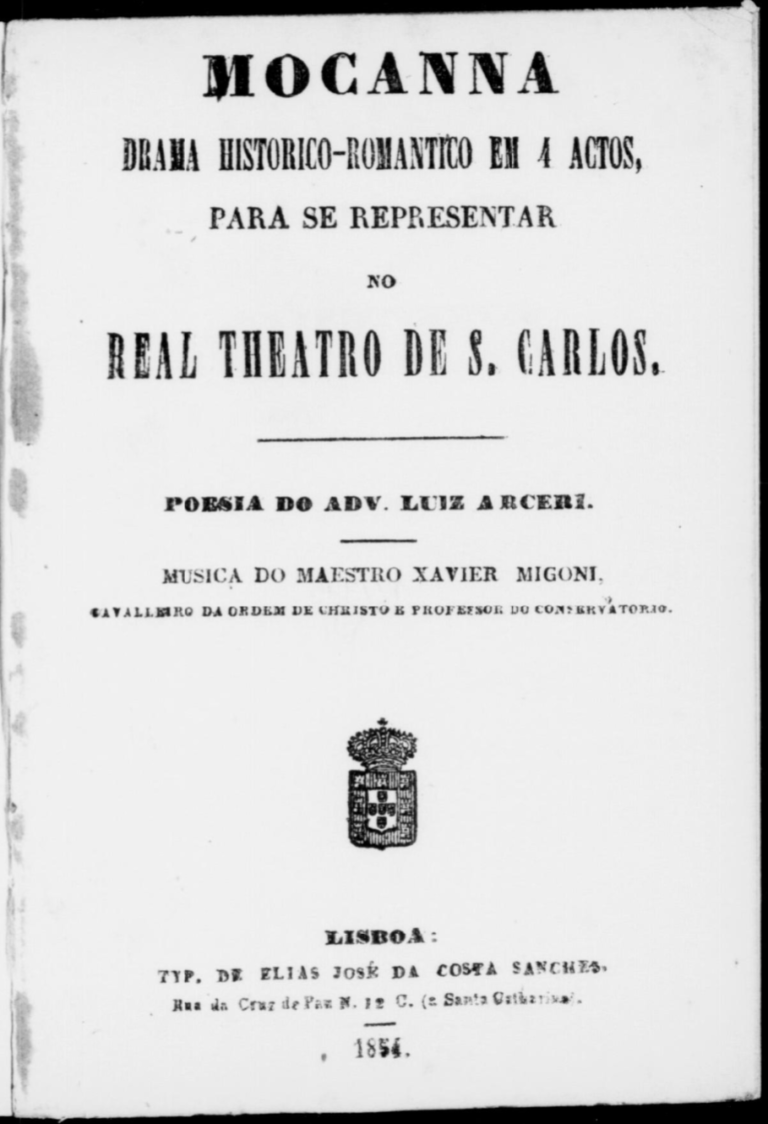
Librettist: Luigi Arceri
Libretto based on one of the episodes of Lalla Roukh by Thomas Moore
Historical-Romantic drama in four acts
Date: 1854
Language: Italian
Large-scale
Mocanna (King-Prophet of Persia): baritone
Zelica (clandestine wife of Mocanna): soprano
Azim (under the name Bethim, commander of armies): tenor
Mahdy (King of Egypt): bass
Makmud (Chief of the Guards): tenor
Chorus
The opera Mocanna tells the story of a false prophet in Persia. Mocanna, a man of extraordinary sagacity, uses physical phenomena and the art of divination to pass himself off as a prophet sent from heaven to liberate the people. By fanaticising the Persians, he manages to dethrone the legitimate king, Mahdy, who is forced to flee to Egypt. Once in power, Mocanna becomes a despot given over to vice, concealing his actions under the cloak of religion so that the people continue to worship him.
Meanwhile, Azim, a valiant warrior loyal to Mahdy, exiles himself and adopts the name Bethim, swearing vengeance against Mocanna and eternal love for his future wife, Zelica. Due to Azim’s absence, Zelica falls seriously ill and loses her reason. Mocanna, enamoured of her beauty, abducts her and restores her health. To force her to marry him, he convinces Zelica that Azim has died, assuring her that they can meet again in heaven if she agrees to become his clandestine wife. The young woman yields to the deception, marrying him surrounded by mummies and spectres.
Years later, Azim discovers that Zelica is captive in the hands of his enemy, but trusts in her fidelity. He then allies himself with Mahdy to invade Persia and punish the false prophet. To protect Zelica, Azim uses the stratagem of infiltrating the enemy ranks, offering himself to Mocanna as defender of the kingdom. The usurper, knowing the military fame of the disguised Bethim, gladly accepts him, at which point the main action of the opera begins.
The first act opens in the royal hall in Khorasan, where the people and the nobles of the kingdom exalt the power of Mocanna, the “Veiled Prophet”. The usurper announces the arrival of the undefeated general Bethim (the hero Azim in disguise), who offers to defend Persia against the Egyptian invasion. Mocanna accepts his loyalty, without suspecting that Bethim is in fact his greatest enemy, who is there to rescue his beloved Zelica and take revenge. During the festive reception for Bethim, Mocanna orders his “favourite lady” to place an honorary sash on the new general’s chest. When the lady lifts her veil, she is revealed to be Zelica. The shock of recognition is immediate: Zelica, believing Azim to be dead and living in a state of dementia and servitude, faints upon seeing him alive before her. Azim, for his part, must restrain his fury before the tyrant so as not to compromise his infiltration plan.
Over the following acts, tension mounts as Mahdy’s Egyptian troops advance. Zelica lives the torment of being bound to Mocanna by a macabre marriage, while Azim tries to organise the downfall of the false prophet from within. The plot culminates in the final confrontation between Mocanna’s religious charade and Azim’s military and moral strength, as he fights to free Zelica and restore the true king to the throne of Persia.
Orchestra
Score: Biblioteca Nacional de Portugal
Mocanna is the second opera by the composer Francisco Xavier Migoni and marks his second collaboration with Luigi Arceri, author of the libretto for Sampiero. The opera was presented at the Teatro de São Carlos on April 26, 1854, but failed to achieve the success of the composer’s first dramatic venture. Regarding the work’s reception, Ernesto Vieira adds: “The impresario was Antonio Porto […] a colleague and great friend of Migoni; this impresario had fallen out of favour with some theatregoers, and they, to cause him displeasure, slighted his friend”.¹
Date: 1854
Venue: Teatro de São Carlos, Lisbon
Cast: Ottavio Bartolini, Castellan, Miraglia, Figueiredo, Antonio Bruni and the Orchestra of the Teatro de São Carlos²