Composer: Alexandre Delgado
Librettist: Alexandre Delgado
Libretto based on the homonymous farce by Raul Brandão
Chamber opera in one act
Date: 1993
Language: Portuguese
Duration: 30 minutes
Small-scale
Civil Governor: tenor
Nunes: actor
Mr. Milhões: baritone
Aninhas: mezzo-soprano
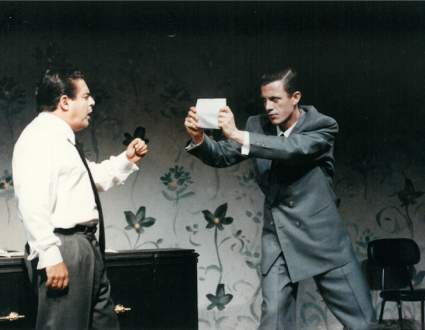
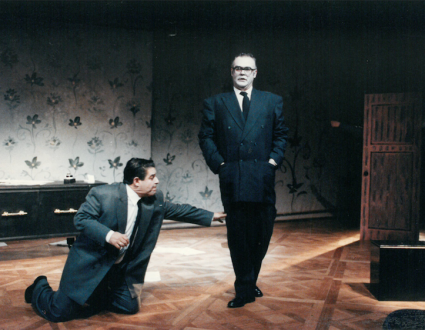
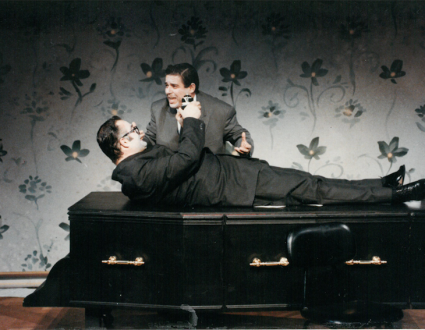
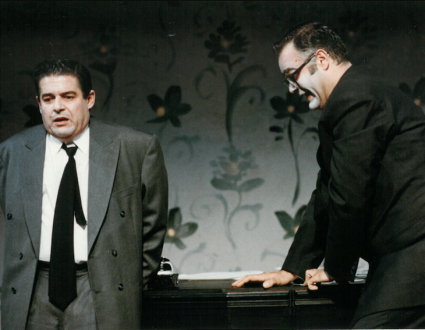
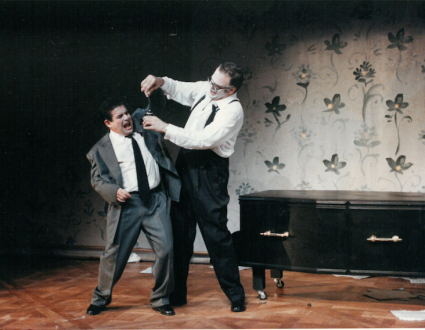
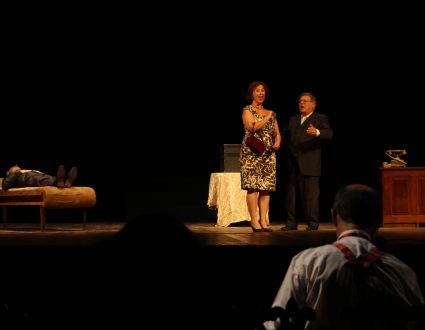
The libretto is based on the homonymous farce by Raul Brandão, premiered at the Teatro Avenida in Lisbon in 1927. In that play, madness results from an excess of lucidity in the face of the world’s injustice: Raul Brandão (1867–1930) started from a burlesque occurrence to find in it a metaphysical and tragic essence. A Civil Governor is visited by Mr. Milhões, the richest man in Portugal, who brings with him a box that he says contains the most powerful of explosives, with which he will cause a hecatomb within twenty minutes; he speaks of injustice and the absurdity of life, while the Governor is abandoned by everyone, including his wife Aninhas, being driven to the peak of humiliation and ridicule. After an outburst of desperate lucidity, Milhões is about to set off the bomb when two nurses enter and one of them shows that the box contains only cotton wool; Mr. Milhões has escaped from an asylum.
The music seeks to trigger the grain of madness contained in the text, musically exploring the phonetic peculiarities of the Portuguese language and the intonations dictated by the psychology of the characters and the situations. With three singers and nine instruments, this opera has an instrumental prologue that represents “the chaos of the world” and presents the four basic themes of the work, later explored in eight variations of different durations, and frantically revisited in the epilogue. Each variation opposes two groups of instruments, always different, in a trajectory of thesis, antithesis and synthesis. The Governor’s growing nervousness at the imminence of the explosion of “nitrogen peroxide” translates into a gradual accelerando that only recedes in the two slow moments when Mr. Milhões reveals what is truly in his soul, reaching the paroxysm of speed in the epilogue, when the bomb is about to explode.
In the Prologue (the “chaos of the world”), the wind quartet (alto flute, clarinet, bass clarinet and contrabassoon) opposes the string quartet (violin, viola, cello and double bass). Each instrument enters the scene with a particular type of obsession, the initial theme, presented by the solo clarinet, being the main theme from which all others derive. When the eight instruments are heard simultaneously, the clarinet makes everyone fall silent and leads to the 1st Variation.
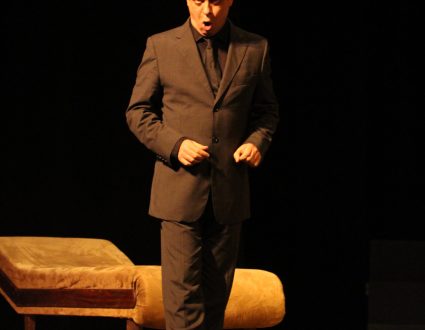
The Governor (tenor) is in his office, composing an opera (in which he plagiarises Verdi’s Il Trovatore). He gives instructions to Nunes (a policeman) not to be interrupted. Strings and winds alternate in increasingly synthetic phrases. When the Governor is interrupted by Nunes, he reacts with fury and the two instrumental groups overlap, generating sonic chaos.
Upon hearing the name Mr. Milhões, the music is cut by an ascending glissando on the harpsichord, the first intervention of this instrument, which does not belong to either of the previous groups and represents the wisdom of another world, the world of Mr. Milhões.
The 2nd Variation takes place to the sound of a harpsichord perpetuum mobile, to which the other instruments gradually join, except the double bass. The Governor complains of being an unappreciated genius in a country that is “a jungle”. When he realises that the visitor comes recommended by a letter from the Prime Minister, he orders Nunes to show him in and exults in a waltz-like ending.
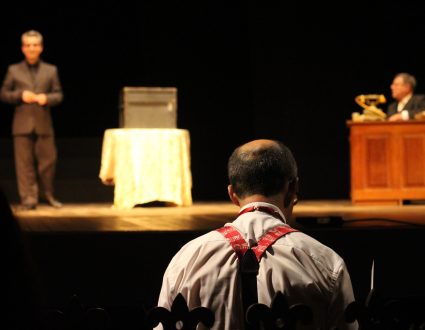
The double bass pizzicatos are associated with the entrance of Mr. Milhões (baritone), initiating the 3rd Variation. In a jazz-like atmosphere, the cello later joins them. Mr. Milhões enters, accompanied by his box, and makes a connection with an electric wire to the bell on the Governor’s table. The flute and clarinet punctuate his explanations about nitrogen peroxide and the impending explosion. As the Governor becomes nervous, the two groups mix and Mr. Milhões’ relaxed phrases contrast with the Governor’s stammering as he tries to call Nunes. The policeman’s entrance coincides with a frantic coda: the Governor whispers to him what is happening and tells him the phrase that will serve as a signal for Nunes and the other policemen to come and seize Mr. Milhões (“Don’t you hear music playing upstairs?”). The policeman withdraws, his eyes wide. Mr. Milhões says he is “king, emperor, God”, but the Governor stops him, telling him that he still hasn’t explained himself.
In the slow 4th Variation, Mr. Milhões is accompanied by harpsichord and bass clarinet. He tells how he came to see the world “not as everyone sees it, but as it really is”. The Governor keeps saying the phrase he agreed with Nunes, without success. Impatiently, Mr. Milhões orders him to be quiet. Peering through the door, the Governor finds that everyone has fled the building. Mr. Milhões says that by blowing up the globe, he suppresses the screams, the injustices, he suppresses death.
The 5th Variation synthesises the Governor’s grotesqueness: contrabassoon, flute and double bass accompany his defence of order, law and institutions. At the opposite extreme, violin, viola and cello, floating, accompany Mr. Milhões’s vision of what Art is, of what it is “to be pulverised, to travel in the clouds”. At the end, the instruments associated with the Governor are “pulverised”.
The abrupt entrance of the Governor’s wife, Aninhas (mezzo-soprano), initiates the lively 6th Variation, whose initial section opposes the cello and double bass against the clarinet and bass clarinet. Astonished to see the building deserted, she asks her husband for the chequebook. The Governor whispers to her what is happening, but Aninhas is incredulous and then tries to flee. Her husband stops her, reminding her that she always said that when he died, she would die too. In an arioso to the sound of pizzicatos and bassoon, Aninhas declares that she never told him she would die like the women of India, on a pyre; her religion is Catholic. A dialogue between the three singers follows, in which all the instruments and ideas of the variation are mixed, a Rossinian finale that ends with Aninhas running off calling for a taxi.
The 7th Variation opens with a huge silence: the characters no longer sing, they only speak; the Governor’s world has been shattered. Three slices of music punctuate the dialogue: harmonic glissandi imitating seagulls over a deserted Lisbon, sul ponticello chromaticism suggesting the Governor’s anger, vocal noises that sound out Mr. Milhões’ explanation that “all the men who did anything in the world were mad.” When the Governor asks him, “But who are you, you supreme scoundrel?”, he stands up, proud and transfigured: “I am the Madman! I am Death!”
A descending chromatic glissando on the harpsichord leads to a unison of the entire orchestra, the first unison since the beginning of the opera. The nine instruments are finally brought together in the crucial 8th Variation, in which Mr. Milhões speaks deadly seriously. Time stands still during his visionary monologue. “I am going to suppress life, because life frightens me.”
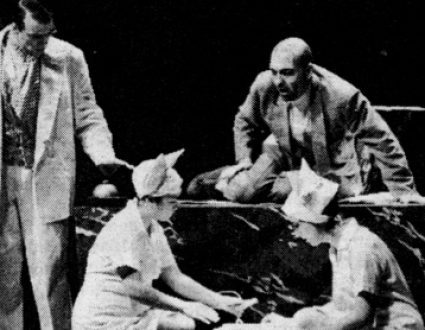
In the frenetic Epilogue, we return to the burlesque register: all the themes of the opera are revisited and superimposed at an unbridled, mechanical speed. The Governor refuses to die, but asks for a confessor. He says he needs to go to the bathroom; the other tells him to do it in the next world. When Mr. Milhões rings the bell, everything collapses: an ambulance is heard (imitated by the violin) and two nurses enter, coming to take Mr. Milhões away. One of them opens the box, showing that it contains cotton wool. Mr. Milhões withdraws, after bowing with his shiny hat. Alone again, the Governor says the phrase that caused a scandal at the time: “Oh, the great son of a bitch!”
Cfl | Cl | Bcl | Cbsn | Vln | Vla | Vc | Cb | Cemb
Publisher: Ava Musical Editions
Alexandre Delgado’s first opera, O Doido e a Morte was commissioned by Lisboa 94 – European Capital of Culture, composed between July and December 1993 and premiered on 9 November 1994 in the Salão Nobre of the Teatro Nacional de São Carlos. Acclaimed by audiences and critics, it has accumulated ten productions since 1994 and has also been staged in Germany and Brazil.
Date: November 1994
Venue: Salão Nobre, Teatro Nacional de São Carlos, Lisbon
Commission: Lisboa 94 – European Capital of Culture
Stage Direction: Pedro Wilson
Music direction: Alexandre Delgado
Cast: Carlos Guilherme, António Wagner Diniz, Ana-Ester Neves, Carlos Gomes, Iwona Saiote, António Saiote, Luís Carvalho, Hughes Kesteman, Ana Mafalda de Castro, Zofia Wocjcicka, Richard Wocjcicka, José Augusto Pereira and Adriano Aguiar.