
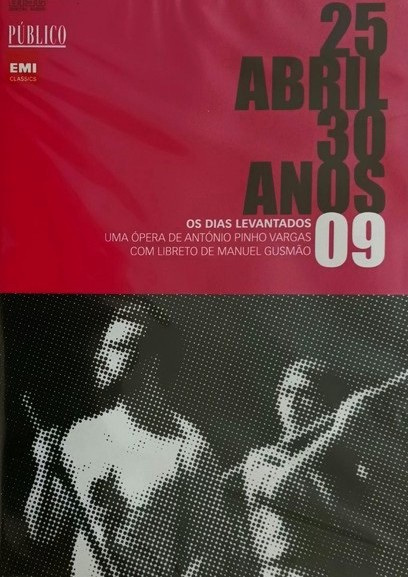
Os dias levantados

The Uprising Days
1998-2001

Description

Librettist: Manuel Gusmão
Opera
Date: 1998
Language: Portuguese
Duration: 105 minutes
Large-scale

Characters

Soprano
Soprano
Soprano
Countertenor
Tenor
Tenor
Baritone
Baritone
Chorus

Synopsis

Prologue: “Conversation of Spectres about the Living”
The imaginary action takes place in Port-Bou, 26 and 27 November 1940, between The Angel of History (Paul Klee; W Benjamin), the Peasant Angel (Carlos de Oliveira) and Walter Benjamin around notions of time and revolution as treated in his Theses on the Philosophy of History. This prologue exposes the concepts and theoretical elements that presided over the elaboration of Manuel Gusmão’s libretto.

Act I – “The Tiger’s Leap in the Open Sky”

  1. Statue of Silence
    In the police dungeons, two torturers interrogate the prisoner forced to stand.
  2. The Four Soldiers: “What Shall We Do with This Sword?”
    After a choral introduction with texts referring to a massacre in the colonial war in Mozambique. The four soldiers express their doubts about the colonial war and its non-reason for being. The scene Statue of Silence continues between the two torturers and now two political prisoners. One of them says the other’s name and immediately denies it. The beatings continue. The continuation of the scene The Four Soldiers in Mozambique is intercut, in which one of them enunciates for the first time the fascist regime as a “knot to be cut”.
  3. The Lifted Days
    After some clandestine preparations between two men, the Chorus sings a set of poetic figurations by various authors around what is to follow: “the tiger jumps the river of time”.

Act II: “The Lifted Days: ‘the time is out of joint’”

  1. The Four Soldiers: “What Shall I Do with This Sword?”
    This scene depicts the day of 25 April itself, interweaving episodes between soldiers of the Movement and their opponents of the regime, in which an officer gives the order to shoot at the rebels, but they disobey, descending in the chain of command, while the chorus (with Fernão Lopes’ text) describes the progressive gathering of the crowd until it ends in a triumphant chorale: “the people began to gather and there were so many that it was a strange thing to see, etc.”

2a. The time is out of joint
The Peasant Angel celebrates “the initial day whole and clean” (by Sophia de Mello Breyner). Sudden interruption, in the stage and in time: four voices on a balcony of the future criticise the unfolding of events in the direction of a utopia as having been “mistakes and more mistakes”.
The scene returns in which the Chorus still celebrates: “This is the sound and the fury of meaning”.
The Angel of History (“I remained looking”) prepares the Chorale in which diverse reactions of the population are superimposed, of enthusiasm (“time has finally gone off its hinges”), of perplexity (“in my time it was not like this”), and of opposition (“this is a time of disgrace”).

  1. The Three Sisters: They Light the Fire
    The three women in their chores express their points of view and expectations regarding the events or previous life, while the madrigal chorus is intercut with verses by Maria Velho da Costa on the situation of women before and after the 25th of April.

2b. The time is out of joint
Choir A, B and C and some soloists successively enunciate positions of hope (A: “and a wave flies over the sea and the moon”), doubts (B: “in my time it was not like this”) or (C) of clear negative reaction to the end of the old regime and the evolution of the political situation (“this is a time of disgrace”).

3b. The three sisters: They light the fire
The 3 sisters sing in a duo the solo (“I want the lights/I want the free friend”). In a final aside, 3 soldiers talk among themselves about the previous battles and their memories (“those who died are missing”).

Act III: “To Take the Word Write the Time”

  1. On the Ground of History
    The Peasant Angel takes the floor with the starting point that opened “we have arrived at the theatre of the world” and all the expectations that were created (“it was a shimmering scene”).
    On the ground of history he refers to the land and the fields. In this scene, almost always in sprechgesang, several workers speak of their past and their present; there is a discussion between them and a landowner who counters this perspective based on the natural character of property. In relation to the peasants of the north, the landowner warns, “they will steal your lands”, and enunciates for the first time the slogan that will mark this third act: “Power has fallen into the street”
  1. The Walking Houses
    In this second scene the residents discuss among themselves the difference between the street and the houses and proceed to occupy them. Here, a man says: “You are taking advantage. You are throwing the houses into the street.” He refers to the Constitution, where “a civil construction” is being written.
  1. Threshold Citizenship
    At the door of a factory, a group of workers contest the closure of the factory by the boss (“We cannot accept”). Between the boss (“he wants to take the machines”) and the workers (who defend the right to work) an exchange of arguments will take place which in this scene reaches the point of the most serious confrontation between the boss (“you want to go beyond your tasks” and “disorder is a disaster”) and the workers who protest in various ways (“it is not only us that you rob”) in the face of the lock-out. The boss argues: “if you do not let me create wealth, hunger will tighten the siege”. The scene continues (“have you seen that he flees?”) with the occupation of the factory and at the end two women who at extreme points of the stage simultaneously make opposite descriptions: between the “marvel to see” of the taking possession of the goods by the people (Fernão Lopes) and, on the contrary, “it was all horror it was all confusion […] the people disposed and executed” (Manuel Severim de Faria).
  1. Power Cannot Fall into the Street
    The division among the population increases and confrontations occur. The Chorus threatens: “We will warm up their summer”. The Angel of History describes: “I see the stones, I see the fire in that house / I hear shots, I hear the explosions”; while the chorus takes up these words (“shots, shots, stones, stones”), the three Sisters leave the chorus and sing: “How difficult freedom is!” At the end the Chorus says in sprechgesang: “You were asking for it”.

Act IV – “Il combattimento”

  1. The Four Soldiers: The Disagreement
    The four soldiers discuss their increasingly extreme divergences until a moderate soldier states: “We want to save the revolution”. The most extreme argues: “power cannot be in the street, you are all to blame, the evil was that you started; but I support you”, creating a more radical split between the two groups. The Angel of History sings: “Could this not have been the frontier, could it? […]”, and announces the imminent combat (“What I see blinds and yet I see”).
  1. Il Combattimento
    “Behind a curtain, shadows mime a combat without the adversaries touching each other”. This was the explicit indication of Manuel Gusmão for “Il Combattimento”. The form chosen for the political-military disagreement was a description based on Sophocles’ Ajax between the Angel of History (AH) and the Peasant Angel (PA). AH: “Ajax must not leave his tent today”. PA: “Ajax has already left. There is no remedy.”. The dialogue of Sophocles’ tragedy ends already with injunctions from the author: “Now will Lisbon return to the minor mode of destined destiny? Where will this story end?”. The music makes a transition to the music of the fourth Soldier who sings: “Now it’s time to clean up that rubbish/this disease that has caught on”. The second Soldier, moderate, replies: “No! Enough!”. To which the fourth says: “We’ll see about that”. A transition of motifs/melodies (derived from the prologue) in oboe, bassoon and cello until the beginning of the following tutti.
  1. The Song of Normalisation
    In this final section there is no action. Only the various songs are superimposed in a tutti of large dimensions. Choruses A and B sing in frequent superimposition the very diverse reactions to the outcome of the revolution in liberal democracy. Chorus A: “Now it’s over. Time is getting back on track”. Chorus B: “It’s not over. There are more things to write”. Throughout this section all the discourses, all the voices of the process of 25 April, seen as long and wide, are heard. Overlapping the choruses, the three sisters sing. The first: “The sun is great, the birds fall with calm” (Sá de Miranda). The second: “On what wings dare he aspire?” (W Blake). The third: “In what distance deeps or skies burnt the fire of thine eyes?” (W. Blake). In the central section the Angel of History sings: “How will you approach the music? What will you do with the river of April? Open it, in the gleams”. In the final repetition, there is also a fragment of the text of Chorus A, with a voice not yet heard: “There life was warmer. The sun died burning in red and purple”; and at the end the two Choruses sing together: “No one can close the open sky”. The Angel of History says the final text:

“No one will erase the honest gesture
broken and fragile,
of those we love without remedy and without
asking forgiveness that is not theirs.”

Instruments

2 Fl | 2 Ob | 3 Cl | 2 Bsn | 2 Hn | 2 Tpt | 2 Tbn | 3 Perc | Pf | Vln | Vla | Vc | Cb

Publisher: Ava Musical Editions

About the opera

Here, the challenge was to compose an opera about recent events with which one maintains a strong emotional relationship and memory. I immediately thought of Jorge Luis Borges’s map story: a map to correspond as accurately as possible to the surface it intends to portray would have to be the size of the world. But perhaps because I had some training in that field, I knew that any history book is only a provisional description, it selects and excludes, operating in some way a reduction of events. The lived experience is unrepeatable.

The selection and exclusion options were almost always decided by the two of us, Manuel Gusmão and me, and later also with Lukas Hemleb. I wanted to work on a text that did not include recognisable historical figures. The events were collective and I believe that paradoxically non-recognition can become a much deeper recognition. On the other hand, the 25th of April [1974 Carnation Revolution] was important for many people in many different ways. I would like their diverse voices to be heard in the piece. But as Deleuze says, “one does not compose with memory but with fabulation. One does not write with childhood memories but by means of childhood blocks which are the becoming-child of the present.” The text by Manuel Gusmão, plurivocal, with a structure in tableaux that is dear to me, and above all, of extraordinary literary quality, was my happy starting point.

For this work, my way of working has not changed in essence. The tableau structure of the text favoured the fragmented work that is my tendency, closer to the paradigms of Monteverdi than of Wagner, of Ligeti than of Stockhausen, etc. Parallel to the different registers of writing in the text, I used some basic rhythmic archetypes: ostinato, tango, recitative, passacaglia, song, walking bass, march, etc. In some cases, more or less explicitly referring to the work of composers I admire (Ligeti, Adams, Schoenberg) and whose techniques I have already used in other pieces.

But here, faced with the immensity of the task, (before starting, all tasks seem immense, but this one more than the others…) I found myself using the omnipresent numbers 25-4-74, and from there I deduced the most diverse microstructures: metrics, privileged intervals, especially the major second and the perfect fifth, rhythms, etc. and, in the same mystical way, the notes A, B and D (‘ré’) (the first three letters of ‘Abril’ in Portuguese) as the main polar notes. This basic musical tool, to which I attach no special importance, allowed me to use my favourite fragmented method, as in the Nine Songs of António Ramos Rosa or Édipo – tragédia do saber, with the other, which derives all the material of a piece from a central nucleus – Monodia or Three Panels for Almada.

After several years of doubts and perplexities, I think I have realised that the essence of my music lies in its impurity. When I work in any general stylistic framework that can be defined as “jazz” or “contemporary music”, my music, sometimes apparently against my will, always orients itself towards the “impure” element, infection by the most diverse viruses, contagion by the most diverse diseases. Stylistic purity is completely foreign to me. When I play or when I write, my music always demands other things. It is not even worth thinking that this is a fundamental trait of this time. I don’t know how to do it any other way. But it is perhaps for this reason that, even though it sometimes triggers violent rejections, my work has interested people and I have been lucky enough to always be able to pursue it.

The 25th of April was illegal, undisciplined, incoherent, unjust, insufficient, sometimes ridiculous, but wonderful and unforgettable. I would like my piece, which certainly has all those defects, to have some trace of these qualities.

Premiere

Date: 1998
Venue: Teatro Nacional de São Carlos, Lisbon
Commission: Expo 98 – Lisbon World Exposition
Stage Director: Lukas Hemleb
Music Director: João Paulo Santos
Cast: Ana Ester Neves, Ana Paula Russo, Elvira Ferreira, Nicolau Domingues, Carlos Guilherme, Paulo Ferreira, Jorge Vaz de Carvalho, Luís Rodrigues, Orquestra Sinfónica Portuguesa and Teatro Nacional de São Carlos’ Chorus
Galeria