
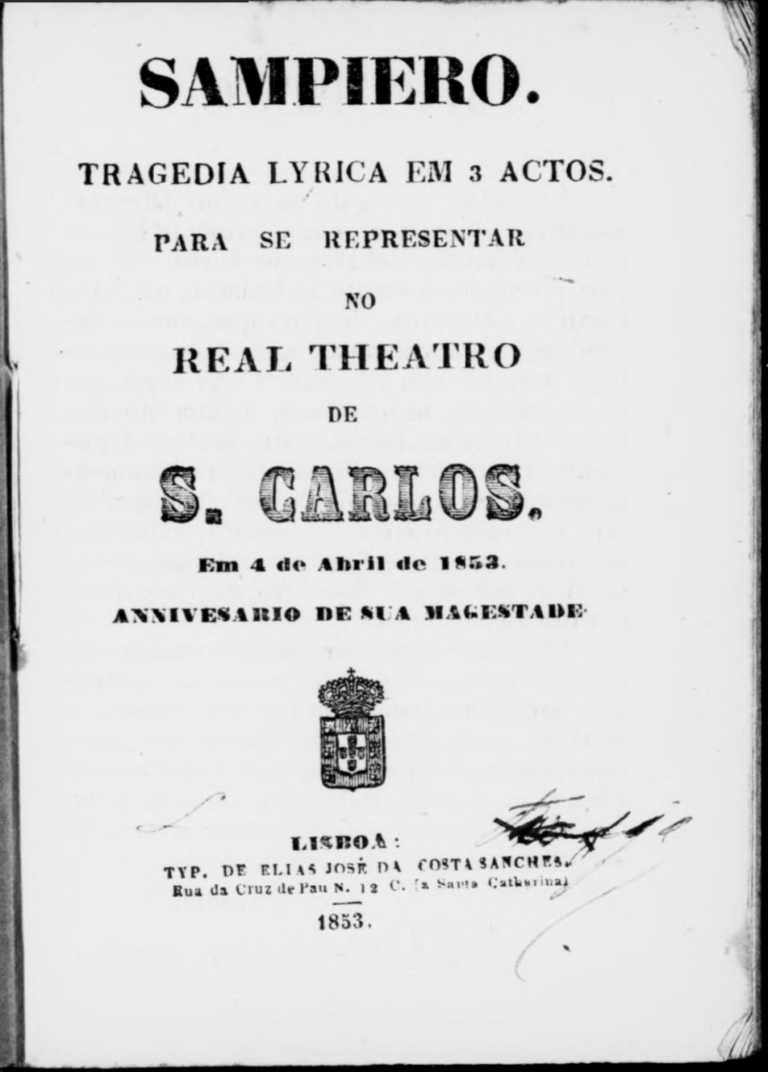
Librettist: Luigi Arceri
Lyric Tragedy in three acts
Date: 1853
Language: Italian
Large-scale
Sampiero: baritone
Vannina d’Ornano: soprano
Antonio di San Fiorenzo: bass-baritone
Vivaldi: tenor
Irene: soprano
Rodolfo: tenor
Chorus
“Tired of Genoese domination, the inhabitants of Corsica, led by Sampiero, expelled them from their homeland. However, the Genoese returned to besiege the island, forcing Sampiero to leave in search of aid abroad, leaving the government in the hands of his wife, Vannina, assisted by a regent (Antonio di San Fiorenzo). Genoa took advantage of this situation to reconquer the island, bribing the regent and sending as captain of its fleet a certain Vivaldi, who was in love with Vannina and an enemy of Sampiero. The drama begins in the year 1564.
In the Council Chamber, ladies and gentlemen comment on the peace agreement with Genoa that is to be celebrated and on Sampiero’s probable reaction when he learns of it. Antonio and Vivaldi enter in succession: the former announces that Vannina has agreed to sign the agreement and remarks to himself that he hopes to have everything concluded before Sampiero’s arrival. Upon entering, Vannina is confronted with the fact that, besides having to cede power, she must go into exile. Despite her reluctance to accept such conditions without consulting Sampiero and under pressure, she ends up signing.
In a square by the sea, soldiers and the people rush to the beach to witness Sampiero’s arrival. Upon disembarking, he is informed by Rodolfo of the signing of the treaty and of his wife’s supposed betrayal. In a room in the castle, she, distressed and without her royal garments, meets with Sampiero and tries to explain what happened, but her husband accuses her of political and conjugal betrayal. Upon leaving, Sampiero and his men encounter Vivaldi. He tries to make them accept the peace terms and explain Vannina’s innocence, but the Corsicans will not listen to him. A scene of tumult follows, in which everyone invokes their motives: Sampiero tries to expel Vivaldi while the latter intends to stay by Vannina’s side, who, feeling abandoned, senses death.
In her study, Vannina is calmed by Irene: the lady-in-waiting makes her notice that there are still those who support her, referring to Vivaldi, but Vannina explains that such protection will only make her feel more guilty. Meanwhile, Vivaldi enters, disguised, and tries to convince Vannina to flee, but Sampiero appears. The two men exchange accusations and are about to duel when Vannina separates them. By moonlight, in a dark forest with various hiding places, a group of conspirators appears. In the midst of the storm that has meanwhile arisen, Antonio enters, is received enthusiastically and announces the moment of vengeance. An oath of the conspirators follows. Sensing death approaching, Vannina asks God to make her husband believe that she was always faithful to him. Then she bids farewell to Irene and the other ladies. Sampiero enters wrapped in a cloak and tells her that he is determined to wash his honour with his own hands. His wife says she is ready, but he cannot bring himself to stab her. Meanwhile, tumult is heard and Rodolfo appears to inform Sampiero that he must flee, as the conspirators have already taken the castle. Sampiero still wants to kill Vannina but Rodolfo stops him, relating that Antonio, before dying in one of the riots, had exonerated her of any guilt. Desperate and seeing himself unable to escape, Sampiero stabs himself. The conspirators enter in his last moments of life, while Sampiero asks Vannina for forgiveness and she dies of grief.”¹
Orchestra
Score: Biblioteca Nacional de Portugal
The opera Sampiero is the result of the collaboration between the composer and pianist Francisco Xavier Migoni and the lawyer and librettist based in Portugal, Luigi Arceri. Arceri wrote a libretto inspired by the history of Corsica and based on another text, Vannina d’Ornano.² Migoni would have finished the composition between 1848 and 1849, but had great difficulty seeing the work staged at São Carlos – throughout the 1840s, several Portuguese composers did not have the opportunity to present their dramatic works.³ The presentation finally took place on April 4, 1853, at a time when the Count of Farrobo, then Inspector General of Theatres, added a new clause to the adjudication contracts for the company at São Carlos that “referred to the possibility of staging ‘an opera by a national author should one exist’”.⁴ As a result of this investment in opera production by Portuguese composers, Sampiero became one of the operas with the highest number of performances of that era and did not disappoint its audience. In reaction to Migoni’s work, António Pedro Lopes de Mendonça wrote in the newspaper Revolução de Setembro that “the harmonic effects are sought with careful rapture, and the ensemble passages are in no way inferior to those produced by his model (Verdi) in the most cherished operas of his repertoire”.⁵
Date: 1853
Venue: Teatro de São Carlos, Lisbon
Cast: Ottavio Bartolini, Rossi Caccia, Franz Maria Dalle Aste, Antonio Prudenza, Regina Perzoli, Antonio Bruni and the Orchestra of the Teatro de São Carlos⁶