
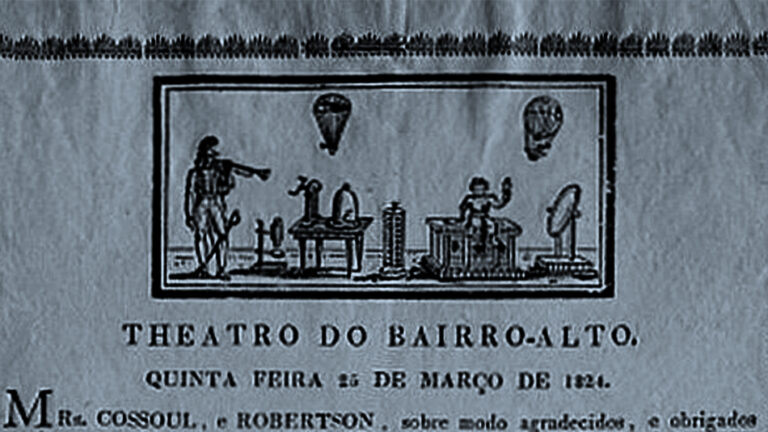
In the 18th century existed two Lisbon theatres designated as Teatro do Bairro Alto. The first, located at an unspecified site in the Bairro Alto district, was also known as the “Casa de bonecos” (House of Puppets), since the actors were not human but cork-and-wire marionettes. Its activity is limited to the years 1733 to 1742, when the eight “Portuguese operas” were performed, with texts by António José da Silva (“O Judeu”) and music by António Teixeira, as well as by other authors who followed the same model: tragicomedies with music, close to Spanish zarzuelas of this period in dramatic terms, featuring arias, duets and ensembles in the Italian style and sung minuets (as in zarzuelas).1 In 1742, with the prohibition of theatrical activity by order of King John V, the Casa de Bonecos closed its doors, being destroyed in the 1755 earthquake.
The second Teatro do Bairro Alto, also known as the Teatro do Conde de Soure (Count of Soure’s Theatre), as it was located in the courtyard of his palace, although in operation from 1761 to 1775,2 staged operas only between 1765 and 1771.3 It was during these years that the Setúbal-born sisters Cecília Rosa, Isabel Ifigénia and Luísa de Aguiar sang – the latter marrying the orchestra’s concertmaster, Francesco Saverio Todi, later travelling throughout Europe as Luísa Todi.4 Among the operas performed at this theatre were works by Perez, Latilla, Scolari and Piccinni. The Teatro da Rua dos Condes also staged operas during these years, and with the creation of the Sociedade para a Subsistência dos Theatros Publicos de Lisboa (Society for the Subsistence of the Public Theatres of Lisbon) in 1771, its regulations granted the Rua dos Condes exclusive rights to staging Italian opera, while the Bairro Alto was restricted to theatre in the Portuguese language.