
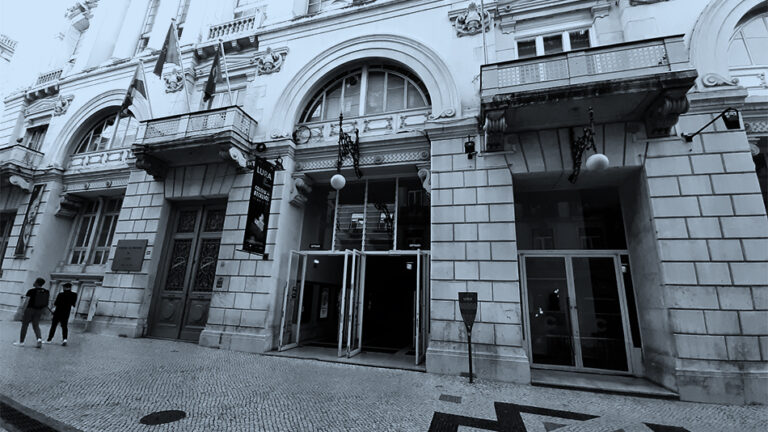
The construction of the Coliseu dos Recreios, a large performance venue located on Rua das Portas de Santo Antão in Lisbon, was initiated in 1887 by a consortium of entrepreneurs. The architectural project by Francis Goulard envisaged an octagonal hall designed to accommodate a wide range of performances, with a capacity of around 6,000 seats, and it was inaugurated on 14 August 1890 with the comic opera Boccaccio.¹
In 1897, the management of the institution was taken over by the impresario António Santos, who would later, in 1919, form a partnership with João Pires Correia and Ricardo Covões. He became a prominent figure in Lisbon’s cultural life through his role at the Coliseu until his death in 1951, after which its management passed to his descendants.²
Between 1890 and 1910, the Coliseu dos Recreios—accessible at relatively low prices, which gave it a dimension of “mass culture”—presented a wide variety of performances, ranging from musical theatre, concerts, and cinema to circus shows, sporting events, and even political rallies. In the operatic field, the repertoire focused on the most popular examples of nineteenth-century Italian and French opera, as well as operetta and zarzuela. During the Republican period, the venue even established itself as an alternative to the Teatro de São Carlos.³
In the 1960s, with the support of the F.N.A.T. (Federação Nacional para a Alegria no Trabalho), under the Ministry of Corporations, “popular seasons” of opera were introduced at the Coliseu dos Recreios, in line with a strategy of so-called “mass education”. During that decade and the following one, performances organised in partnership with the Teatro Nacional de São Carlos offered audiences the opportunity to engage with canonical repertoire and renowned soloists at accessible prices.⁴
After the 25 April 1974 Revolution, in addition to its long-established programming lines (musical theatre, concerts, traditional Portuguese music, and fado), the Coliseu dos Recreios also gave significant space to leading figures of Brazilian popular music, French chanson performers, and new names in Portuguese popular music, rock, and pop-rock, as well as singers from former Portuguese colonies.⁵