
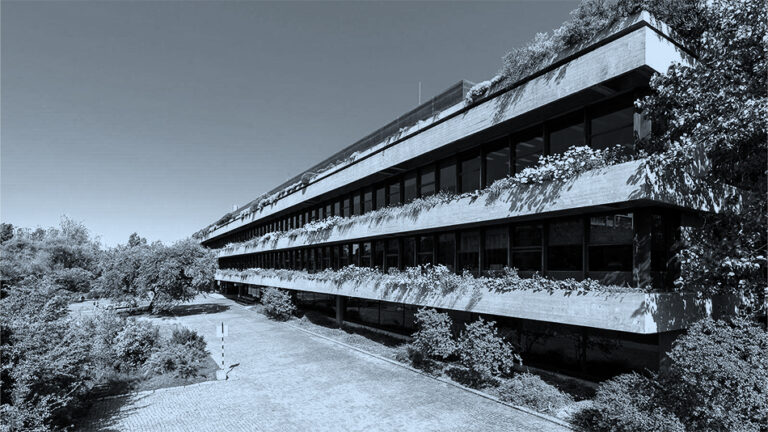
Based in Lisbon, the Calouste Gulbenkian Foundation is an institution devoted to charitable, artistic, scientific, and educational purposes, established on 18 July 1956 through the will of the Armenian millionaire Calouste Sarkis Gulbenkian (1869–1955), who had settled in the Portuguese capital in 1942. After several years in temporary premises, the headquarters building and the Gulbenkian Museum (which houses the testator’s exceptionally rich art collection) were inaugurated in 1969, designed by the architects Ruy Athouguia, Pedro Cid, and Alberto Pessoa, with landscape architecture by Gonçalo Ribeiro Teles (following an initial design by Caldeira Cabral).¹
The new institution quickly came to exert a decisive influence, at multiple levels, on Portuguese musical life through a wide range of initiatives promoted by its Music Department, driven by its first director, Madalena de Azeredo Perdigão (appointed in February 1958). Among these were: the organisation of the Gulbenkian Music Festivals between 1957 and 1970, which were subsequently replaced by regular concert seasons in the Foundation’s auditoriums; the creation of its own professional orchestra in 1962, initially named the Gulbenkian Chamber Orchestra and, from 1971 onwards, the Gulbenkian Orchestra, expanded to symphonic scale; and the establishment of a semi-professional choir—the Gulbenkian Choir—in 1964, as well as, in the following year, a dance company, later known from 1976 as the Gulbenkian Ballet.²
During this period, between 1961 and 1963, the Music Department also sponsored, as an external project, an Experimental Chamber Opera Group directed by Filipe de Sousa and composed of Portuguese performers. In its brief existence, it explored repertoire from both the eighteenth and twentieth centuries, including works by Domenico Cimarosa, Wolfgang Amadeus Mozart, Giovanni Battista Pergolesi, as well as Ferruccio Busoni, Jean Françaix, Gian Carlo Menotti, and Igor Stravinsky. Although innovative in the Portuguese context, the initiative met with a lukewarm reception from the general public, leading the Music Department to withdraw its support and redirect it to the newly created Portuguese Opera Company at the Teatro da Trindade.³
Other notable initiatives included the Gulbenkian Encounters for Contemporary Music (from 1977), the Early Music Days (from 1980), and the Great World Orchestras cycle (from 1988), alongside a wide range of additional programmes (support for the expansion of music education, scholarships in Portugal and abroad, masterclasses, support for musicological research and publishing, and commissions to composers), as well as ACARTE (created in June 1984). Altogether, these initiatives contributed decisively to the development of Portuguese musical life and enabled Lisbon to integrate into the principal international circuits of classical music.⁴