
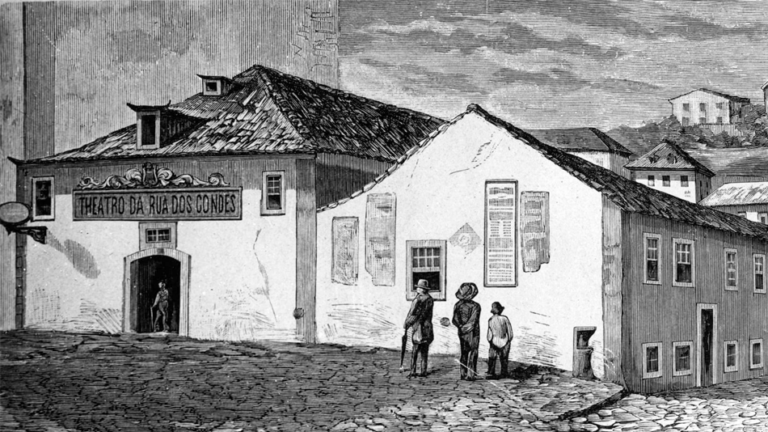
The Teatro da Rua dos Condes, whose name derived from its location on land formerly owned by the Counts of Ericeira, was built in 1738 and, from the outset, hosted the operatic activity that had been developed since 1735 at the Academia da Trindade, on the initiative of Alessandro Paghetti, a violinist of the Royal Chapel.1 As in that earlier venue, performances consisted exclusively of Italian opera seria, sometimes accompanied by comic intermezzi during the intervals, and enjoyed significant support from the court aristocracy. The earthquake of 1755 led to its destruction.2
Destroyed by the earthquake of 1755, the original building of the Teatro da Rua dos Condes (1738–1755) was replaced by a new one, constructed between 1756 and 1765, based on a design by the architect Petronio Mazzoni. The life of this new venue can be divided into two major periods. In its first phase, until the official opening of the Teatro Nacional D. Maria II (13 April 1846), the Teatro da Rua dos Condes sought to establish itself as a “National Theatre”, in competition with the Teatro do Salitre. Its activity began in the early 1760s, alternating spoken theatre in Portuguese with Italian operas and ballets.3
In 1771, the creation of the Sociedade para a Subsistência dos Theatros Publicos de Lisboa—a monopolistic company under court protection, intended to manage theatrical and operatic activity—granted the exclusive right to spoken theatre in Portuguese to the Teatro do Bairro Alto, and that of Italian opera to the Teatro da Rua dos Condes. However, commercial failure led to its dissolution in 1774, and Italian opera only returned to this stage between 1790 and 1792, under the direction of António Leal Moreira, who would take up a position the following year at the newly opened Teatro de São Carlos.4
In the early nineteenth century, the Teatro da Rua dos Condes mainly hosted national dramatic companies, operating with limited resources. After a brief closure in 1833, during the Civil War, a French company settled there (including the influential Émile Doux), performing romantic dramas and comedies in French. In 1837, the company departed, but Doux remained, forming a new ensemble and presenting the same repertoire in translation.5
In 1840, the Count of Farrobo became the theatre’s impresario, while Doux retained responsibility for repertoire, actors, and stage direction. This period saw the dissemination of French comic musical theatre, paving the way for the success of Offenbach’s operettas from 1868 onwards. However, audiences gradually declined. Meanwhile, in April 1843 the contract of the Count of Farrobo’s company ended, and in the spring of 1846 most of the actors moved to the newly inaugurated Teatro D. Maria II.6
In a second phase, following its reopening in 1852, the Teatro da Rua dos Condes functioned primarily as a comedy theatre—the only genre then licensed for its stage—hosting mainly Portuguese dramatic companies that presented national and French works in translation, as well as revue theatre. Given the limited space and ongoing safety concerns, the building was ultimately demolished in 1882.7