
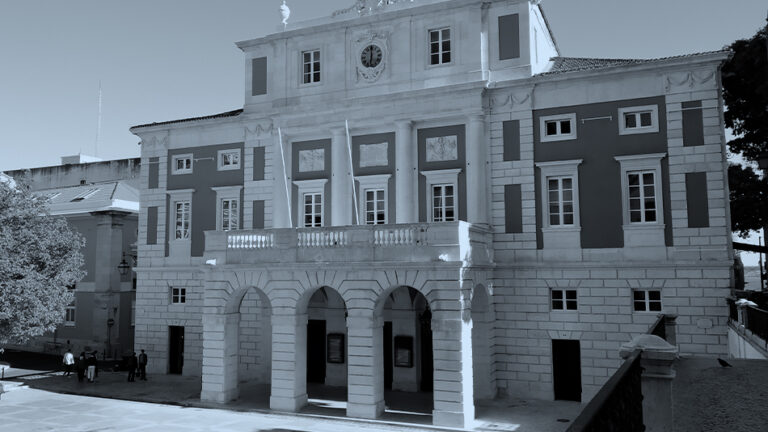
The construction of the Teatro de São Carlos was promoted in 1792 by a group of figures from Lisbon’s elite, and it was inaugurated on 30 June 1793 with the opera La ballerina amante by Domenico Cimarosa. The design by the architect José da Costa e Silva was based on Italian models, and for several decades the theatre effectively functioned as an “Italian theatre”, importing not only its repertoire but also most of its performers from that circuit. The operas of Gioachino Rossini were introduced as early as 1815, and after a brief interruption in activity between 1828 and 1833 (in the context of the Miguelist regime and the Civil War), the reopening in 1834 brought the music of Gaetano Donizetti and Vincenzo Bellini, followed by the Verdian repertoire from 1843 onwards.¹
In 1854, the Teatro de São Carlos became definitively public property, when the State settled the remaining debt to the descendants of its original financiers.² From the 1860s onwards, the dominance of the Italian operatic tradition began to be challenged by the growing importance of French opera in its programming. The introduction of the operas of Richard Wagner (from 1883, with the Portuguese premiere of Lohengrin), initially in Italian versions, as well as the music of Giacomo Puccini and the Giovane Scuola in the 1890s, also proved highly significant.³
Following the establishment of the Republic on 5 October 1910, the activity of the Teatro de São Carlos was suspended in 1912, largely due to a lack of consensus among the leaders of the new regime regarding the institution’s role.⁴ In the early 1920s, its administration was entrusted to the newly formed Sociedade do Teatro de São Carlos, Lda., which organised a series of opera seasons until 1924 under the direction of the Italian impresario Ercole Casali. This period focused on Wagnerian music dramas and the most popular late nineteenth-century French and Italian operas.⁵
In 1926, a public tender awarded management to Ricardo Covões, impresario of the Coliseu dos Recreios, who organised the 1926/1927 season under the artistic direction of Luís de Freitas Branco. However, the theatre’s activity was soon disrupted following the military coup of 28 May 1926.⁶
The theatre closed in 1934 for restoration works, which only began in 1938, reopening to the public in 1940 in the context of the Exposição do Mundo Português and the celebrations of the 300th anniversary of the Restoration. In 1943, during the celebrations of its 150th anniversary, the institution adopted the name Teatro Nacional de São Carlos, and from 1946 onwards it came under direct State administration. The new direction under José de Figueiredo marked the beginning of a long cycle of opera seasons that reinforced the theatre’s position among cultural elites.⁷
A new phase began after the Revolution of 25 April 1974. Political uncertainty regarding its status and funding led to its transformation into a public company in 1980, which was dissolved in 1992 to give way to the Fundação de São Carlos, itself extinguished in 1998, when the institution resumed the designation Teatro Nacional de São Carlos. In terms of repertoire, from 1974 onwards there was a marked increase in national premieres of Baroque and contemporary works, and from the 1990s an attempt to balance popular repertoire with more adventurous programming.⁸
Today, the institution includes two resident artistic ensembles: the Choir of the Teatro Nacional de São Carlos, created in 1943, and the Portuguese Symphony Orchestra, founded in 1993 (which replaced the former orchestra of the theatre). The management of the entire structure (as well as the Companhia Nacional de Bailado and the Estúdios Victor Córdon) is the responsibility of OPART — Organismo de Produção Artística, E.P.E., founded on 27 April 2007, whose mission is to provide a public cultural service in the field of musical theatre.⁹