
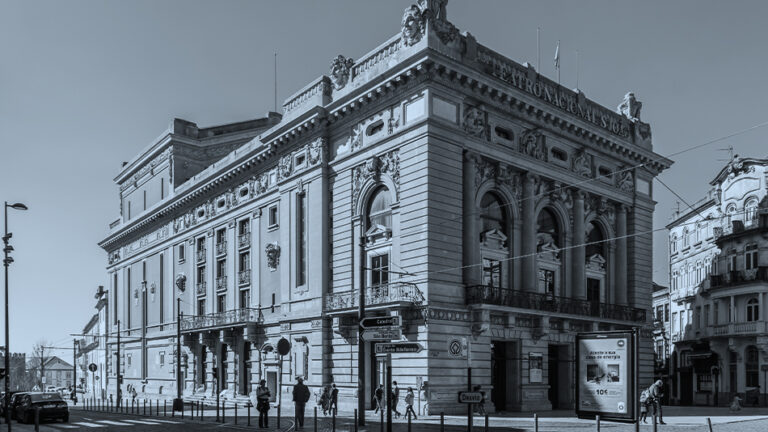
In the context of the social and cultural rivalry with Lisbon (which had already witnessed the inauguration of the Teatro de São Carlos in 1793), the elites of Porto also moved to establish their own public opera house. The construction of the Teatro de São João was promoted by Francisco de Almada e Mendonça, former corregedor of Porto, through a joint-stock company formed by local capitalists and merchants. Its name was granted in honour of Prince João, then regent due to the incapacity of Queen Maria I.
Designed by the Italian architect Vicente Manzoneschi (then a scenographer working for the Teatro de São Carlos and the Teatro da Rua dos Condes in Lisbon), construction began in April 1796, and the inauguration took place on 13 May 1798, the birthday of the future King João VI, with the comedy A Vivandeira.¹
Throughout the nineteenth century, with the exception of two periods of inactivity (1798–1816 and 1880–1885), the theatre maintained relatively continuous activity in both opera and spoken drama, despite limited state subsidies. In its early years, the operatic repertoire consisted mainly of serious and comic operas by composers such as Domenico Cimarosa, Valentino Fioravanti, Pietro Alessandro Guglielmi, Johann Simon Mayr, Giovanni Paisiello, Antonio Salieri, and Niccolò Zingarelli, as well as some French operas (performed in Italian).
From around 1820, the operas of Gioachino Rossini began to dominate the programme, followed by those of Vincenzo Bellini and Gaetano Donizetti in the following decade, and those of Giuseppe Verdi from 1844 onwards. The grand operas of Giacomo Meyerbeer arrived in the 1860s, followed by further important French repertoire, and in the 1890s by works of the Giovane Scuola and Richard Wagner.²
On the night of 11 to 12 April 1908, the Teatro de São João was completely destroyed by fire, and its reconstruction was delayed by the political turmoil of the following years. The new building, designed by Marques da Silva, was finally inaugurated on 7 March 1920 with a performance of Aida by Giuseppe Verdi.
This new venue initially continued the established tradition, combining opera with spoken theatre. However, from the 1930s onwards, symphonic concerts, chamber music ensembles, and solo recitals came to predominate, particularly following its association with the Orpheon Portuense in 1934, which connected Porto to major international circuits. From 1949, concerts by the National Symphony Orchestra and the Conservatory Symphony Orchestra also became notable.
The growth of other cultural institutions in the city led, however, to the gradual decline of the Teatro de São João, which was finally acquired by the State on 8 October 1992 and converted into a National Theatre.³