
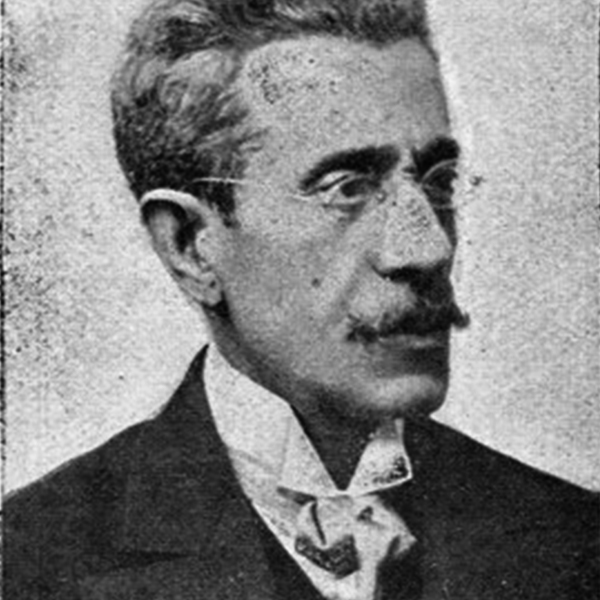
Filipe Duarte was born in Lisbon on 1 July 1855. He received his musical training at the Lisbon Conservatory, where he studied violin, composition, and conducting. In 1875, he became the founding conductor of the Academia de Alunos do Conservatório de Lisboa; however, the following year, due to financial difficulties, he began his professional career as an ocarinist, joining the Sociedade de Concertos de Ocarinas, with which he toured South America.¹
Upon returning to Portugal, he attempted to reunite the dispersed members of the Academia de Alunos do Conservatório de Lisboa and to establish a new orchestra of amateur musicians that would give regular concerts, based at the Club Guilherme Cossoul in 1881. Three years later, he took part in the creation of the Real Academia dos Amadores de Música, where he served as a teacher and orchestral conductor for around 50 years. Shortly before that, in 1882, he made his debut as a violin soloist at the Teatro de São Carlos, in a performance of Les Huguenots by Giacomo Meyerbeer.²
The musician collaborated with the Revista do Conservatório Real de Lisboa and was a member of the council for musical arts of the same institution.³ In partnership with Marcelino Mesquita and Ribeiro de Carvalho, he coordinated the periodical Almanach Editora: musical artistico litteratio, published in Lisbon between 1910 and 1911.⁴
As a composer, Filipe Duarte focused mainly on music for revues and operettas, establishing himself as a prominent figure in Portuguese musical theatre at the turn of the century. Among his works are A Lancha Favorita, his first operetta, staged at the former Clube do Calvário, as well as Agulhas e Alfinetes (Teatro da Rua dos Condes, 1895), Nicles (1901), O Fado (Teatro Apolo, 1910), A Leiteira d’Entre-Arroios (Teatro São Luiz, 1920), and A Mouraria (Teatro Apolo, 1925). The popular character of his creations brought him extraordinary success with audiences. In 1911, regarding the success of O Fado, Ernesto Vieira wrote:
In this latest production the author took as his theme the popular tune that gives the piece its title, developing this theme with great skill, to the satisfaction of the public, who at this moment applaud him with great enthusiasm. Filippe Duarte is now the most admired composer among the audiences of popular theatres.⁵
Despite the success he had already achieved, Filipe Duarte’s popularity reached a new level in the 1920s with the composition of A Severa (1923), with a libretto by Júlio Dantas and André Brun. The success of this work inspired the first Portuguese sound film, Severa, directed by Leitão de Barros in 1931.
8 soloists + 2 Fl | 2 Cl | Ob | Fg | 2 Hn | 2 Tpt | Tbn | Timp | Perc | Vln | Vla | Vc | Cb
See Opera