
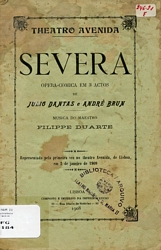
Librettists: Júlio Dantas and André Brun
Operetta in three acts
Date: 1909
Language: Portuguese
Small-scale
Severa
Count of Marialva
Timpanas
Diogo
Romão
Custódia
Marchioness
D. José
A Severa tells the story of a poor fado singer who prostitutes herself in her spare time, to whom Júlio Dantas attributed a Romani background. The Count of Vimioso—renamed in the story as the Count of Marialva for rather far-fetched reasons—falls in love with her, or perhaps not quite. Through her relationship with the Count, widely and corrosively criticized by the regulars of the Taberna do Mangerona, where Severa sings, she hopes to escape the condition to which she feels condemned.
However, what interests the Count is not her escape, but rather that she remains, so that he himself may indulge in a life of dissipation in the tavern, singing his fadinho. Many others love her and urge her to change her life—Timpanas, Diogo, Romão—but they all belong to the same social condition. Only Custódia, madly in love with her (perhaps because he is mad), receives her fraternal affection, much to the Count’s displeasure.
There is also a Marchioness, herself deeply in love with the Count, who abandons her for a mere fado singer—unthinkable! Meanwhile, D. José, of noble lineage, sees his love rejected by the Marchioness, who prefers the aristocratic cavalier turned tavern-going fado singer of the Mouraria.¹
2 Fl | 2 Cl | Ob | Bsn | 2 Hn | 2 Tpt | Tbn | Timp | Perc | Vln | Vla | Vc | Cb²
Score: Biblioteca Nacional de Portugal
Premiered on 2 January 1909 at the Teatro Avenida in Lisbon, A Severa combines the story of the novel written by Júlio Dantas in 1901—adapted for the stage by the author in the same year—with a libretto by the humorist André Brun and music by Filipe Duarte. The work achieved considerable success both in Portugal and abroad, being translated into Catalan, Spanish, and German³.
According to Maria Espírito Santo:
The plot devised by Júlio Dantas […] presents to mass audiences a staged representation of what may be considered the first narrative myth of fado—reconstructing the Mouraria district of the 19th century, its archetypal characters, and its customs. Within this narrative, Maria Severa is involved in a romantic relationship with an aristocrat, inspired by the real-life 13th Count of Vimioso, with whom she was said to have had an affair. Dantas, however, chose not to name the nobleman directly, replacing his title with “Marialva,” evoking the archetype of the gallant aristocrat. It is also in this text that Severa is, for the first time, attributed a Romani ethnic origin, adding a layer of exoticism and marginality to the character (Guinot, Carvalho and Osório 1999: 228–229)⁴.
Date: 1909
Venue: Teatro Avenida, Lisbon