
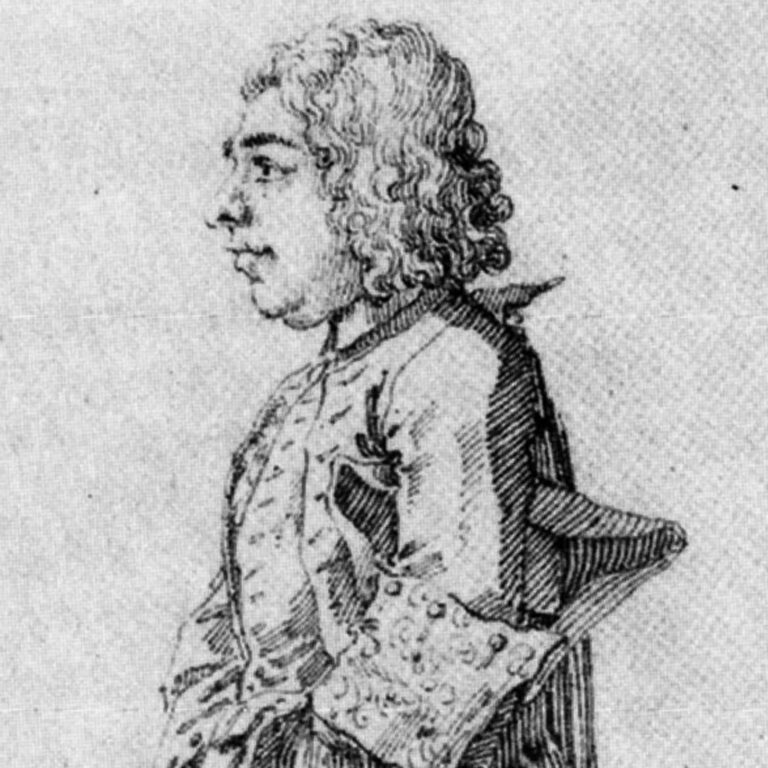
The birth and death dates of Francisco António de Almeida are unknown, but it is known that he was one of the first scholarship holders of King João V, following António Teixeira, sent to Rome with the aim of deepening his knowledge in composition. During Lent of 1722, his oratorio Il pentimento di Davidde was heard at S. Girolamo della Carità and, four years later, another oratorio, entitled La Giuditta, was presented at the Oratorio dei Filippini, in the Chiesa Nuova, in Rome1. Records from this period are scarce, but revealing of his success: Andrea Trabucco, author of the libretto of Il pentimento di Davidde, praised the composer’s “virtuous talent”, while the caption of a caricature by Pier Leone Ghezzi describes him as “a most brilliant composer of concertos and church music who, despite being young, is astonishing and sings with unsurpassable taste”2.
In 1726, Francisco António de Almeida returned to Portugal, where he dedicated himself to the composition of religious and secular works, presenting, in 1728, his first serenata, Il trionfo della virtú, composed to celebrate the elevation of D. João da Mota e Silva to the cardinalate. In 1729, his scherzo pastorale Il tronfo d’amore was heard at the Paço da Ribeira and, the following year, the same venue received his serenata Gl’incanti d’Alcina. In the 1730s, he began composing operas with La Pazienza di Socrate (The Patience of Socrates), based on a libretto by Nicolò Minato revised by the secretary of King João V, Alexandre de Gusmão. The work was presented at the Paço da Ribeira during the Carnival of 1733 and is considered the first Italian opera sung on national territory3 – at the same time, puppet opera performances emerged at the Teatro do Bairro Alto, with texts by António José da Silva and music by António Teixeira4.
No records survive of the composer’s second opera, La Finta Pazza, which premiered in 1735 at the Paço da Ribeira – the same fate befell most of his works, perhaps lost in the aftermath of the 1755 earthquake. However, the third opera by Francisco António de Almeida, La Spinalba ovvero il Vecchio Matto (Spinalba or the Old Fool), premiered during the Carnival of 1739 – again at the Paço da Ribeira – is the oldest opera written by a Portuguese composer that survives intact. With a libretto by an anonymous author, scenes rounded off with da capo arias, and an elegant and expressive style, this comic opera in 3 acts establishes a clear relationship with the innovations of composers such as Antonio Scarlatti, Francesco Gasparini and Antonio Maria Bononcini, who, at the beginning of the 18th century, contributed to the systematisation of this dramatic genre5.
2 S | A | Mz | 2 T | Bar | B/Bar + 2 Ob | 2 Hn | Vln | Vla | Vc | Cb | Cemb
See Opera