
Librettist: Anonymous
Comic opera in three acts
Date: 1739
Language: Italian
Duration: 240 minutes
Small-scale
Spinalba: soprano
Dianora: alto
Elisa: mezzo‑soprano
Vesperin: soprano
Ipolito: tenor
Leandro: tenor
Arsenio: bass‑baritone
Togno: baritone
Spinalba decides to leave home for fifteen days, disguised as a man, in order to follow Ippolito, the love who had rejected her. Her stepmother, Dianora, tells her husband, Arsenio, that her stepdaughter has gone to visit her cousin Elisa, but the deception is soon uncovered and Spinalba’s father succumbs to symptoms of madness that worsen over time.
In parallel, Elisa struggles with a new passion for Florindo (who is actually Spinalba in disguise) and declares herself indifferent to the flattery of her suitors, Ippolito and Leandro. In disguise, Spinalba tries to convince her beloved that Elisa will not return his affection, but Ippolito refuses to listen. He challenges Leandro to a duel, but Elisa intervenes and manages to calm the two candidates for her love.
In the end, Dianora reveals to Elisa Florindo’s true identity, leading her to reconsider her feelings for Leandro. The couple reconciles, and the servants Togno and Vespina, whose advice and interference influence the unfolding of the action, also discover they are in love. Spinalba sheds her disguise and finally returns, restoring her father’s health and winning back Ippolito’s love¹.
2 Ob | 2 Hn | Vln | Vla | Vc | Cb | Cemb
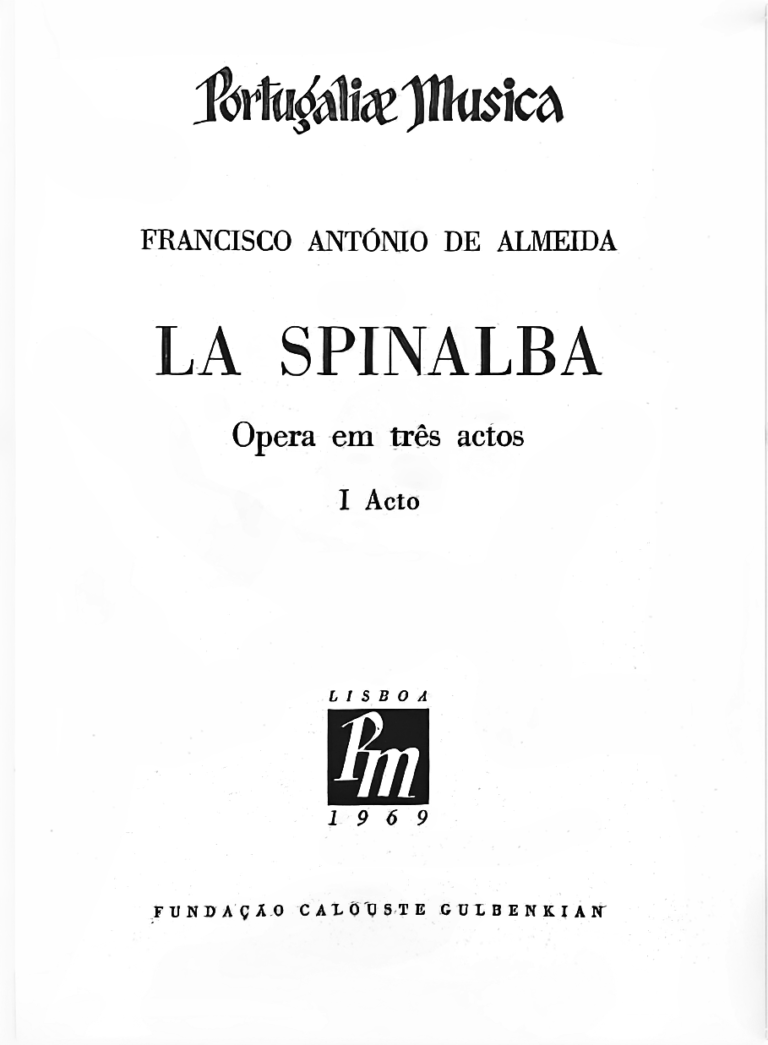
Score: Edition by Pierre Salzmann/Calouste Gulbenkian Foundation
Considered the most important work by Francisco António de Almeida to have survived to our day, La Spinalba received its modern premiere in 1965 at the Teatro Nacional de São Carlos, on the occasion of the 9th Gulbenkian Festival². Since then, it has been presented in Rome, Paris and London, and again in Portugal, at São Carlos and the Centro Cultural de Belém. The recording of the work by the Calouste Gulbenkian Foundation Chamber Orchestra received the Grand Prix from the Académie Nationale du Disque Lyrique³. The composer, for his part, has been the subject of much praise: Mário de Sampaio Ribeiro compared the finest pages of Francisco António de Almeida to the best works of Handel and J.S. Bach; João de Freitas Branco wrote that his work is on a par with the best being composed in Europe in his time, as far as comic opera is concerned; and Manuel Carlos de Brito classified La Spinalba as one of the masterpieces of our 18th century⁴.
Date: Carnival of 1739
Venue: Palácio da Ribeira, Lisbon
1. “Argumentos de Ópera: La Spinalba,” Antena 2, accessed January 2, 2026.
2. Manuel Ivo Cruz, O Essencial sobre a Ópera em Portugal (Imprensa Nacional-Casa da Moeda, 2008), 12.
3. “La Spinalba ovvero il vecchio matto (1739),” Centro Cultural de Belém/Ministério da Cultura, 8.
4. Cruz, O Essencial sobre a Ópera em Portugal, 9-10.