
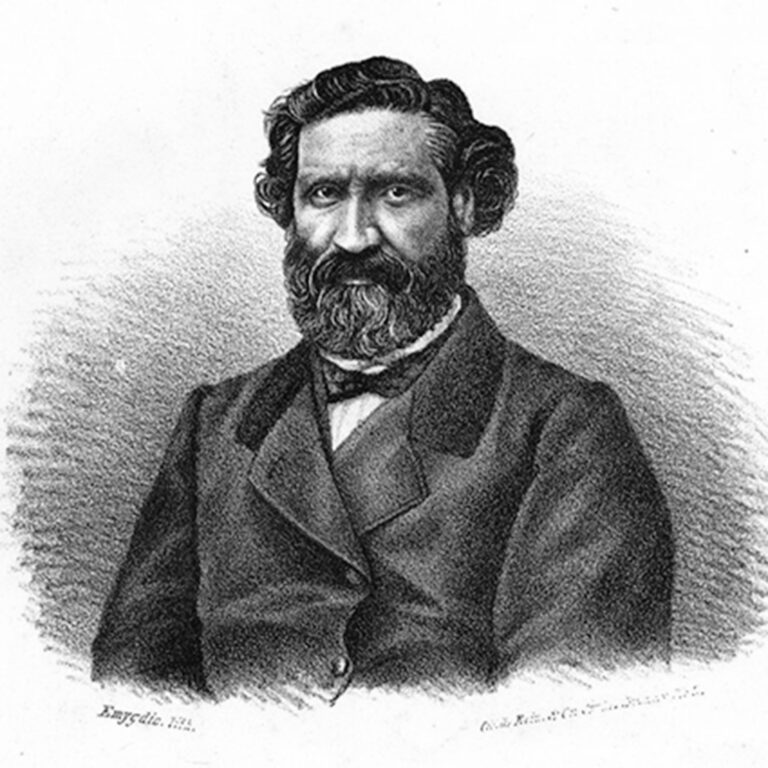
Francisco de Sá Noronha was born in Viana do Castelo on February 24, 1820, and distinguished himself as the first Portuguese composer to write operas based on literary works by national authors¹. Originally destined for an ecclesiastical career, the composer and violinist soon demonstrated an inclination for music and received his first lessons from a Spanish master named Bruno. However, his musical training was largely self‑taught². In 1837, following the death of his parents, at only 17 years of age, Sá Noronha emigrated to Brazil – there he developed a career as a violinist that would lead him to tour South America and perform in New York and Philadelphia between 1846 and 1847, as well as in England in 1854, and Portugal³.
Arriving in Lisbon in the 1850s, he established himself as musical director of the Teatro da Rua dos Condes and experimented with composing some dramatic works, such as comic operas, operettas and vaudevilles, for the Portuguese public, without, however, generating much enthusiasm. From the Rua dos Condes, he moved his activity to the Teatro do Ginásio and from there to the Teatro de São João in Porto, where he managed to convince his listeners as a violinist⁴. Sá Noronha returned to Rio de Janeiro in 1856 and, on that side of the Atlantic, began composing the opera Beatrice di Portogallo, with a libretto written by another Portuguese émigré in Brazil, Reinaldo Carlos Montoro, and based on a work by Almeida Garrett. With this initiative, the duo aimed to “consistently set in motion a project to create a national opera”⁵.
Back in Lisbon from the 1860s onwards, Sá Noronha exchanged the violin for composition and fought to have his operas in Portuguese presented in the country’s main theatres. Having overcome various obstacles, the aforementioned Beatrice di Portogallo premiered at the Teatro de São João in 1863. His second lyric drama, L’arco di Sant’Anna, again based on a work by Garrett, was staged on the same stage in 1867. His third and last Italian opera, entitled Tagir, used a libretto drawn from the novel A Virgem de Guaraciaba by the Brazilian Pinheiro Chagas⁶. This work was presented on March 25, 1876, but failed to achieve the resounding success of its predecessors⁷. Disillusioned with the fleeting reaction of the public, Noronha chose to return to America and settle once more in Rio de Janeiro, where he gained recognition with new comic operas and operettas and where he eventually died on January 23, 1881⁸.