
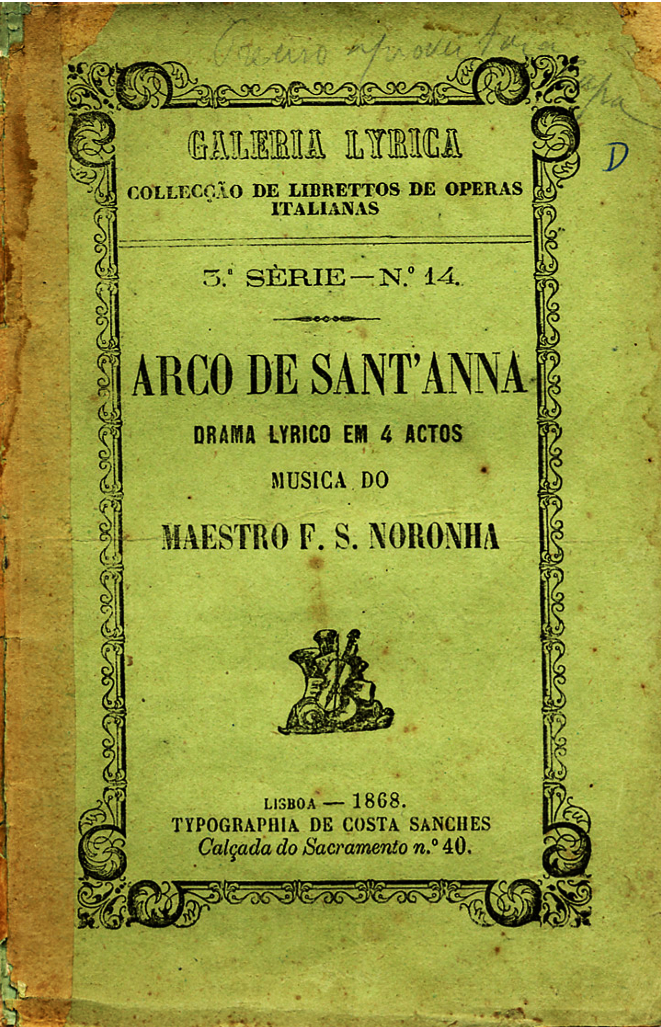
Librettists: António Correia and Ernesto Pinto de Almeida
Libretto based on the novel O arco de Sant’Ana by Almeida Garrett
Lyric drama in four acts
Date: 1867
Language: Italian (translation by Francesco Tagliapietra)
Large-scale opera
Aninhas: soprano
Vasco: tenor
D. Afonso: baritone
Guiomar: mezzo-soprano
D. Pedro: bass
Guterres: baritone
Pêro Cão: bass
Chorus
“The events take place in Porto during the reign of King Pedro I in the 14th century. The action begins at night, in an alley near the Arco de Sant’Ana, with the abduction of Aninhas, ordered by the bishop. Vasco, powerless, witnesses the event.
The scene shifts to a tavern outside the city walls, where, amidst a violent storm, the Witch of Gaia appears. Vasco seeks refuge there. In a long dialogue, Guiomar reveals to him that she is his mother, explains that the king is aware of the bishop’s abuses, and urges him to lead a rebellion. However, as a protégé of the prelate, the young man hesitates.
At that moment, the king himself arrives, and Vasco, now more confident, asks him to free the city. In a brief trio, the three characters praise freedom and the bond of love between a king and his people.
Meanwhile, Aninhas is alone and imprisoned in one of the cells of the episcopal palace, but she is comforted by the archdeacon Paio Guterres. In the tavern in Gaia, Vasco and other townspeople gather. Guiomar once again incites them to rebellion, and all drink to the conquest of freedom. The king appears at the end, declaring his intention to overthrow the tyrant.
At the same time, in the bishop’s palace, he dines with his entourage, celebrating a new romantic conquest. Vasco arrives and shows his discomfort. The bishop senses that something is wrong and wonders whether the young man has discovered his origins.
Left alone with Aninhas, the bishop attempts to seduce her but is prevented by Guterres. A former companion of D. Afonso, the archdeacon tries to bring him to reason, and the bishop pretends to comply. When they leave, Aninhas collapses beside the cross.
She is found in this state by Guiomar and Vasco, who have managed to infiltrate the palace. Guiomar promises to free her.
In the Largo da Sé, the people gather, armed with cauldrons, hammers, and other tools. Vasco assumes leadership of the revolt. Inside the cathedral, the bishop is assembled with his chapter, while the people occupy the vast nave. In a final attempt, Guterres urges the bishop to fulfil his pastoral duty, but D. Afonso orders his arrest. At that moment, the people advance and the revolt begins.
It is halted by the authoritative voice of the king, who deposes the bishop. Guiomar then reveals Vasco’s true parentage. The bishop confesses to having raped Ester in the past and declares himself deserving of death. The king, however, orders him to live and atone for his crimes.”¹
Orchestra
Score: Biblioteca Nacional de Portugal
Around two weeks after the premiere of his first opera, Beatrice di Portugallo (1863), Francisco de Sá Noronha expressed his desire to compose a new dramatic work based on another text by Almeida Garrett, O arco de Sant’Anna, as a tribute to the people of Porto.²
The opera was eventually premiered almost four years later, on 5 January 1867, at the Teatro de São João. According to Luísa Cymbron:
“the excitement was considerable, and so many were the ticket requests that reservations for the second and third performances were already being made at the first. However, the conditions under which it was staged could hardly have been worse. The critic of Braz Tisana rightly pointed out the difficulty in assessing the work, since, due to the illness of the bass Giovanni Battista Cornago, the role of the king had been drastically reduced, eliminating much of the first and second acts. As if that were not enough, the other performers were also not at ease in their roles. Even so, some numbers were appreciated, and the fourth act, according to the newspaper, produced a fine effect.”³
Despite these problems, the work managed to convince audiences and, one year later, was presented in Lisbon at the Teatro Nacional de São Carlos, where it achieved a “resounding success”.⁴ This warm reception was partly the result of a growing patriotic sentiment among critics, contributing to the recognition of Sá Noronha as a representative national composer.⁵
Date: 1867
Venue: Teatro de São João, Porto
Cast: Bagagiolo, Massini, Locatelli, Bulterini, Reduzzi and Mendioroz⁶