
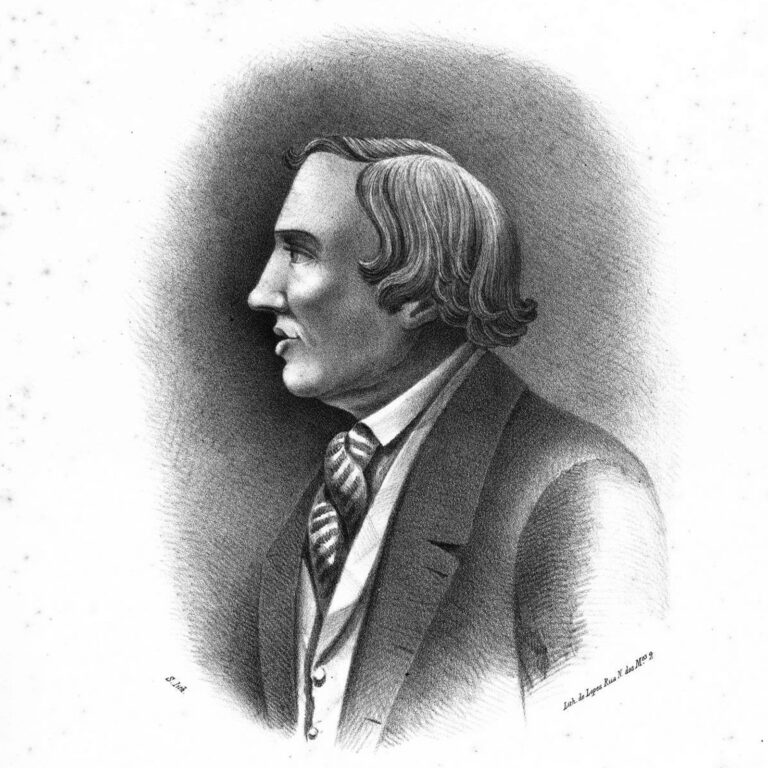
Joaquim Casimiro Júnior was born in Lisbon on May 30, 1808, the son of Joaquim Casimiro da Silva, who worked as a copyist and musician at the Teatro de São Carlos. Júnior began his musical training at Lisbon Cathedral and studied composition with José de Santa Rita Marques e Silva. In 1829, after some years as an organist at the chapel of the Bemposta Palace, he gained recognition as a composer of sacred music, notably for works such as the Matinas de Santa Luzia and a Te Deum written in tribute to King Miguel.¹
After the deposition of the absolutist king, Casimiro spent some time imprisoned and, according to Ernesto Vieira, lived through the second half of the 1830s “hidden in some friendly house on the outskirts of Lisbon, as happened to many others who were fearful”.² In 1842, he emerged again to become one of the most prominent composers of dramatic music in the country. Over his 20 years of activity associated with the theatrical scene, he wrote music for plays, comic operas, mágicas (fairy plays), fantasies and a biblical drama by José Romano – Sansão, ou A destruição dos Philisteus (1855).³
He began by associating himself with the Teatro do Salitre, where, in a single year, he composed the music for a mystery inspired by Meyerbeer’s Robert le Diable, for two plays by Molière, and for the farce Pecados Velhos. Still in the 1840s, he was drawn to the Teatro da Rua dos Condes by the then director Émile Doux, who commissioned Casimiro to compose the music for a farce in the vein of O beijo (1844) by Angelo Frondoni. This project gave rise to Um par de luvas, a piece that marked the inauguration of the Teatro D. Maria and the celebration of King Fernando’s birthday on October 29, 1845, and was later repeated at the Rua dos Condes.⁴ Already in 1849, he produced “the first parody of Italian operas that appeared among us”: Ensaio da Norma, based on the work of Vincenzo Bellini.⁵
A year later, the premiere of his opera A Batalha de Montereau at the Teatro D. Fernando was a success – despite some criticism of its closeness to the Italian style⁶ – and transformed Casimiro into the most sought-after composer in the theatres of the Portuguese capital. Several collaborations and projects followed, and on October 13, 1854, a new operetta of his authorship, Ópio e Champanhe, which would be revisited several times and in various theatres.⁷
Alongside his work in the field of theatrical music, Casimiro Júnior served as organist and, from 1860, as Mestre de Capela of the Patriarchal Cathedral.⁸ Among his sacred repertoire, the responsories for Holy Wednesday (1857) stand out, which Vieira classified as Casimiro’s masterpiece.⁹ The composer died five years later, on December 28, 1862, leaving an impressive catalogue with “almost 100 sacred music works and more than 200 theatrical scores” – it is therefore no wonder that the most renowned music professors granted him “primacy among the composers of his time”.¹⁰
6 Soloists + Chorus + 2 Fl (Picc) | Cl | Tpt | 2 Hn | Tbn | Perc | Vln | Vla | Vc | Cb
See Opera