
Librettist: Joaquim Augusto de Oliveira
Libretto based on Louis-François Nicolaie’s L’Opium et le Champagne
Operetta in one act
Date: 1854
Language: Portuguese
Small-scale
Kangarú
Nasçá
Dog-dog
Yang-Ti
Ventrebiska
Arthur
Chorus
“The action of this little piece takes place in China and invokes the high consumption of opium in that country, encouraged by English merchants, and the unfolding of the First Opium War between the two nations (1839–1842) as pretexts for a comedy of errors. A French midshipman, Arthur, secretly courts the Chinese woman Nasçá, niece of the tea merchant Kangarú and betrothed to his clerk, Yang-ti. His interest lies as much in the girl as, and mainly, in selling champagne, taking advantage of the war context to also do business: ‘Since England has sworn to lull this poor nation to sleep, inducing it to smoke opium, it is only fair that France awakens it by force of Champagne.’ Ventrebiska, Kangarú’s wife, in turn allows herself to be seduced by an English officer, Dog-dog, who takes the opportunity, in disguise, to try to ‘sell much opium.’ But the husband and fiancé discover the foreigners in the tea warehouse and try to pursue them, running ‘both furiously around the theatre, as if searching, but in opposite directions – as they are blinded by rage, this scene must be arranged so that Yang-ti and Kangarú bump into each other a few times.’ After some disguises, vicissitudes, pursuits and many couplets, Arthur manages to convince Kangarú to give him his niece’s hand, ‘especially after learning that I am to be the saviour of China, that I hold in my hand the means to triumphantly awaken this country and make it as cheerful as France.’ Kangarú, curious, invites ‘the chosen company […] to attend such a festive experiment!’ The piece ends with everyone drinking ‘divine Champagne’ joyfully, toasting the nectar, and dancing the cancan.”¹
2 Fl (Picc) | Cl | Tpt | 2 Hn | Tbn | Perc | Vln | Vla | Vc | Cb
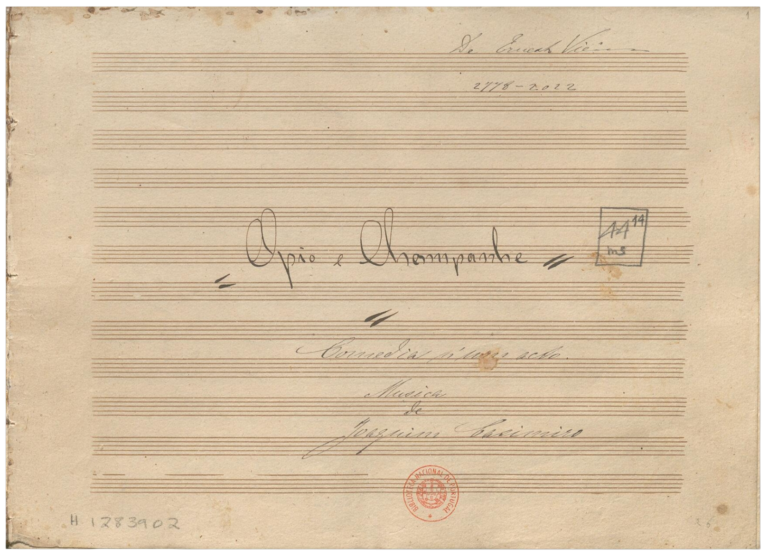
Score: Biblioteca Nacional de Portugal
The operetta Ópio e Champagne by Joaquim Casimiro Júnior premiered on October 13, 1854, at the Teatro da Rua dos Condes and soon won the public’s favour. On the occasion of one of the several revivals of the work, staged five years after the composer’s death, the Chronica dos Theatros challenged the reader to find a “music more appropriate to the genre, that better translated the poet’s thought”². The text of this operetta constitutes an imitation or translation by Joaquim Augusto de Oliveira of the original French text L’Opium et le Champagne, presented to the Portuguese public a few months earlier in a production by a French troupe at the Teatro D. Fernando.³
Date: 1854
Venue: Teatro da Rua dos Condes, Lisbon
Cast: Roche, Pascal, Dumesnil, Méraux, Mlle. de Boissy and Mlle. Desgranges