
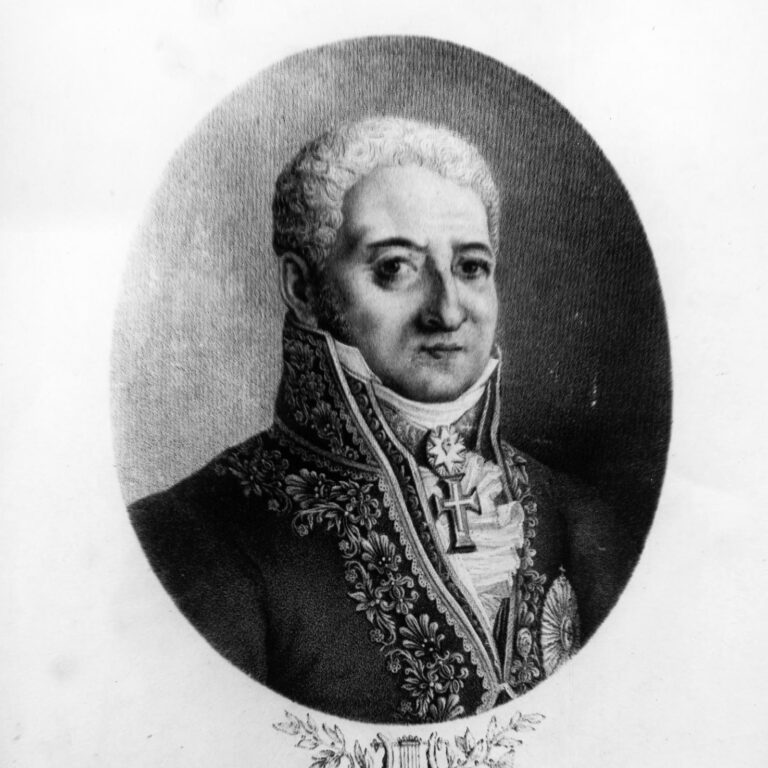
Marcos António da Fonseca Portugal was born in Lisbon on March 24, 1762, the son of Joaquina Teresa Angélica da Fonseca Portugal and Manoel António da Assumpção, a musician at the Santa Igreja Patriarcal. He was a Portuguese‑Brazilian organist and composer and one of the most prolific and internationally recognised figures in Portuguese music of the late 18th and early 19th centuries. In 1771, he entered the Patriarchal Seminary, where he studied with João de Sousa Carvalho and, most likely, with José Joaquim dos Santos. Still as a student, he began composing liturgical music for the Patriarchal See and, in 1782, obtained his first position as organist, followed by formal appointment as composer in 1787¹.
Marcos Portugal’s relationship with the Portuguese royal family began in 1782, when the composer received his first royal commission – a Mass with instruments to be sung at the Royal Chapel of Queluz on the occasion of the feast of Saint Barbara². Around 1784, Marcos Portugal began attending the Teatro do Salitre and composing music for entremezes, comedies, burletas and royal odes that were heard there on the occasion of royal family birthday celebrations³.
In 1792, he left for Italy, where, under the Italianised name Marco Portogallo, he premiered with great success a series of comic operas and farces⁴. Between 1795 and 1800, the composer premiered an average of three works per year in different parts of the Italian operatic circuit, achieving an unprecedented international reputation for a Portuguese‑Brazilian composer. According to António Jorge Marques:
In the last years of the 18th century and the first 19 years of the 19th century, his Italian success spread to the rest of Europe and Brazil, with revivals in Vienna, Paris, London, Dublin, Saint Petersburg, Berlin, Dresden, Hamburg, Hannover, Leipzig, Nuremberg, Corfu, Barcelona, Madrid, Rio de Janeiro, Lisbon, Porto…, for a total of performances numbering in the thousands.⁵
Upon returning to Lisbon in 1800, Marcos Portugal was appointed mestre de Solfa at the Patriarchal Seminary and Maestro of the Teatro de São Carlos, composing numerous opere serie – most of them written for the soprano Angelica Catalani⁶. Among the many operas he presented at that theatre, notable are La Donna di Genio Volubile, Adrasto, Semiramide, Le Donne Cambiate, L’oro non compra amore, and Demofoonte⁷. In 1807, he produced an exceptional set of sacred works for the Basilica of Mafra, exploiting the six organs of the church in a grand style associated with the display of royal power⁸.
After the transfer of the court to Brazil, he was summoned to Rio de Janeiro in 1811, becoming Master to Their Royal Highnesses, the children of King João, and official composer of the Royal Household. In Brazil, he dedicated himself mainly to sacred and ceremonial music, also composing the first official national anthems of Portugal and Brazil. Marcos Portugal was awarded a commendation of the Order of Christ in October 1820 and remained in the service of Emperor Pedro I until his death on February 17, 1830, leaving behind a vast œuvre that includes opera, sacred music and symbolic repertoire of strong political dimension⁹.
4 S | 2 T | B + Chorus + Fl | Ob | Cl | Bsn | 2 Hn | Tpt | Timp | Vln | Vla | Vc | Cb | Cemb
Ver Ópera
4 S | 2 T | Bar | 2 B + 2 Fl | 2 Ob | 2 Cl | Bsn | 2 Hn | 2 Tpt | Vln | Vla | Vc | Cb | Cemb
Ver Ópera
2 S | Mz | 2 T | B + Chorus + Fl | Ob | Cl | Bsn | 2 Hn | Tpt | Timp | Vln | Vla | Vc | Cb | Cemb
Ver Ópera