
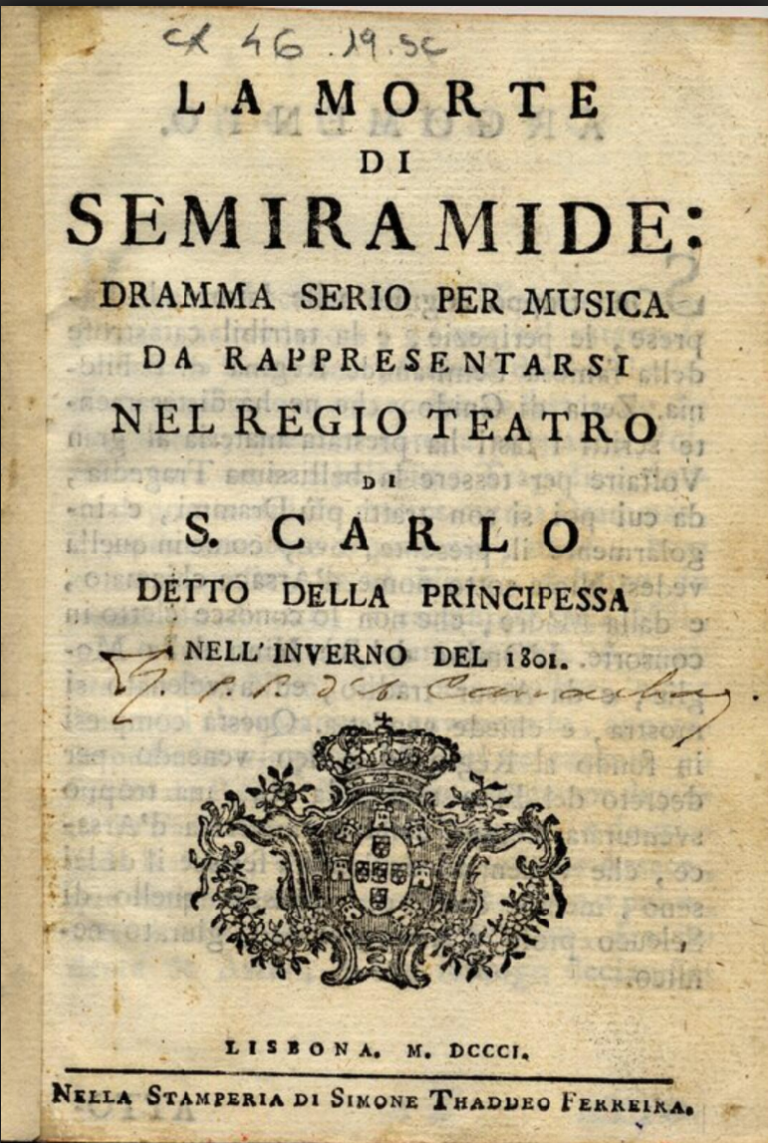
Librettist: Giuseppe Caravita
Libretto: Antonio Sografi
Libretto based on another libretto by Antonio Sografi
Serious Drama
Date: 1801
Language: Italian
Large-scale
Semiramide: soprano
Arsace: mezzo‑soprano
Seleuco: tenor
Mitrane: tenor
Oroe: bass
Azema: soprano
Chorus
“Well known in History are the undertakings, changes and terrible catastrophe of the famous Semiramis, Queen of Babylon. Zesia of Cnidus wrote her annals so extensively that they gave matter to the great Voltaire to weave the very beautiful Tragedy, from which many other Dramas were later drawn, and particularly the present one, where, as in that, we see Ninyas, under the name of Arsace, chosen by his Mother, who does not recognise him, as her Husband. The ghost of King Ninus, who was treacherously poisoned by his wife and by Assur, appears demanding vengeance; which is executed in the depths of the Royal Mausoleum, where by decree of Fate the guilty and unfortunate Queen had gone, and by the very hand of Arsace, who, forced by the ghost, pierced her chest, believing that he was killing Seleuco, descendant of Assur and his declared enemy.”¹
Fl | Ob | Cl | Bsn | 2 Hn | Tpt | Timp | Vln | Vla | Vc | Cb | Cemb
Score: Biblioteca da Ajuda
Marcos Portugal composed La morte di Semiramide for a benefit performance for Angelica Catalani in 1801. The work premiered at the Teatro de São Carlos in Lisbon on December 23, with Catalani in the role of Semiramide and Crescentini as Arsace. It is assumed that Catalani kept a copy of the score and, based on it, promoted the performance of the opera outside Portugal. Productions at the King’s Theatre in London in 1806, at the Crow Street Theatre in Dublin in 1808, and at the Théâtre-Italien in Paris in 1817 featured her participation².
Date: 1801
Venue: Teatro de São Carlos, Lisbon
Cast: Angelica Catalani, Girolamo Crescentini, Vincenzo Praun, Domenico Neri, Filippo Senesi, Giuseppa Pellizzoni and Orchestra of the Teatro de São Carlos
Scores: Biblioteca da Ajuda