
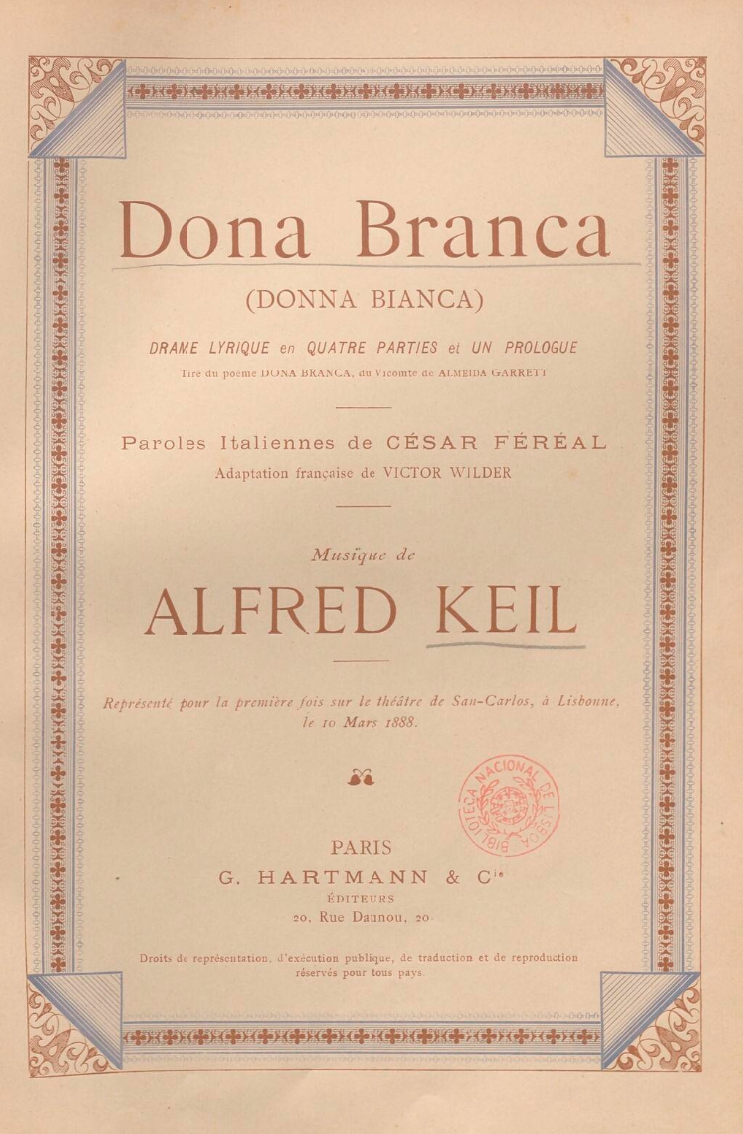
Librettist: César Féreal
Libretto based on the text Dona Branca by Almeida Garrett
Lyric drama in four acts and a prologue
Date: 1888
Language: Portuguese
Large-scale
Aben-Afan: tenor
Donna Bianca: soprano
Adaour: baritone
Velha Moura: contralto
Don Payo Peres Correia: bass
Don Nuno: tenor
Soldado: baritone
Fada: mezzo-soprano
Alda: soprano
Popular: tenor
Chorus
The action takes place in Portugal during the reconquest of the Algarve from the Moors in the 13th century, centering on the tragic love story between Infanta Dona Branca, daughter of King Afonso III, and Aben-Afan, a Moorish leader of the region. Despite belonging to antagonistic worlds and political positions, the two fall deeply in love, creating a conflict between duty and desire. The narrative explores themes of honour, identity and loyalty against the historical backdrop of the Reconquista. Other characters—allies and antagonists on both sides—further complicate the lovers’ relationship, leading to a tragic outcome marked by the weight of love.
2 S | Mz | A | 3 T | 2 Bar | B + Pic | 2 Fl | Ob | 2 Cl | 2 Bsn | 2 Tpt | 2 Hn | Tbn | Timp | Vln | Vla | Vc | Cb¹
Score: Ava Musical Editions
Premiered at the Teatro de São Carlos in 1888 and dedicated to King Luís, Alfredo Keil’s Donna Bianca quickly established itself as one of the most significant Portuguese operas of the late 19th century. The reception from audiences and critics was overwhelmingly favourable—the opera was unanimously considered a composition of great quality, comparable to the major national dramatic works of the time. Its success was reflected in an exceptional number of performances, with twenty shows over two consecutive seasons, surpassing many works from the international repertoire then being staged.² According to Luís Raimundo:
Such was the prestige the opera achieved with the general public that the Eastern and Northern Railway Company decided to establish train journeys at reduced fares to allow residents from the provinces to attend the two extraordinary performances of Dona Branca that took place in early April 1888.³
Inspired by the eponymous poem by Almeida Garrett, Donna Bianca aligns itself with an aesthetic close to French grand opéra, combining musical, dramaturgical and scenic ambition. The prestige it attained also led to its revival in Portugal and at the Teatro Lírico in Rio de Janeiro, confirming the work’s central place in 19th-century Portuguese operatic landscape.⁴
Date: 1888
Venue: Teatro de São Carlos, Lisbon
Cast: António D’Andrade, Elena Theodorini, Francisco d’Andrade, Giulia Prandi, Meroles, Durini, Pietro Ghidotti, G. Figuet, Olavarri, Foresti and Chorus and Orchestra of the Teatro de São Carlos