
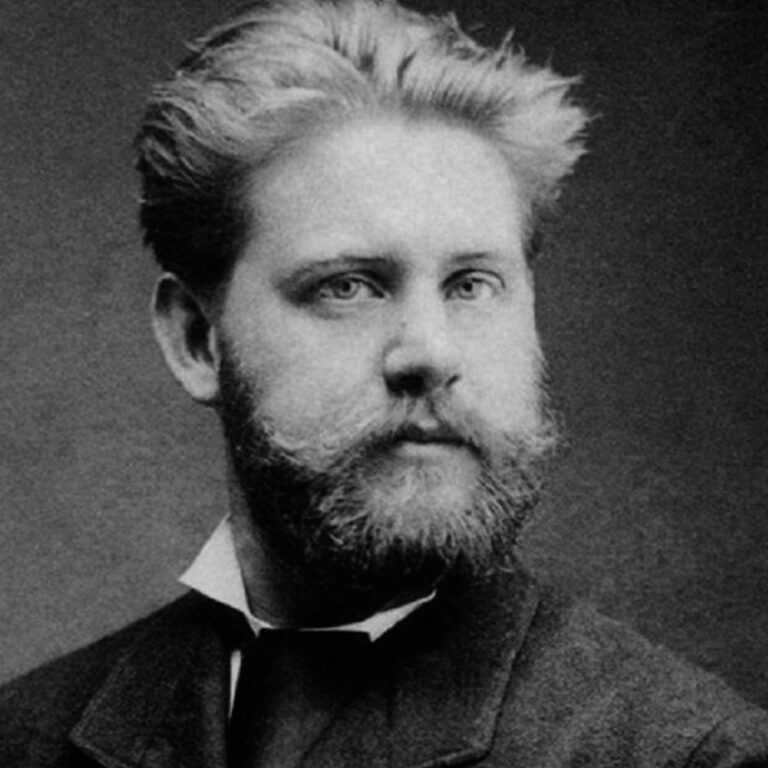
Alfredo Keil was born on July 3, 1850, in Lisbon, the son of Johan Christian Keil, a German tailor who had gone into exile in Portugal at the end of the 1830s, and Maria Josefina Stellpflug, whose family of Alsatian descent had settled in the country in the late 18th century1. Throughout his childhood, Keil travelled with his parents across various European countries, learned languages, and developed an interest in diverse art forms, especially painting and music. He began his studies in both arts in Lisbon, but in 1868, at only 17, he left for Nuremberg and continued his training at the Royal Academy of Fine Arts under the direction of August von Kreling2.
With the outbreak of the Franco-Prussian War in 1870, Keil returned to Portugal and began an artistic career that soon gained popularity. At the same time that his paintings were being exhibited and awarded prizes in national and international exhibitions, he took his first steps in the musical world, enchanting audiences in private salons with his light music, dances and songs3.
In 1883, Keil presented his first opera, Susana, at the Teatro da Trindade; five years later came Donna Bianca, whose tremendous success with the public at the Teatro de São Carlos earned him the Order of Santiago. Both works share a nationalist theme that would be revisited at the beginning of the following decade, marked by the diplomatic and military conflict between Portugal and Great Britain. Caught up in the patriotic fervour that arose against the British Ultimatum, the composer wrote the march A Portuguesa – with verses by Henrique Lopes de Mendonça – which quickly became a symbol of the republican movement and, in 1911, was eventually chosen as the national anthem of the Portuguese Republic. Still in the 1890s, Keil composed his first large‑scale opera, Irene, which was presented at the Teatro Regio in Turin in 1893, and the well‑known Serrana, heard for the first time at the Teatro de São Carlos in 18994.
Between salon music, operas and other large‑scale works – the symphonic poem Uma caçada na corte (1885) and the cantatas Patrie (1884), As Orientais (1886) and Poema de Primavera (1886) – Keil maintained his interest in the visual arts and continued his activity as a painter. In the last years of his life, the artist enjoyed his multifaceted talents and devoted himself especially to his art collections, which brought together a vast array of musical instruments, manuscripts, illuminations and paintings by artists such as Francisco Goya, Luca Giordano and Pieter Bruegel. The composer died on October 4, 1907, leaving traces of several works that remained unfinished, among them the opera Simão, o Ruivo5. On the centenary of his birth, Fernando Lopes‑Graça wrote:
[…] whatever the definitive judgement (if such a thing exists) that may be made of Alfredo Keil’s musical personality, one thing can be counted as certain in his favour: that he tried, within the limits that an incomplete musical technique and his structural ‘amateurism’ naturally imposed on him, that he tried, I say, to solve the problem of national opera – and this already seems to me a great deal to consider, in a country where music never had great problems to solve, for lack of its own vitality and of integration into the dominant contemporary aesthetics6.
S | 2 T | Bar | 2 B + Fl | Ob | Fg | 2 Cl | Tpt | 2 Hn | Perc | Vln | Vla | Vc | Cb
See Opera
S | 2 Mz | T | Bar | B + Fl (=Picc) | Ob | 2 Cl | Fg | 2 Tpt | 2 Hn | Tbn | Perc | Vln | Vla | Vc | 2 Cb
See Opera
2 S | Mz | A | 3 T | 2 Bar | B + 2 Fl (=Picc) | Ob | 2 Cl | 2 Fg | 2 Tpt | 2 Hn | Tbn | Timp | Vln | Vla | Vc | Cb
See Opera