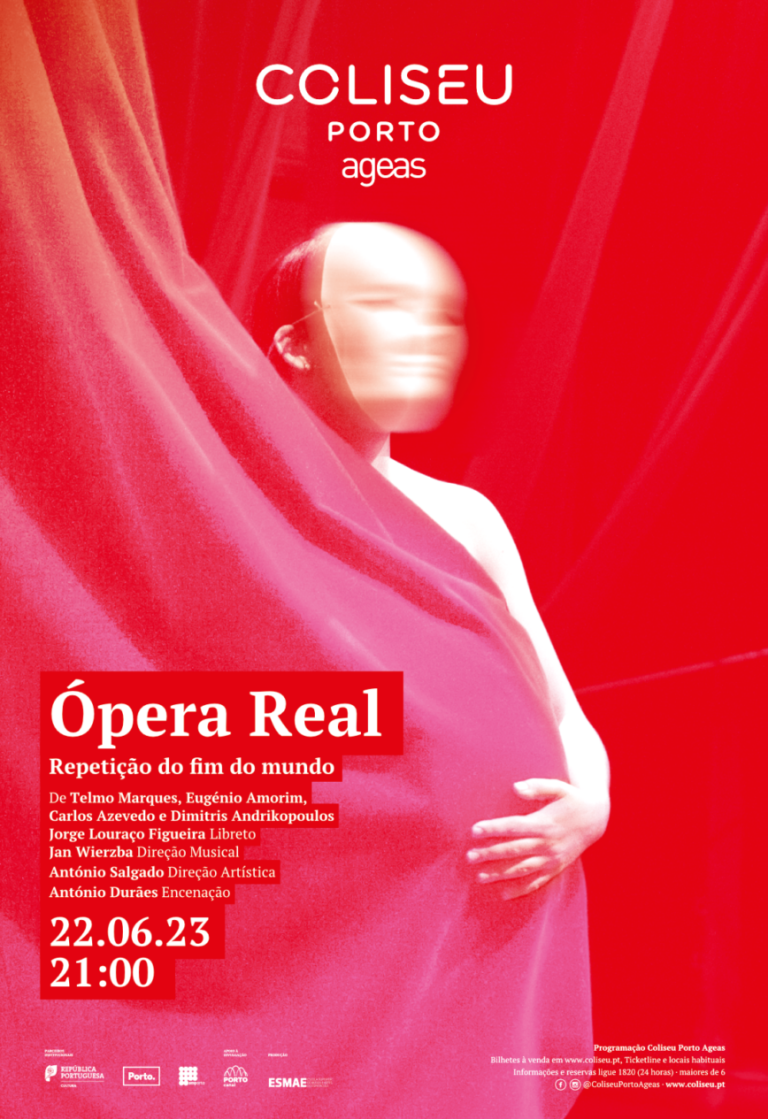
Composer: Telmo Marques (Act I), Eugênio Amorim (Act II), Carlos Azevedo (Act III), Dimitris Andrikopoulos (Act IV)
Opera in four acts
Librettist: Jorge Louraço
Date: 2023
Language: Portuguese
Large-scale
Act I
José I, the cloaked king: heroic tenor
Donato Bufão, aka Paupério, circus animal tamer: actor
Priest, chaplain, slightly drunk: bass
Mariana Paupério, the Paupério matriarch: mezzo-soprano
Brida Paupério, the most brash Paupério: actress/soprano
Sabina Paupério, the most clever Paupério: actress/soprano
Frida Paupério, the most feigned Paupério: actress/mezzo-soprano
João Mudo, the mute Paupério: actor
Belmiro Enxovia: tenor
Federica Ricci, improvised midwife: soprano
Salvador Ricardo, Federica’s husband: baritone
Act II
Marianinha Ricardo, singer, granddaughter of Mariana Ricardo: soprano
Vittorio Ricci, singer, great-grandson of Federica and Salvador: tenor
Mariano Neto, actor, grandson of Mariano Paupério: baritone
Visconde, Brazilian from Torna-Viagem: bass-baritone
Margarida Ricardo, twin of Rosa, cousin of Marianinha: soprano
Rosa Ricardo, twin of Margarida, widow, cousin of Marianinha: mezzo-soprano
Libéria, twin of Camélia, great-granddaughter of Mariana Paupério: actress
Ilda Pulga, model for the bust of the Republic: actress
Photographer: actress
Blind man: actor
Camélia: actress
Act III
Vítor Mariano, director: baritone
Tânia Paupério, twin of Vânia, model and actress: soprano
Vânia Paupério, twin of Tânia, model and actress: soprano
Zézinha Paupério, model and actress, very similar to Joana: soprano
Milu Ricci, Radio singer: soprano
Pêpe Ricardo, playboy and actor: tenor
Ana Ricardo, twin of Maria, pharmacist, mother of Joana: soprano
Maria Ricci, twin of Ana, teacher, mother of Sara and Mariana: soprano
Sara Ricci, twin of Mariana, student: soprano
Mariana Ricci, twin of Sara, student: soprano
Joana Ricardo, student, similar to Zézinha: soprano
Uncle Mário Magno, producer: bass-baritone
Uncle Chico, Franciscan abbot: baritone
Religious sister 1: soprano
Religious sister 2: mezzo-soprano
Religious sister 3: mezzo-soprano
Seminarian: tenor
Cameraman: actor
Act IV
Frederica: soprano
Clowns Without Borders: chorus
Blue Helmets: chorus
Act I: A theatre in ruins | Composer: Telmo Marques
1755 – The earthquake destroys the Ópera do Tejo. One of the opera singers desperately searches for his best coat. The musicians and singers arrive to find everything in ruins and come across a band of strolling players stealing the leftover costumes from the wardrobe, especially shoes, to sell, and the scenery canvases to set up their tents. They are led by a matriarch, Mariana da Enxovia, visibly pregnant. The king, who had come incognito for a rendezvous with the opera singer Federica Ricci, stays to assess the damage and promises to build a new theatre on the same spot. Meanwhile, with the effort, Mariana da Enxovia’s waters break. Federica, the prima donna, helps the pregnant woman. Two healthy twins are born. But Mariana dies after childbirth. Federica Ricci keeps one of the children, and one of the strolling players, Donato Paupério, keeps the other.
Act II: A theatre in flames | Composer: Eugênio Amorim
1866 – At the official inauguration of a new opera house, named after Federica Ricci in honour of the great artist of the previous century, a controversy breaks out between republicans and monarchists, much to the dismay of Marianinha, Federica’s great‑granddaughter, who, despite some difficulty because she is pregnant, insisted on performing at the ceremony. Mariano Neto, also a descendant of Federica but through another branch, tries to climb onto the platform and read O Enteado do Diabo (The Devil’s Stepson), a play written by his great‑grandfather. That is when the fire is noticed. The theatre never gets used. In the heat of the action, Marianinha’s waters break, and she gives birth to triplets.
Act III: A decadent cinema? | Composer: Carlos Azevedo
1977 – The revolution brought democracy to Portugal, including to the conservative and Catholic north. At the Cinema São João, the entire Ricci family gathers to attend the premiere of the erotic film directed by João Ricci. Outside, a group of nuns call for a boycott. The family is scandalised to see that the youngest members appear in the film as actors and actresses, and they try to stop the premiere. They soon discover that those young men and women, who coincidentally look very much like them, are not from the Ricci family but from the Paupério family. They then conclude that they are all cousins of one another. The premiere is blessed by the presence of an uncle, a Franciscan friar, preacher of liberation theology and of the law of love above all else.
Act IV: An abandoned theatre | Composer: Dimitris Andrikopoulos
2088 – In a theatre used to shelter war refugees, a couple of clowns, members of Clowns Without Borders, try to entertain the others with the same worn‑out routines as always, when a group of journalists, pushed by the Blue Helmets, and a group of rulers and ambassadors arrive. The women present their complaints, but one of them, Federica, is so angry that she speaks nonsense. She is apparently pregnant, which is hard to believe given her advanced age. The Blue Helmets conclude that she is a bomb and the woman a suicide bomber. And indeed she is. Her offspring explodes, blowing up the original twins and the devil himself. Only the memory of the theatre remains.
Fl (Rain Stick) | Ob (Wind Chimes/Shell/Bamboo/Glass) | Cl | Bsn| Hn | C Tpt | Tbn | 2 Perc | Vln | Vla | Vc | Cb | Elec
This Ópera Real: Repetição do Fim do Mundo was conceived to bring together on the same stage students from the theatre and music courses at ESMAE. Hence, the melodramatic plot that pits two branches of the same family against each other: on one side the Ricci (or Ricardo), a lineage of singers; on the other the Enxovia (or Paupério), a clan of actors. Over four acts, with time jumps of exactly 111 years, we follow the deaths and births of members of this large family and lose ourselves in the labyrinth of kinships and catastrophic blood ties of the feuding clan. The theatre is destroyed in each act: in Act I, in 1755, by an earthquake; in Act II, in 1866, by a fire; in Act III, in 1977, by its transformation into a cinema showing pornographic films; and in Act IV, in 2088, by its transformation into a refugee camp. We then learn that, due to the breach of a pact with the devil, any member of the family who sets foot on a stage is destined to destroy the theatre and, on their own scale, to repeat the end of the world. In the first three acts, the libretto tries to play with the common history of theatre, music, and opera; in the last, with the stage space transformed into a refugee camp that could be in Ukraine, Syria, on one of the shores of the English Channel, in Melilla or in Odemira, things become apparently more serious. If it hasn’t ended already, the world really will end right after, as many times as necessary.
The fable begins at the start of the 18th century, when Baltasar, one of the two twins of Querubim, a seller of chapbooks in Lisbon in 1755, and of Mariana, a chambermaid at the opera theatre, make a pact with the devil to acquire a theatre. While the devil rubs one eye, the twin Baltasar, playing the clever rustic, signs in the name of his brother, Belmiro, and thus outwits the demon. Belmiro flatly denies having signed the pact but, out of fraternal loyalty, does not denounce his brother Baltasar. Satan, unable to claim the soul of either one, because he does not know exactly which twin is which (having rubbed one eye so much, he sees very poorly, as is well known), throws a demonic tantrum and begins to intervene directly whenever one of them sets foot on stage, condemning them to be nothing more than epilogues and prologues to the shows they create. The devil will not let them sleep until the twin who signed the contract, whichever one it is, or one of their descendants, reveals who is who, and assumes and settles the debt. Devil’s luck, all the descendants present themselves as twins, which only muddies the action.
Date: 2023
Venue: Teatro Helena Sá e Costa, Porto
Stage Direction: António Durães
Music Direction: Jan Wierzba
Cast: Ana Rosa, André Fernandes, Bárbara Xavier Quintais, Beatriz Patrocínio, Beatriz Ramos, Catarina Santos, Cliff Pereira, Erick Valverde, Gustavo Gil Godinho, Henrique Lencastre, Isabel Gundana, Joana Santos, Júlia Anjos, Lioba Vergely, Maria Duarte, Maria João Gomes, Miguel Soares, Ricardo Rebelo da Silva, Rita Gama and the ESMAE Orchestral Ensemble