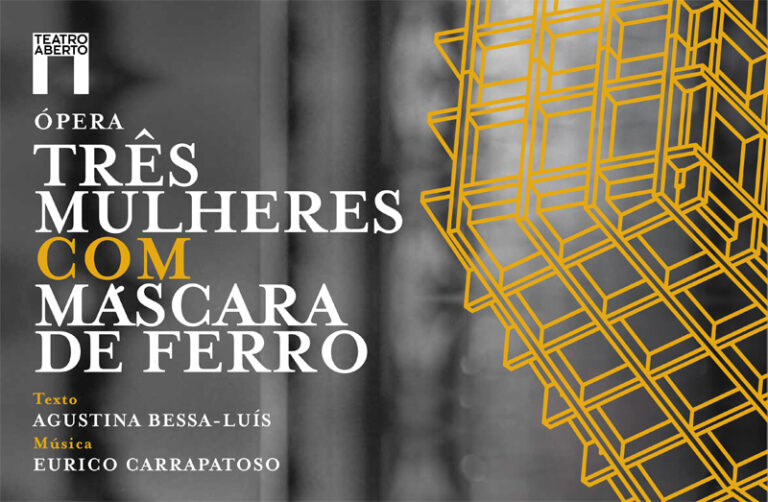
Librettist: Agustina Bessa-Luís
Libretto based on an unpublished text, adapted
Static drama in One act
Date: 2014
Language: Portuguese
Duration: 55 minutes
Small-scale
Fanny Owen: soprano
Ema: soprano
Sibila: mezzo-soprano
Cl | Vln | Vc | Pf
A short note regarding the score Três mulheres com máscara de ferro, by Eurico Carrapatoso, a static drama in one act, based on the homonymous and unpublished text by Agustina Bessa-Luís.
I’ve always liked challenges. But this one, posed by João Lourenço and Vera San Payo de Lemos, was one of the biggest I’ve accepted: writing an opera based on a text that was not initially conceived for that purpose. All the music was certainly conditioned by that sweet original sin, a risk I could and, above all, wanted to take.
Our first meeting was in November 2013. On that occasion, I became acquainted with the unpublished text by Agustina Bessa-Luís, Três mulheres com máscara de ferro. There it was, that little play, with an “autumnal tone, of sorrowful ends of day.” It wasn’t a libretto. I kept mulling over the idea, like one chews over a troublesome tooth.
In March 2014, after four months of silence following the first meeting, I received the phone call from João Lourenço: “It’s going ahead. You can proceed!” I wasn’t expecting the news. I had that expression on my face that men often have at the barber’s: an oblique look, with the extreme melancholy of someone chasing after shorn hair, against a background sound of icy scissors’ snips (not only the effective ones that cut, but also those with which the barber, scissors raised, tries out his stereophonic moves).
Yes: there rose before me, in a dramatic orography similar to that of Curral das Freiras, a sheer mountain, a dead end to overcome. I went to the bottom drawers of my being to fetch the climbing gear. And off I went, scaling a static drama in one act, lasting an hour, in the summer time. A static drama whose plot, according to Fernando Pessoa’s definition cited by Isabel Pires de Lima in her analysis of Agustina’s play, “does not constitute action – that is, where the figures not only do not act, because they neither move nor dialogue about moving, but they don’t even have senses capable of producing an action; where there is no conflict nor perfect plot” (…) where “there can be revelation of souls without action [revelation of souls through exchanged words (“sung,” in accordance with my element)], and there can be creation of situations of inertia, moments of the soul without windows or doors to reality.” (…)
In other words: climbing wasn’t all that summer had in store for me. It was, above all and ultimately, spelunking. Ah, yes! not forgetting the rappel necessary to close the work, with the return of Ema, Fanny, and Sibila to the petrified condition of the Three Graces.
The score also ended up with three distinct sections:
Date: 2014
Venue: CAM Auditorium, Fundação Calouste Gulbenkian, Lisbon
Commission: Teatro Aberto/Fundação Calouste Gulbenkian
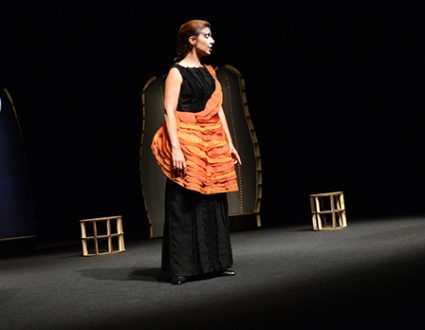
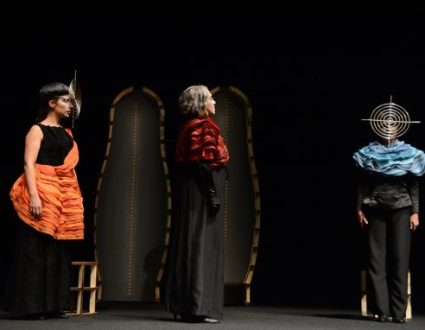
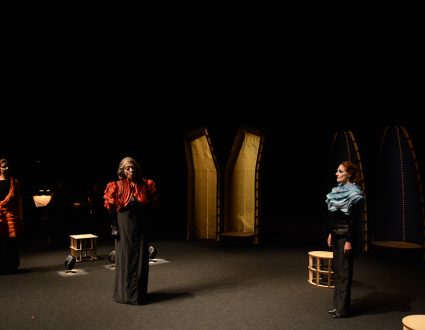
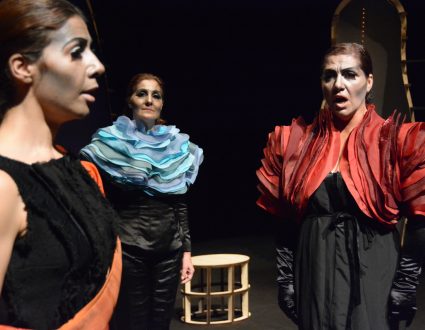
Stage Director: João Lourenço
Music Director: João Paulo Santos
Cast: Ana Ester Neves, Angélica Neto, Patrícia Quinta, Horácio Ferreira, António Figueiredo, Irene Lima and João Paulo Santos